
Your team has a few experiments running with enterprise generative AI, but nothing that actually carries production traffic or touches real customers. The demos look great, the slideware looks even better, yet you still don’t have a clear path from “cool prototype” to a reliable part of the business.
That gap between pilot and production is where most enterprise generative AI programs stall. The technology isn’t the main problem. Governance, integration, and ownership are. Let’s walk through how organizations that do ship GenAI to production structure their work, reduce risk, and keep the value flowing after the initial excitement fades.
Clarify Why You Need Enterprise Generative AI
If you don’t pin down the business reason, your enterprise generative AI efforts will keep drifting from one shiny use case to another. Start with a short list of problems that hurt today: long cycle times, high manual effort, inconsistent quality, or poor customer experience.
Good candidates are processes with repetitive text or document work, clear quality criteria, and enough volume to matter. Think of contract summarization, RFP responses, marketing content variants, knowledge search, and customer support drafts.
From Ideas To Prioritized GenAI Use Cases
Turn the “could we use AI here?” brainstorming into a simple scorecard for GenAI use cases. Score each idea on value potential, feasibility, risk, and data readiness. Then force ranking. The point isn’t precision; it’s alignment, so product, IT, and the business side all agree on the first three things you will actually build.
Set Up A Practical Generative AI Strategy
Once you’ve picked those first use cases, you need a generative AI strategy that fits how your company already ships software, not a 50-page vision deck. Start by deciding who owns which parts: who funds, who builds, who governs, and who runs the thing after launch.
Strategy here is mostly about guardrails and focus. What problems are in scope this year? Which models and platforms are approved? How do teams request access to shared AI services instead of building one-off stacks for every project?
Target Architecture For Enterprise AI Solutions
Define a reference architecture for your first few enterprise AI solutions. That usually means a standard way to connect to LLM providers, a retrieval layer into your internal data, an observability stack, and clear interfaces to your existing apps, APIs, and identity platform.
Design Your GenAI Implementation Lifecycle
This is where a lot of pilots go sideways. They jump from “we got a model call working” to “let’s roll it out” without an implementation lifecycle. You want a path that looks familiar to any product or engineering leader, just tuned for GenAI’s quirks.
Think in four gates: discovery, design, build, and hardening. Discovery validates the problem and data. Design covers UX, security, and failure modes. Build is not only model prompts and orchestration, but also tests and telemetry. Hardening is where you address model reliability, scaling, and handoffs to operations.
Patterns For Reliable AI Deployment
Production-grade AI deployment leans on patterns that absorb model messiness. Response validation, fallbacks to traditional rules or search, human-in-the-loop review, and feature flags are all standard. Treat your prompts and retrieval logic as versioned artifacts and push them through the same deployment pipelines you use for code.
Build GenAI Governance And Risk Management
At pilot scale, one senior person can approve everything. That stops working quickly. You need GenAI governance that is light enough not to block progress but strong enough to keep you out of trouble with regulators, customers, and your own board.
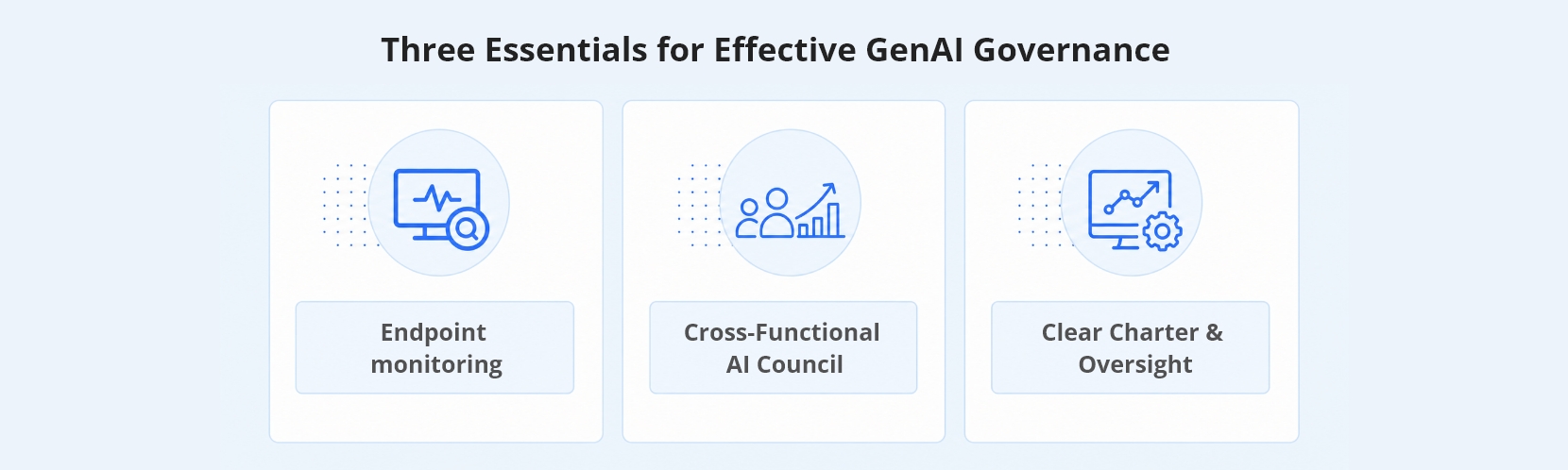
Most enterprises form a small cross-functional council with representatives from security, legal, compliance, data, and the business. Give this group a clear charter: define acceptable use, approve new use cases, and review incidents and model changes.
Policies That Support, Not Smother, AI Transformation
Good policy makes AI transformation safer and faster, not slower. That means clear rules on data residency, PII handling, and model selection, plus a process for exceptions. Write policies in language product teams can actually use, with examples of allowed and disallowed patterns for prompts, training data, and external APIs.
Plan For Enterprise AI Adoption At Scale
You can ship a GenAI feature and still fail if no one trusts it. Enterprise AI adoption is less about internal marketing and more about building confidence through transparent behavior. If users understand when the system is confident, when it might be wrong, and how their feedback matters, usage climbs on its own.
Start with a tight group of power users. Give them fast ways to flag issues, track those fixes in public, and publish simple usage playbooks based on what actually works for them. Treat that group as partners, not test subjects.
Change Management For Frontline Teams
Frontline teams don’t care that you used RAG or model distillation. They care about whether this GenAI implementation saves time or adds hassle. Field tests should measure time saved on real tasks, error rates, and where people still drop back to the old way of working.
When To Bring In Generative AI Consulting Help
There’s a point where internal enthusiasm runs ahead of internal expertise. That’s where targeted generative AI consulting can pay off, as long as you’re clear on the outcome you want. Typical triggers are a stalled platform decision, repeated security pushback, or pilots that look good in isolation but don’t fit your broader architecture.
The best external partners don’t try to replace your teams. They bring reference patterns, hard-won lessons, and accelerators like prompt libraries, evaluation suites, and prebuilt connectors. Use them to stand up your first few production workloads, then have your people own the road map.
Conclusion
Moving enterprise generative AI from experiments to real, supported products is mostly a management and design challenge, not a model challenge. Clarity on goals, guardrails, and ownership turns one-off demos into a repeatable production pipeline.
If you line up a focused use case portfolio, a right-sized strategy, strong governance, and a realistic adoption plan, you’ll have a durable path to value from enterprise generative AI rather than a string of disconnected proofs of concept, and partners like Infocepts can help you scale that momentum when you’re ready.
Frequently Asked Questions
Scale Generative AI Beyond the Pilot Stage
Turn promising AI experiments into secure, scalable, and business-ready enterprise solutions.
Recent Blogs



Infocepts