
Infocepts’ Media & Entertainment Intelligence Services team attended roughly twenty pre- and post-show technology briefings across the content supply chain at IBC 2026 in Amsterdam. This research piece is built directly from those conversations, focused on data & AI/ML analytics & intelligence trends within the media & entertainment industry that we expect to shape vendor roadmaps over the next 6-12 months.
AI/ML adoption in media and entertainment is moving fast – and IBC 2026 made the direction unmistakable: analytics and AI are shifting from a back-office reporting function into a real-time, unified intelligence layer used across content acquisition, production, and monetization. Three converging trends are shaping this shift – unified intelligence across the content supply chain, operational cost-efficiency, and consistent cross-team access – what we’re calling the 3C Intelligence framework: Cohesive, Cost-effective, and Consistent.
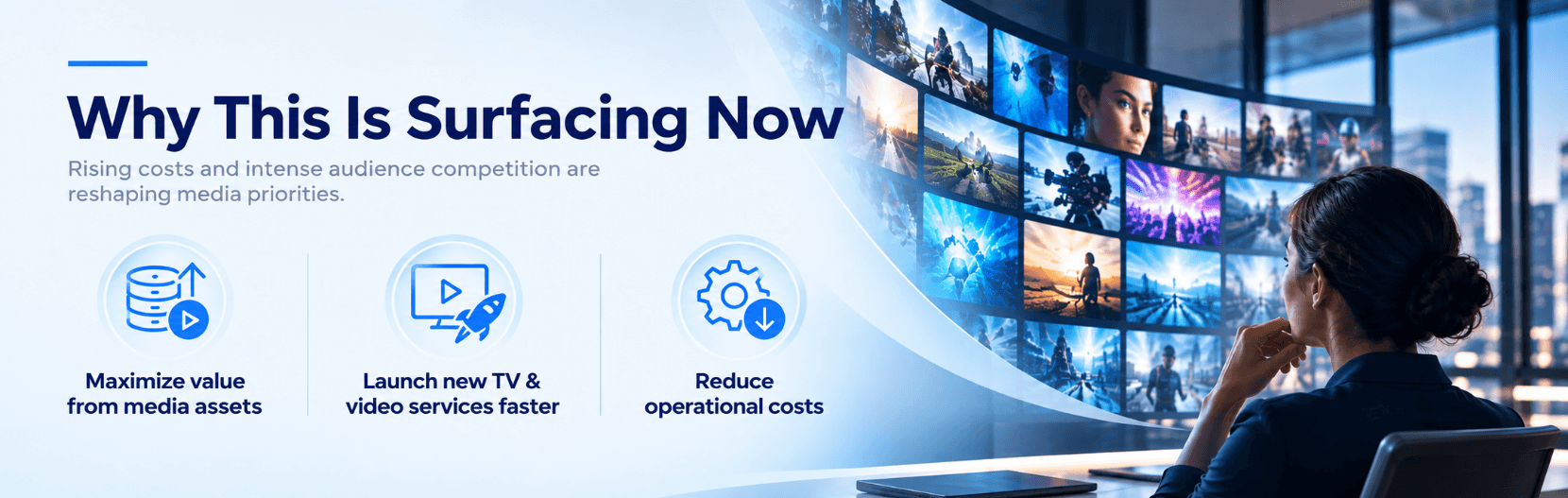
Why This Is Surfacing Now
Margins are under pressure across the industry, driven by rising content costs and the growing difficulty of holding audience attention. In response, media enterprises are converging on three business priorities:
- Getting more value out of every media asset – improving ROI and justifying future content-acquisition budgets
- Launching new digital TV and video services faster, using existing content and resources to reach new audiences
- Cutting operational cost (lower total cost of ownership) across short-form content workflows
As AI/ML adoption accelerates across the TV & video supply chain, vendors are no longer treating it as a bolt-on. Nearly every vendor we spoke with at this year’s show has pre-configured AI/ML directly into their platform – and the clearest theme across the new releases was using AI to build an intelligence layer that goes beyond monitoring and executive reporting, delivering measurable KPIs against the three priorities above.
Trend 1: Unified Intelligence Across the Content Supply Chain Is Gaining Momentum
Media companies have traditionally run best-in-class but loosely connected technology stacks, each with its own siloed intelligence and its own dedicated team. That worked in the linear-only era. It doesn’t hold up in today’s connected TV economy, where multiple business units and personas all need real-time insight to make decisions.
A common gap we heard about repeatedly: a resource-scheduling system’s insights sitting in isolation, never connected to planning or budgeting tools in the same pre-production pipeline – and that intelligence rarely reaching anyone outside the pre-production team. Unified intelligence – shared data insight from multiple systems, accessible to the different teams who each need it for their own KPIs – is how vendors are closing that gap. We’re seeing this show up in a few concrete ways:
- Pre-production intelligence built per content type (drama, general entertainment, sports, news) – aggregating scheduling, project management, planning, and budgeting data into one standardized view for every persona that touches it
- Automated contracts and licensing reporting connected directly to structured audience data, so LOB heads and the C-suite (CFO, CXO) see licensing and audience performance in one place instead of two
- Standardized metadata indexing and tagging – shared by internal teams and external partners – for short-form content at scale
- Aggregated visibility into unused media assets across archiving workflows (media asset management, cloud storage, high-performance shared storage) to recover ROI on content that’s just sitting there
Infocepts helps media companies build exactly this: unified intelligence-as-a-service across the upstream content supply chain, from acquisition and archiving to re-purposing and production. Content Metadata Matching & Viewership Attribution (ContentIQ)
Trend 2: Operational Efficiency Is Driving Demand for Cost-Effective, Consistent Intelligence
Over the past 12-18 months, the industry has quietly shifted its ambition from “efficient” to “smarter.” Media enterprises are now investing in intelligence layers built for secure, consistent value – and pre-packaging that intelligence across the downstream supply chain: post-production, personalization, distribution, monetization, and engagement. As content volume keeps rising in a multi-screen world, “more from less” is becoming the default – and that means cost-effective insight pulled from both in-house and third-party data. The clearest use cases we saw:
- IP migration (especially live media logistics) is demanding consistent, cost-effective bonding intelligence – connectivity management, eSIM, 5G modems, and MIMO antenna arrays that dynamically route transmission based on network conditions and content mix
- Multi-dimensional audience QoS/QoE (household and individual level) is pushing demand for AI-native intelligence focused on engagement operations – helping digital service providers deliver hyper-personalized experiences in real time, down to tailoring content and UX for each viewer in a shared living-room session
Infocepts has delivered tailored, cost-effective intelligence ecosystems for tier-1 media enterprises worldwide – across both monetization and audience intelligence workflows.
What This Means for Media Leaders
Infocepts believes the 3C Intelligence framework – Cohesive, Cost-effective, and Consistent – will be pivotal for media & entertainment enterprises not just to meet near-term business requirements, but to build sustainable competitive positioning over the long run.
Frequently Asked Questions
Unlock the Power of Unified Media Intelligence
Connect content, audiences, operations, and monetization through AI-driven intelligence built for the modern Media & Entertainment enterprise.

Author
Kedar Mohite heads M&E Intelligence, Analytics, and Advisory practice at Infocepts. He has spent almost two decades in media & broadcast space as a technology consultant, and analyst. He was Principal Consultant with Omdia (earlier Ovum) focusing on media & broadcast technology arena for over a decade.
Read Full BioRecent Blogs

10 Best Databricks Consulting Firms for Manufacturing and Supply Chain
September 29, 2026

BI Debt: The Hidden Cost of Duplicate, Orphaned, and Unused Reports in Every Migration Project
September 29, 2026

Infocepts vs Tiger Analytics: Which Databricks Partner Is Better for Enterprise AI?
September 28, 2026
Infocepts