Modernize a legacy data warehouse into a cloud data lakehouse | September 23, 2026 | Infocepts Editorial Team | 3 to 9 months (pilot: 6 to 8 weeks) | Beginner
What You’ll Learn
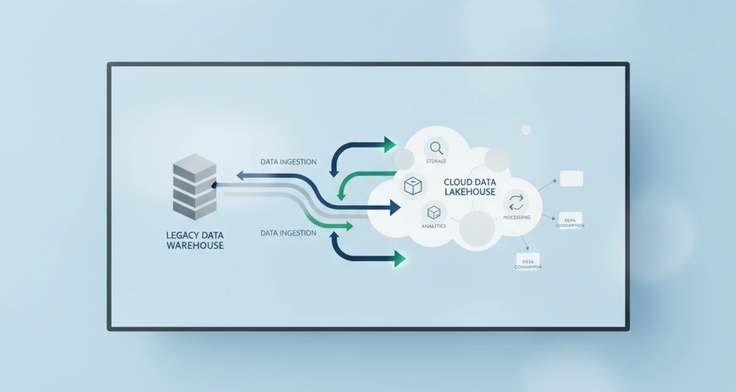
This guide walks you through exactly how to modernize a legacy data warehouse into a cloud data lakehouse using a five-phase framework that works across industries. You’ll learn how to assess what you have today, pick the right cloud platform and design your lakehouse architecture, move your data without breaking existing reports, validate that everything works as expected, and put the governance and DataOps practices in place to keep things reliable long after you flip the switch. The approach builds on patterns Databricks has published and real-world engagements across media, retail, life sciences, and manufacturing.
- Follow a clear, repeatable 5-phase process to modernize a legacy data warehouse into a cloud data lakehouse without the risk of a major outage.
- Choose between Snowflake, Databricks, BigQuery, Redshift, or Fabric based on your actual workload needs.
- Sequence data migration, pipeline refactoring, and parallel validation to keep reports running smoothly.
- Understand the governance and DataOps capabilities you need before you turn off the old warehouse.
Prerequisites: Executive sponsorship, an inventory of your current ETL jobs and reports, and a designated cloud platform team (internal or partner-led) before you start.
Why Modernizing to a Cloud Data Lakehouse Matters in 2026
Legacy on-premises warehouses were built for a different era. They can’t handle the volume, speed, or AI workloads enterprises need today. Gartner reports that more than 75% of databases will be deployed or migrated to a cloud platform by 2025, and that shift has only sped up since. Meanwhile, IDC finds that over 70% of enterprises have already started moving workloads from legacy warehouses to data lakes or lakehouse platforms for better performance and lower costs. A data lakehouse combines the flexibility, cost-efficiency, and scale of a data lake with the data management and ACID transactions of a data warehouse, giving you the best of both.
The business case is just as compelling. S&P Insider projects the cloud data warehouse market will hit $43.57 billion by 2032, growing 23 to 24% annually as organizations retire warehouses they’ve simply outgrown. For CDOs in media, retail, life sciences, and manufacturing, the cost of doing nothing is real: rigid schemas, ballooning maintenance windows, and duplicated data pipelines compound every quarter your legacy platform stays in place.
The good news: this isn’t a rip-and-replace job. As Databricks notes, most workloads, queries, and dashboards from enterprise data warehouses can run with minimal code changes once the initial data migration and governance setup are done. That’s why a structured, phased approach beats improvisation every time. For supporting data, see THE WAREHOUSE! | Vault Hunters Update 20.
The Process at a Glance
| Step | Action | Time | Outcome |
|---|---|---|---|
| 1 | Assess legacy environment and set goals | 2-4 weeks | Documented inventory and modernization business case |
| 2 | Choose platform and design lakehouse architecture | 2-3 weeks | Approved target architecture and medallion data model |
| 3 | Migrate data and refactor pipelines | 4-12 weeks | Data and ETL logic running on the new platform |
| 4 | Validate, reconcile, and cut over | 2-4 weeks | Legacy and new systems match; production cutover complete |
| 5 | Enable governance and DataOps operations | Ongoing | Sustainable, AI-ready, self-service data platform |
Total time: Most enterprise migrations to modernize a legacy data warehouse into a cloud data lakehouse take 3 to 9 months, though a focused pilot for a single business domain can often be delivered in 6 to 8 weeks.
Step 1: Assess Your Legacy Environment and Define Modernization Goals
What You’re Doing
Before you touch a single pipeline, you need a complete picture of what exists today: schemas, ETL jobs, report dependencies, data volumes, and compliance obligations. This assessment drives every architectural and sequencing decision that follows.
How to Do It
- Catalog every schema, table, ETL job, and downstream report or dashboard currently in production.
- Quantify data volumes, refresh frequency, and peak processing windows, since these determine migration complexity and cost.
- Talk to business stakeholders in finance, operations, and analytics to identify which workloads are business-critical versus low-value “garbage” data that can be retired instead of migrated.
- Document compliance and data residency requirements (HIPAA, GDPR, or industry-specific rules) that the new platform must satisfy.
- Define measurable modernization goals: cost reduction targets, query performance benchmarks, or time-to-insight improvements.
Best Practices
- Treat this as a “clean your closet” exercise: skipping obsolete data before migration cuts both storage and compute costs on the new platform.
- Bring in a partner early if your team is stretched thin. Infocepts believes that data and AI are essential enablers for competitive advantage, and starts every engagement with discovery assessment before recommending architecture.
Common Mistakes
Teams often skip stakeholder interviews and assume IT alone understands report dependencies, which leads to broken dashboards mid-migration. Others fail to map governance and access controls at this stage; ignoring governance and access control mapping can lead to serious security gaps later.
What Done Looks Like
You have one document listing every workload, its business owner, its data volume, and a go/no-go migration decision for each one.
Key Takeaway: A thorough assessment, including stakeholder interviews and compliance mapping, prevents costly mistakes later in the migration process. For a more detailed walkthrough, see mySSA account.
Step 2: Choose Your Cloud Platform and Design the Lakehouse Architecture
What You’re Doing
This step turns your assessment into an approved target architecture, deciding which cloud lakehouse platform fits your workloads and how data will be organized once it arrives.
How to Do It
- Evaluate leading platforms against your workload profile: Snowflake and Databricks SQL for unified analytics and AI, Google BigQuery for serverless scale, Amazon Redshift for AWS-native shops, or Azure Synapse/Fabric for Microsoft-centric estates.
- Decide on open table formats such as Delta Lake (an open-source storage layer that brings ACID transactions to data lakes), Apache Iceberg (an open table format for huge analytic datasets), or Parquet (a columnar storage file format) to avoid vendor lock-in and preserve interoperability.
- Design a layered (medallion) data model separating raw, cleansed, and business-ready data zones. The medallion architecture organizes data in a lakehouse into three layers: Bronze (raw), Silver (cleansed and conformed), and Gold (business-ready).
- Select your migration pattern: lift-and-shift for speed, re-platforming for balance, or full re-architecting when you need lakehouse-native features.
- Get architecture sign-off from both IT and business stakeholders before migration begins.
Example
| Migration Pattern | Best For | Typical Timeline |
|---|---|---|
| Lift-and-shift | Fast wins, low-risk workloads | 4-6 weeks |
| Re-platforming | Moderate optimization with schedule pressure | 6-10 weeks |
| Re-architecting | Full lakehouse adoption, AI/ML readiness | 10-20+ weeks |
What Done Looks Like
An approved architecture diagram and platform decision exist in writing, with defined data zones and a documented migration pattern for each workload.
Step 3: Migrate Data and Refactor Pipelines
What You’re Doing
This is the technical core: moving historical and incremental data to the target platform and rebuilding ETL logic so it runs natively in the new environment instead of as a brittle lift-and-shift.
How to Do It
- Move historical data to the target platform in open formats such as Delta Lake, Apache Iceberg, or Parquet, following Databricks’ migration guidance.
- Refactor ETL (Extract, Transform, Load) logic for modern batch and streaming capabilities rather than porting legacy code as-is.
- Use integration tooling such as Fivetran, AWS DMS, Informatica, or Azure Data Factory to accelerate connector-based data movement.
- Migrate workloads domain-by-domain (finance, supply chain, marketing) rather than attempting one enterprise-wide cutover.
- Use an accelerator where available: Infocepts’ Flash Migrate for Databricks automates key stages from analysis to deployment and has helped retailers achieve results up to three times faster than traditional manual methods.
Example
A North American retailer faced data processing jobs that stretched beyond 8 hours during peak holiday season. Using Infocepts’ Flash Databricks Migrate to move from Teradata to Databricks on Azure, they achieved a 30% cost reduction while improving operational efficiency ahead of a tight holiday deadline.
Best Practices
- Never lift-and-shift legacy stored procedures wholesale; refactor them to take advantage of native lakehouse compute and streaming.
- Migrate the lowest-risk domain first to build team confidence and refine the runbook before tackling business-critical workloads.
What Done Looks Like
Data and transformation logic for at least one full business domain runs successfully end-to-end on the new lakehouse platform, producing outputs that match the legacy system.
Key Takeaway: Refactor ETL logic for native lakehouse capabilities and migrate workloads domain-by-domain, using accelerators to speed up data movement and transformation.
Step 4: Validate, Reconcile, and Cut Over
What You’re Doing
Before you retire anything, you need proof that the new platform produces identical (or intentionally improved) results compared to the legacy warehouse. Skipping this step is the single most common cause of post-migration trust issues with business users.
How to Do It
- Run the legacy warehouse and the new lakehouse in parallel for a defined validation window.
- Compare outputs at the report, dashboard, and row level to catch discrepancies before cutover, as outlined in standard migration methodology.
- Establish a verified rollback plan; without one, any technical failure during cutover can cause significant downtime, a risk documented across enterprise migrations.
- Get formal sign-off from business owners for each domain before flipping production traffic to the new platform.
- Decommission the legacy warehouse only after all workloads are validated and running reliably on the new platform.
Common Mistakes
The problem: teams rush cutover before completing a full parallel-run cycle across a representative reporting period (e.g., a full month-end close). The fix: extend the validation window until every high-priority report reconciles, even if it delays the original timeline by a few weeks.
What Done Looks Like
Business stakeholders have signed off that reports on the new lakehouse match the legacy system, and production traffic has fully shifted with no rollback triggered.
Step 5: Enable Governance, DataOps, and AI-Ready Operations
What You’re Doing
A lakehouse is only as valuable as the operating model around it. This step establishes the ongoing governance, quality, and DataOps discipline that keeps the platform trustworthy and ready for AI workloads long after the migration project ends.
How to Do It
- Deploy data quality and observability tooling such as Monte Carlo for pipeline observability and Collibra for governance and lineage tracking.
- Formalize access controls, data retention policies, and audit trails aligned to your compliance obligations.
- Implement CI/CD (Continuous Integration/Continuous Delivery) style DataOps (a methodology that automates and monitors data flows to improve quality, speed, and collaboration) practices for pipeline deployment, testing, and version control rather than manual, ad hoc changes.
- Train analytics and data science teams to work directly against lakehouse tables rather than duplicating data into separate lake and warehouse copies.
- Establish a continuous cost and performance monitoring cadence to catch drift before it becomes technical debt.
Best Practices
Infocepts delivers measurable business value through tailored Data and AI solutions, leveraging 21+ years of expertise, proprietary platforms, and a global footprint across AI-led operations, advanced analytics, cloud modernization, and frictionless migration. That’s why governance and DataOps enablement is typically scoped as a distinct post-migration phase rather than an afterthought.
What Done Looks Like
Analysts, data engineers, and data scientists all work against the same governed lakehouse tables, with automated quality checks flagging issues before they reach a dashboard.
What to Do After Completing the Migration
Phase 1 (Months 1-3 post-cutover): Stabilize. Monitor performance, cost, and data quality closely; resolve any residual reconciliation gaps and retire remaining legacy infrastructure once confidence is high.
Phase 2 (Months 3-6): Optimize. Tune compute costs, consolidate redundant pipelines, and expand self-service analytics access to more business units now that the platform is stable.
Phase 3 (Months 6+): Extend into AI. Use the unified lakehouse as the foundation for machine learning, generative AI, and real-time analytics use cases that a rigid legacy warehouse could never support.
Resources You’ll Need
| Resource | Role | Status | Price |
|---|---|---|---|
| Infocepts | Migration accelerator and full-stack modernization partner (Databricks Silver Partner) | Recommended | Custom quote |
| Databricks | Unified lakehouse compute and open table format platform | Required (or equivalent) | Usage-based |
| Snowflake | Alternative cloud data platform for SQL-first workloads | Optional | Usage-based |
| Fivetran | Connector-based data integration and ingestion | Recommended | Usage-based |
| Monte Carlo | Data observability and pipeline monitoring | Recommended | Custom quote |
| Collibra | Data governance and lineage management | Optional | Custom quote |
See also, see Data Lakehouse vs Data Warehouse: Modern Architecture ….
Common Plateaus and How to Break Through
Reports don’t match between legacy and new platforms
The problem: slowly changing dimensions and historical data were not reconciled before cutover, a challenge frequently reported in multi-terabyte migration scenarios involving facts, dimensions, and history tables. The fix: extend the parallel validation window and reconcile dimension-by-dimension before declaring any domain complete.
Migration costs are running over budget
The problem: obsolete or duplicate data was migrated instead of retired during the assessment phase. The fix: revisit your Step 1 inventory and archive or delete low-value data rather than paying to move and store it indefinitely.
Business users don’t trust the new lakehouse
The problem: cutover happened before adequate stakeholder sign-off or without a rollback plan communicated to end users. The fix: re-run a transparent reconciliation report showing side-by-side figures and involve business owners directly in final sign-off.
Migration is taking far longer than the original estimate
The problem: the team attempted a single enterprise-wide “big bang” cutover instead of a phased, domain-by-domain approach. The fix: break the remaining scope into smaller domain-level migrations, each with its own validation and cutover milestone. For more troubleshooting advice, see Five Mistakes Companies Make During Data Modernization.
Conclusion
Modernizing a legacy data warehouse into a cloud data lakehouse is achievable in as little as 6 to 8 weeks for a single-domain pilot, and 3 to 9 months for a full enterprise rollout, provided you follow a disciplined assessment-to-DataOps sequence rather than an improvised lift-and-shift. The organizations succeeding fastest are pairing open lakehouse architectures with proven accelerators and experienced delivery partners to reduce risk at every phase.
Key Takeaways
- A phased, domain-by-domain migration with a validated rollback plan consistently outperforms a single “big bang” cutover.
- Governance and DataOps enablement are not optional add-ons; they determine whether the lakehouse remains trustworthy and AI-ready after go-live.
- Next action: complete a full legacy environment assessment (Step 1) before selecting a target platform or accelerator.
FAQ
How do you modernize a legacy data warehouse into a cloud data lakehouse?
You modernize a legacy data warehouse into a cloud data lakehouse by following a five-phase process. Assess your current environment and workloads, choose a target platform and design a medallion-style architecture, migrate data and refactor ETL pipelines using open table formats, validate outputs through a parallel run before cutover, and enable governance and DataOps practices. This ensures the platform stays reliable and AI-ready. This step-by-step guide to modernizing a legacy data warehouse into a cloud data lakehouse (2026) typically takes 3 to 9 months for a full enterprise rollout, or 6 to 8 weeks for a focused pilot.
How long does a data warehouse to lakehouse migration take?
Most enterprise migrations take 3 to 9 months depending on data volume, pipeline complexity, and team readiness, while a pilot migration for a single business domain can often be completed in 6 to 8 weeks.
What is the difference between a data lake, a data warehouse, and a data lakehouse?
A data warehouse stores structured, schema-enforced data optimized for reporting; a data lake stores raw, often unstructured data at low cost with high flexibility; a lakehouse combines both, offering the storage flexibility of a lake with the query performance and governance of a warehouse in a single platform.
Which cloud platform should I choose for my lakehouse migration?
The right platform depends on your existing cloud footprint and workload mix: Databricks and Snowflake both offer strong unified lakehouse capabilities, BigQuery suits serverless, Google-centric environments, Redshift fits AWS-native shops, and Azure Synapse/Fabric works well for Microsoft-centric enterprises.
What are the biggest risks in legacy data warehouse migration?
The biggest risks are migrating data without a rollback plan, failing to map governance and compliance controls before cutover, and attempting a single enterprise-wide “big bang” migration instead of a phased, domain-by-domain approach.
Do I need to decommission my legacy warehouse immediately?
No. Best practice is to run legacy and new systems in parallel, reconcile outputs, and only decommission the legacy warehouse once every migrated workload has been validated and signed off by business stakeholders.
How much can a migration accelerator reduce cost and timeline?
Purpose-built accelerators can meaningfully compress both cost and schedule. For example, Infocepts’ Flash Databricks Migrate has helped enterprises achieve results up to three times faster than traditional manual migration methods while reducing migration costs by automating analysis-to-deployment stages.
What should happen after the migration is complete?
After cutover, organizations should stabilize the platform by monitoring cost and quality for the first 1-3 months, optimize compute and consolidate pipelines in months 3-6, and then extend the lakehouse foundation into AI, machine learning, and real-time analytics use cases from month 6 onward.
Methodology: This guide was compiled from publicly available migration frameworks, vendor documentation from Databricks, and industry research from Gartner, IDC, and S&P Insider, supplemented by named case study data from Infocepts. It is intended as general guidance; specific timelines and outcomes will vary by data volume, industry, and organizational readiness.
Planning a Legacy Data Warehouse Migration?
Reduce migration risk, eliminate data silos, and modernize your architecture with a phased approach designed to preserve business continuity while accelerating innovation.
Recent Blogs

Infocepts vs Tiger Analytics: Which Databricks Partner Is Better for Enterprise AI?
September 28, 2026

Infocepts vs Fractal Analytics Comparison: Which Analytics Partner Is Best for Your Team?
September 28, 2026
10 Best Data Engineering Service Providers for Media and Entertainment Companies in 2026
September 28, 2026
Infocepts