
Most of the conversations our Life Sciences team has with biopharma leaders do not start with technology. They start with frustration. A commercial or operations leader describes a supply chain that looks orderly on an org chart and behaves like a guessing game in practice, and within the first ten minutes the real issue surfaces: nobody fully trusts the numbers, so every decision carries a tax of doubt.
We have learned to listen for that moment, because it is where the business case writes itself. When a team cannot agree on what happened last week, it cannot move quickly on what to do next. In a global, regulated supply chain, hesitation is not free.
This point of view draws on our work with life sciences manufacturers, including a recent program with a global biopharmaceutical company that had reached exactly that point. We share what we proposed, what it returned, and how we would frame the decision for any leader weighing the same investment.
The question is not what it costs. It is what fragmentation is already costing you.
When buyers evaluate a data platform, the first question is almost always about price. We understand the instinct, but it is the wrong place to start. The more useful question is the cost of the status quo, because that number is usually far larger and almost never on anyone’s dashboard.
In the company we worked with, orders sat in one system, production in another, inventory somewhere else, and vendor updates were scattered across tools and inboxes. Spreadsheets had become the integration layer, which meant skilled people spent their days reconciling instead of deciding. Reporting ran weekly, so the business was always managing last week. None of that showed up as a line item, and all of it was expensive.
The industry data supports what we see in the field. McKinsey has estimated that supply chain disruptions can carry a potential loss equal to about 25 percent of a pharmaceutical company’s EBITDA over a ten-year horizon. The exact figure matters less than the pattern: fragmentation compounds quietly into real money, and the longer it runs, the more it costs to unwind.
We always push leaders to put a rough number on it before the conversation turns to solutions. Add up the hours planners and analysts spend reconciling rather than deciding. Estimate the inventory carried as insurance against numbers no one trusts, because that safety stock is working capital sitting idle. Count the decisions delayed by a week because reporting runs weekly. None of those figures will be precise, and they do not need to be. Even a conservative tally usually dwarfs the cost of the platform, and that gap is the entire argument.
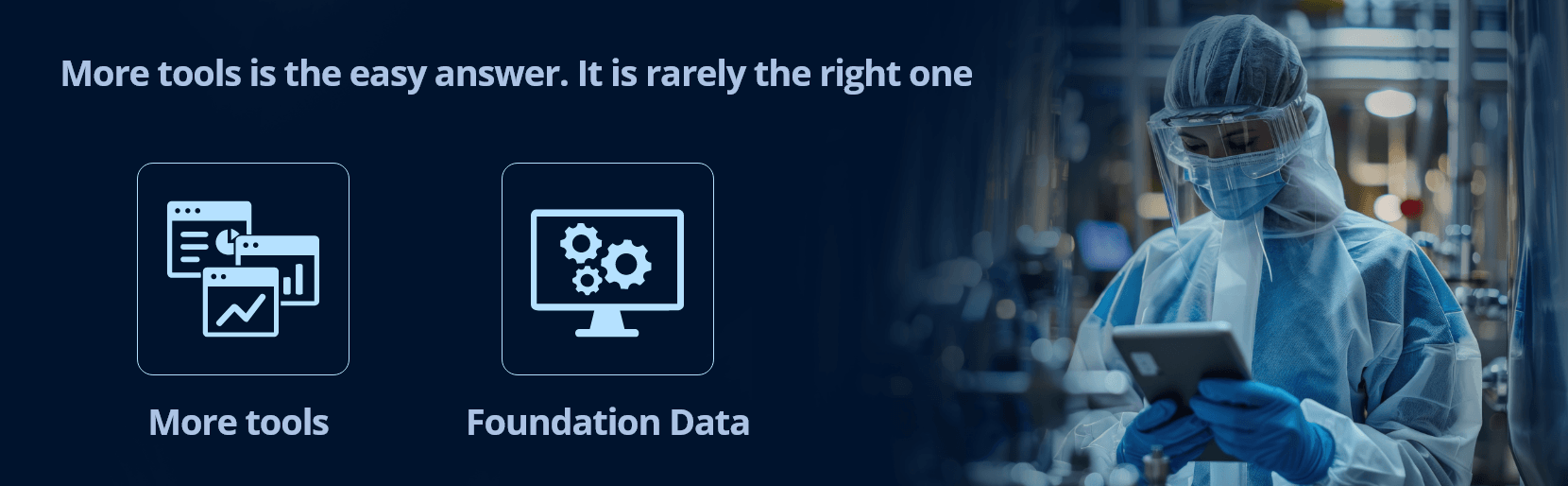
More tools is the easy answer. It is rarely the right one.
When a supply chain feels out of control, the reflex is to buy another application. Another dashboard, another planner, another tracker. We see it constantly, and we will be candid: it is an easy thing to approve and a hard thing to defend a year later. When the foundation is fragmented, every new layer inherits the same problems, and the organization ends up with more software and the same arguments in the room.
What we recommend instead is not another tool. It is a foundation: a single, automated supply chain data platform that brings ingestion, transformation, and analytics together so the whole business operates on the same facts. It is a less flashy choice in the moment, and a far easier one to live with.
The objection we hear most
The pushback we encounter most often is some version of this: we already have a data warehouse, so why is this different? It is a fair question, and it deserves a straight answer. A warehouse is not the same as a trusted, current, end-to-end view of the supply chain. Plenty of companies have storage and still cannot produce one agreed number for on-time delivery, because the data arrives late, the definitions differ by team, and the last mile into a dashboard a planner will actually use was never built.
So we shift the test. A platform is not judged by whether the data exists somewhere. It is judged by whether a planner acts on it on Monday morning without first calling three colleagues to confirm it. That is the line that separates a storage project from a decision platform, and it is the bar a buying committee should hold any partner to, including us.
What the investment actually buys
We built the platform on Microsoft Azure, and we will keep the technical detail short, because the outcome is what matters to a buyer. Azure Data Factory automates ingestion and orchestration, so nobody is manually exporting files. Azure Data Lake and Synapse handle storage and analytics that grow with the business. Spark performs the transformation that turns messy inputs into trustworthy tables. Power BI puts decision-ready supply chain dashboards in front of planners and leaders without a detour through IT.
In the language of a buying committee: one source of truth, automated from end to end, that planners, operations, finance, and leadership can all stand on. That is the asset. Everything else is plumbing.
The business case in three numbers
When we walk a leadership team through this engagement, we anchor it in three results, because they map cleanly to how a CFO and a COO think.
First, close to 15 percent in cost savings over seven to eight months. The payback timeline is what makes the headline credible. This was not a multi-year bet. It was visibility and smarter planning turning into savings inside two to three quarters.
Second, a 20 percent improvement in delivery efficiency. Bottlenecks became visible, delay patterns became legible, and the gains compounded as the team stopped debating causes and started removing them.
Third, reporting moved from weekly to daily. This is the result buyers underrate. A daily cadence is not a nicer report. It changes behavior. It lets a team act on a problem while it is still small, which is where most of the avoided cost actually lives.
There is one point we make sure every leader hears: none of these gains came from adding headcount or asking people to work harder. They came from better information. That is the most defensible return there is, because it does not depend on squeezing the organization.
What “AI-ready” buys you next
Buyers are right to ask what they get beyond the first return. This is where the foundation earns its name. An AI-ready supply chain data platform means data that is clean enough to trust, connected enough to explain outcomes, and fresh enough to act on daily. Once those conditions hold, the next wave of value (sharper demand forecasting and production planning, earlier risk detection, vendor performance analytics that flag problems before they land) stops being a future project and becomes a setting the business turns on.
That sequence is the whole point. Deloitte’s 2025 life sciences outlook found that AI investments could create value equal to as much as 11 percent of revenue across functions, yet fewer than one in five supply chain organizations have deployed AI at scale. In our experience, the companies stuck in that gap share the same root cause: they bought the ambition before they built the data foundation. The platform is what closes the gap, which is why we treat the first 15 percent as a floor, not a ceiling.
Why this is a 2026 board conversation
Supply chain has moved out of the back office and into the boardroom, and the commercial stakes are why. Customers experience your supply chain as reliability. Regulators experience it as discipline. Finance experiences it as working capital. In life sciences, patients experience it as availability, which raises the stakes again.
The 2026 environment has sharpened all of it. Tariffs, nearshoring, and pressure to move more manufacturing and sourcing into the United States are forcing companies to redesign networks built over decades. McKinsey’s 2025 research found more than 40 percent of organizations planning to shift more of their footprint to the United States over the next three years. You cannot redesign a network you cannot see in real time, which is why real-time supply chain visibility has become a precondition for nearly every resilience strategy a board is now asking for. In our work, the organizations that move fastest are the ones that fixed the data layer first.
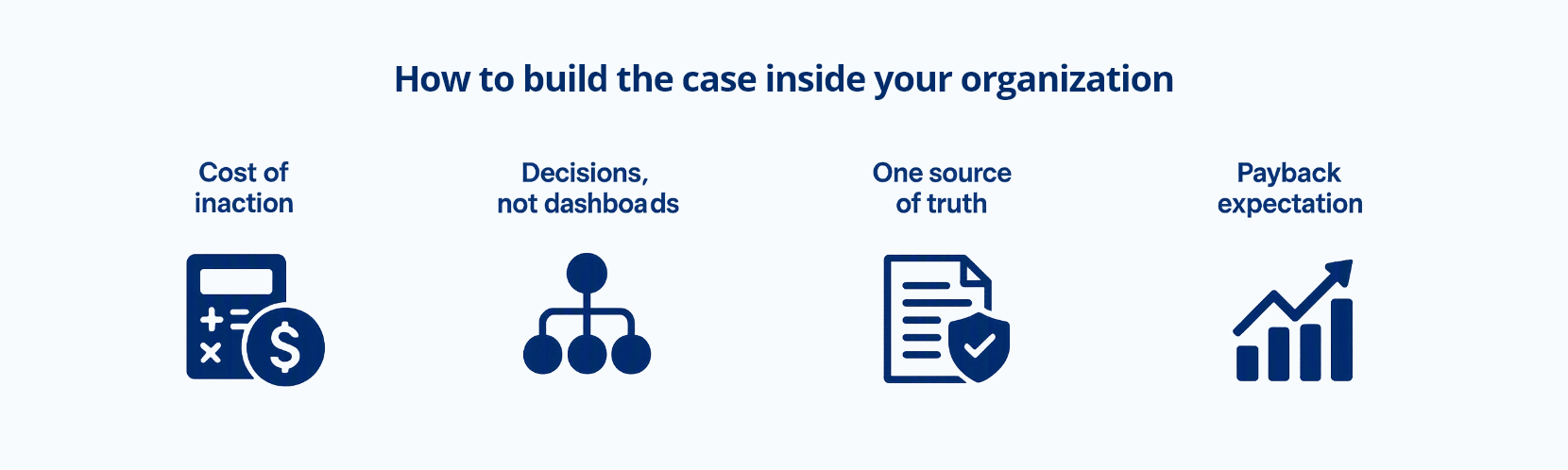
How to build the case inside your organization
For the leader who has to win this investment internally, here is how we would frame it.
- Lead with the cost of inaction, not the price of the platform: Put a number on what slow reporting, excess inventory, and reconciliation hours are costing today. That number is the real competition, not a line item.
- Tie the case to decisions, not dashboards: Name the choices that are slow, the metrics leaders quietly distrust, and the meetings that start with reconciliation. Those are the proof points a CFO will recognize.
- Treat one source of truth as a commitment, not a feature: It means agreed definitions, ownership, and refresh cadence. That governance is what makes the savings stick past the first quarter.
- Set the payback expectation honestly and early: This engagement returned roughly 15 percent in under eight months. A credible, near-term payback is what moves a buying committee from interest to approval.
- Measure in business terms: We anchor progress in cost savings, delivery efficiency, and reporting speed, because those are the words that earn budget, not the completion of a technology project.
The bottom line
Across our Life Sciences work, the conclusion is consistent: in these supply chains, the cost of fragmentation is almost always higher than the cost of fixing it, and the fix pays back faster than most leaders expect. The answer is not more tools. It is connected, trustworthy data that teams can act on without debate, and a business case honest enough to survive the CFO’s questions.
If your organization is living with slow reporting, disconnected systems, inconsistent demand planning, or limited visibility across the delivery lifecycle, that is not only an operational headache. It is a return waiting to be captured. The companies that act early get the savings, the resilience, and the head start on everything AI-ready makes possible next.
If you want to size what an Azure-based supply chain data platform could return for your enterprise, covering demand forecasting and production planning, inventory optimization to reduce stockouts, vendor performance analytics, and real-time supply chain visibility, the InfoCepts Life Sciences team would be glad to build the case with you.
Ready to transform your supply chain data into measurable business value?
Build a trusted, AI-ready supply chain foundation to improve visibility, optimize inventory, accelerate planning, and drive operational efficiency across your life sciences enterprise
The Infocepts Life Sciences COE is a team of domain and data experts working with pharma, biotech, and medical device companies to accelerate data-driven outcomes. The team covers clinical data management, regulatory analytics, commercial insights, and AI applications across the drug development and commercialization lifecycle.
Read Full BioRecent Blogs



Infocepts