
A rate card conversation moves fast. Commercial intelligence means your sellers can move with it.
4:47 PM. A media sales director is fifteen minutes into a call that was supposed to take ten. The advertiser wants 15% off the rate card, three extra placements thrown in, and a yes by end of day.
There’s a pause on the line — the kind that costs deals. The seller is doing math in their head that no one taught them how to do quickly: Has anyone given this client a discount like this before? Is there even premium inventory left across Linear TV, CTV, and Streaming this week? If I say yes right now, what does that do to Q4?
None of those questions are actually difficult. The answers exist — in a CRM, an ad server, a pricing sheet somebody updated three weeks ago. The problem is they’re not in front of the seller, and the client isn’t going to wait while someone digs through four different logins.
This exact moment plays out dozens of times a day across a media sales org. According to Salesforce’s State of Sales Report, sales reps spend only 30% of their average week actually selling — the other 70% goes to exactly this kind of searching, validating, and coordinating. Three things are usually behind it, and they compound on each other.
The Informal Deal Desk Most Media Sales Orgs Already Have
Most B2B companies with any pricing complexity have a formal deal desk — a function that reviews non-standard pricing, checks it against precedent, and approves or escalates it before a deal closes. Media ad sales almost never calls it that, but the function exists anyway: it’s just informal, distributed across whoever happens to remember the last similar deal, and running without the structure a deal desk is supposed to provide. That’s the actual gap. Not a missing tool — a missing function, currently being performed ad hoc by memory and Slack messages instead of a system that can answer the question the moment it’s asked.
Why Rate Card Negotiations Get Stuck
It starts with pricing precedent nobody can see. Every rate card exception gets negotiated as if it’s the first time, even when it isn’t, because the answer to “have we done this before” usually lives in one person’s memory or a spreadsheet nobody else has open. A national broadcaster running 200+ active advertiser relationships can easily have three different sellers independently approve three different discount depths for the same tier of client in the same quarter — not because anyone did anything wrong, but because none of them could see what the other two had already agreed to. This is the same quiet, repeated pricing drift behind The $40 Million Revenue Leak Most Publishers Don’t Know They Have — small, uncoordinated decisions that add up to real money over a year.
Then, even when a seller knows what precedent looks like, they often can’t confirm what’s actually available. Premium inventory status usually lives in a different system than the one open on the seller’s screen — the ad server shows what’s booked, but not what’s about to free up from a campaign that’s underdelivering three placements over.
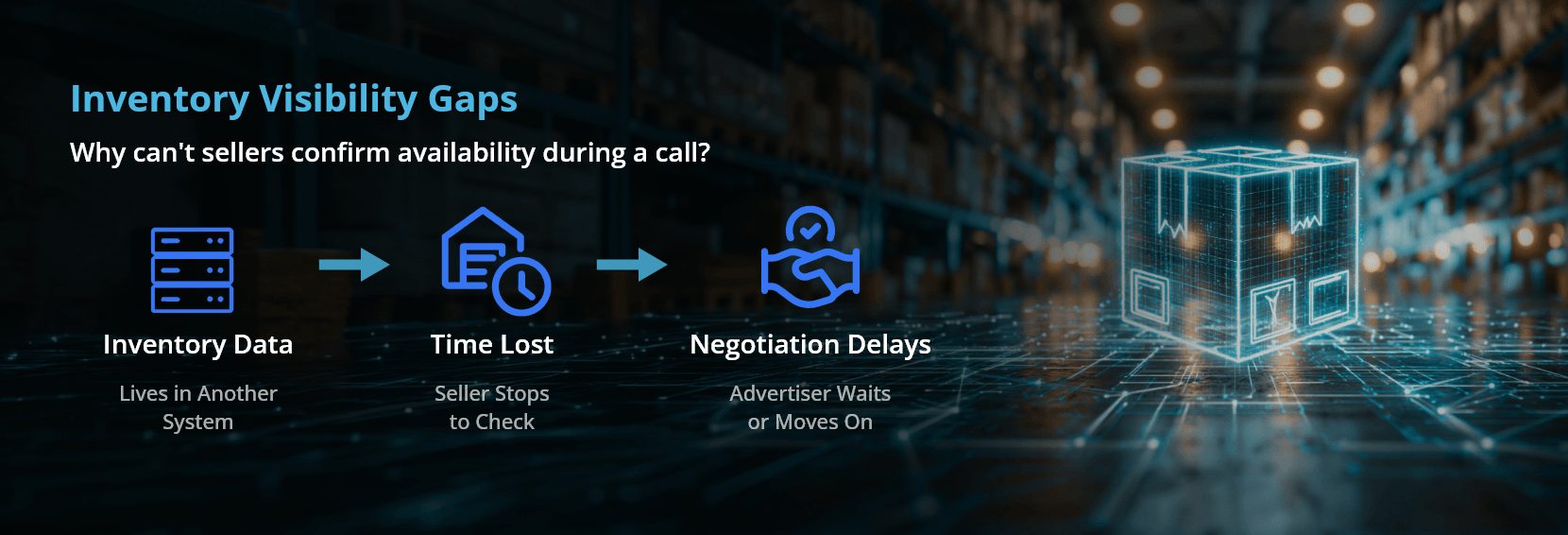
Approving a pricing exception without knowing the inventory implications is how good-faith discounts turn into overcommitted quarters. This gets sharpest during high-pressure windows like the upfront, where — as The Currency Wars Are Here covers — everyone’s negotiating against the same shrinking inventory at once. By the time someone checks the ad server, the advertiser’s already moved on to another question, or worse, already called a competitor.
And once the deal is verbally agreed, building the actual proposal is its own delay. Most proposals still get built from scratch — pulling last year’s spend, this year’s pricing, and audience data from three different exports — instead of starting from what the organization already knows about that advertiser — the quote-to-cash gap between ‘we have a yes’ and ‘the paperwork reflects it. A seller preparing a renewal proposal for a top-20 account can lose the better part of a day just reconstructing history that already exists somewhere in the CRM.
Individually, none of these three is a crisis. Together, they’re the reason a ten-minute call turns into fifteen, and a same-day yes turns into “let me get back to you.”
How Commercial Intelligence Changes the Call
Instead of a seller manually checking three systems while an advertiser waits, the answer can already be sitting there the second the question gets asked — pricing precedent, inventory status, account history, all in one place, surfaced as a direct answer rather than a report to interpret.
A seller asking the right questions in the moment gets specific answers instead of guesses:
- Has this client gotten a discount this size before?
- What’s actually available this week?
- Is there a higher-value package that serves them better than the one they’re asking for?
- What does saying yes do to their full-year value?
Concretely, that means the seller isn’t opening a dashboard and scanning three tabs — they’re asking a question in plain language and getting a specific answer: “Yes, this advertiser received a 12% discount in Q2 tied to a volume commitment they didn’t fully meet — recommend capping this one at 10% unless the placement count increases.” That’s the difference between having data and having a decision-ready answer, in the ninety seconds it actually matters— the same principle behind sales intelligence more broadly, just applied to the one deal in front of you instead of the whole pipeline.
Why the Data Foundation Comes First
Here’s the part that gets skipped over a lot: none of this is really about AI. It’s about whether the data behind the AI is trustworthy in the first place.
The pricing history, the inventory numbers, the account context a seller needs – it’s almost always already sitting somewhere inside the company. It’s just spread across systems that were never built to compare notes with each other: a CRM that knows the relationship, an ad server that knows the delivery, a finance system that knows the margin, and none of the three aware the other two exist. Fix that first, and the AI layer on top has something real to work with. Skip it, and you’ve just built a faster way to guess.
Infocepts works with media organizations on exactly that first step – connecting commercial, operational, and customer data on the Databricks Data Intelligence Platform, using Databricks Genie to turn that connected data into a natural-language answer a seller can just ask for, and Lakebase to keep advertiser, campaign, inventory, and pricing data unified in one place rather than reconciled by hand after the fact. A rate card question gets answered from the full picture, not from whatever one system happens to remember.
Where This Shows Up: SalesNav AI
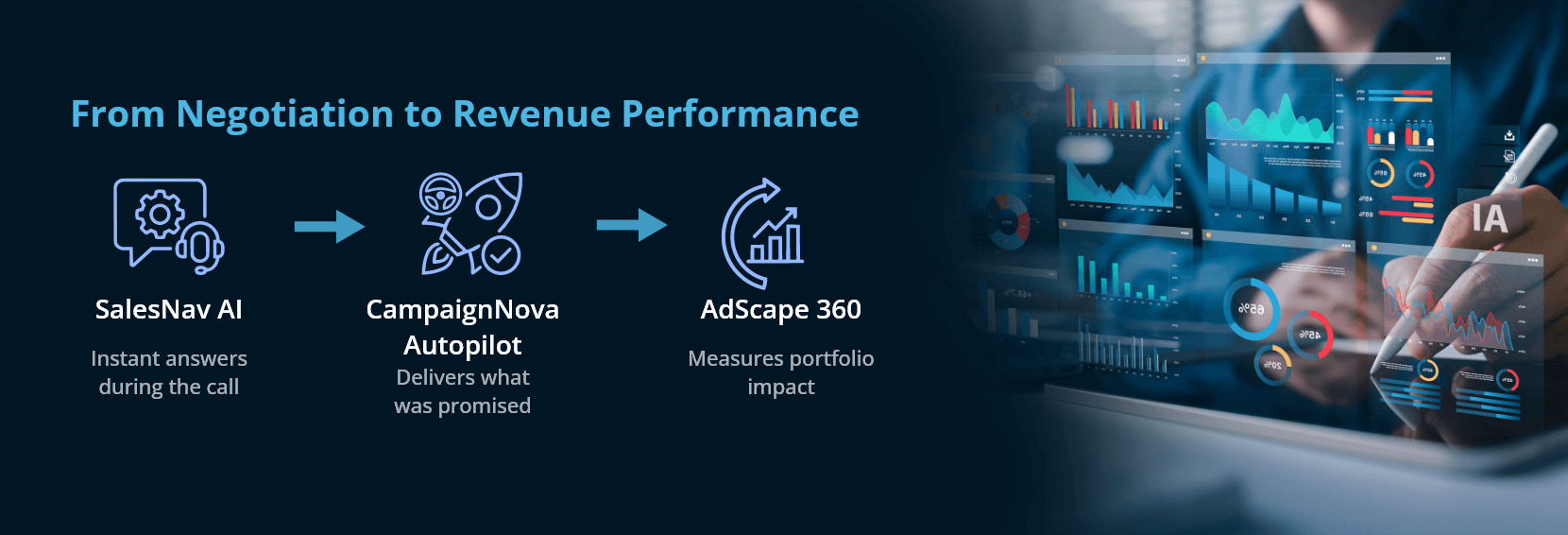
SalesNav AI is Infocepts’ answer to that 4:47 PM moment — an agentic AI solution built specifically for media advertising sales, running on Genie and Lakebase. It pulls pricing history, inventory, and advertiser value into one place a seller can just ask. Not a dashboard to check before the call — an answer available during it.
Early deployments show what that shift is worth in practice:
- 30%+ reduction in deal preparation time
- 25% improvement in follow-up effectiveness
- 2-4 hours returned to each seller every week
- 3x faster access to account and revenue insight
Put another way: a seller who used to spend 45 minutes before a renewal call pulling together account history is closer to 15 — the other 30 minutes go back into the conversation itself, or into the next call. These are product-level results across early SalesNav AI deployments, not one customer’s figures, but they point at the same underlying shift: the negotiation stops depending on how fast one person can search four systems, and starts depending on how well they use an answer that’s already there.
Getting the rate card decision right is the first moment, not the last one — pacing and delivery risk after signing, and portfolio-wide yield across every seller’s calls, are their own problems, worth their own read if this one lands for you.
What Happens After the Deal Is Signed
Getting the rate card decision right is the first moment, not the last one. Once the deal is signed, someone has to make sure the pricing and inventory promises made on that call actually hold up during delivery. That’s CampaignNova Autopilot’s job – watching pacing and delivery risk so what got promised on the phone doesn’t quietly slip weeks later into a makegood nobody saw coming.
And because the real test of any pricing call is what it does to yield across the whole portfolio, not just one deal, AdScape 360 is where that adds up – giving revenue leaders a way to see whether all those individual calls, made under pressure by a dozen different sellers, are actually the right ones in aggregate, or whether the same 10-15% discount is quietly becoming the default rather than the exception.
The Ninety Seconds That Matter
Relationships still close deals. Inventory breadth still matters. Reach still matters. But none of that helps in the ninety seconds after an advertiser asks for a number a seller doesn’t have ready.
The teams pulling ahead aren’t the ones sitting on the most data. They’re the ones whose sellers aren’t stuck waiting on four systems to catch up with the conversation they’re already in.
Stop Searching. Start Selling.
Empower media sales teams with the commercial intelligence needed to respond faster, negotiate smarter, and protect revenue.
Frequently Asked Questions
The Infocepts Media & Entertainment COE helps streaming, publishing, and content businesses harness data to grow audiences and optimize revenue. The team specializes in content analytics, subscriber intelligence, ad tech data, and building the data foundations modern media companies need to compete.
Read Full BioRecent Blogs



Infocepts