



3:47 p.m. on a Sunday, mid-game. A publisher’s biggest advertiser of the quarter is running a spot during the most-watched fifteen minutes of the year. Somewhere between the ad server and a smart TV app, a formatting error drops the campaign silently. No alert fires. No dashboard flags it. The first anyone hears about it is Monday morning, when the advertiser’s own measurement report shows a gap nobody on the publisher’s side can explain.
That failure was never possible in linear TV. Linear had one job: fill the same handful of national and local breaks, at predictable volumes, on a schedule set months in advance. CTV advertising doesn’t work that way, and most of the ad ops tooling built for linear never adjusted to that fact.
Every streaming session is its own ad decision, made in real time, against inventory that shifts by device, by app, by household. A publisher running CTV alongside linear and digital isn’t managing one inventory pool anymore — they’re managing three, each with its own failure patterns, and most legacy ad ops stacks were never built to watch all three at once.
The Six Operational Problems CTV Publishers Need to Solve
Three failure points used to define this conversation. Streaming scale has added three more.
1. Fragmented inventory. CTV inventory is spread across apps, devices, streaming platforms, content types, demand partners, and delivery paths — a publisher isn’t managing one inventory pool, they’re managing a dozen overlapping ones simultaneously.
2. Campaign pacing and under-delivery. Campaigns fall behind plan quietly, problems are often caught too late to fix, and under-delivery creates make-goods and real revenue risk by the time anyone notices.
3. Invalid traffic and ad fraud. CTV’s app-based delivery model — dozens of streaming apps, smart TV operating systems, and connected devices — creates far more surface area for bot-driven and invalid traffic than a browser-based web buy ever did. The industry’s own standard splits this into two categories: GIVT, general invalid traffic that’s typically accidental, and SIVT, sophisticated invalid traffic that’s typically deliberate. Ad fraud detection built for web display doesn’t map cleanly onto CTV’s device and app fragmentation. SIVT specifically is where most legacy tooling falls short.
What Is CTV Ad Fraud?
CTV ad fraud is any ad impression on a connected TV that was never seen by a real viewer, but was still counted and paid for. Common types include:
- Device spoofing: fake devices pretending to be smart TVs or streaming boxes
- App spoofing: low-quality apps posing as premium streaming apps to sell their inventory at higher prices
- SSAI spoofing: fake servers imitating server-side ad insertion, so impressions look legitimate
- Bot traffic: automated scripts generating ad requests with no viewer behind them
Industry bodies such as the IAB Tech Lab have published standards to make CTV supply more transparent. For publishers, the risk runs both ways: fraud lowers trust in all CTV inventory, including legitimate premium supply.
4. Endpoint and integration failures. A typical large publisher’s CTV stack touches dozens of ad servers, SSPs, measurement vendors, and device-specific integrations simultaneously. When one of them fails silently — a formatting error, a broken pixel, a dropped integration — the impact doesn’t surface as an alert. It surfaces as an advertiser noticing their campaign under-delivered.
5. Measurement and frequency gaps. Cross-device viewing, co-viewing within a household, and duplicate reach across platforms make frequency capping and unique-reach reporting genuinely harder in CTV than in a single-device environment.
Why Frequency Capping Is Harder in CTV
Frequency capping limits how many times the same viewer sees the same ad. On the web, a cap follows one browser. In CTV, one household may watch on a smart TV, a streaming stick and a phone, and several people may share one screen. Without a way to tie those devices to one household, caps either fail (the viewer sees the ad too often) or over-trigger (reach is lost). Reliable CTV frequency capping depends on household-level identity and cross-device measurement.
6. Yield volatility. Demand shifts constantly around live events, content popularity, audience mix, device mix, and seasonal spikes — inventory that was premium last week can be standard this week, and pricing has to keep pace.
What This Looked Like at Olympic Scale
During the Paris Olympics, the broadcaster we support handled roughly 2.5 times its normal daily data volume across linear, digital and CTV, without a single SLA breach. That is the bar CTV monitoring has to clear: staying ahead during the exact hours when the most revenue is on the line. We cover what that readiness takes in The Super Bowl, the Olympics, and the Art of Not Losing Your Biggest Revenue Moment.
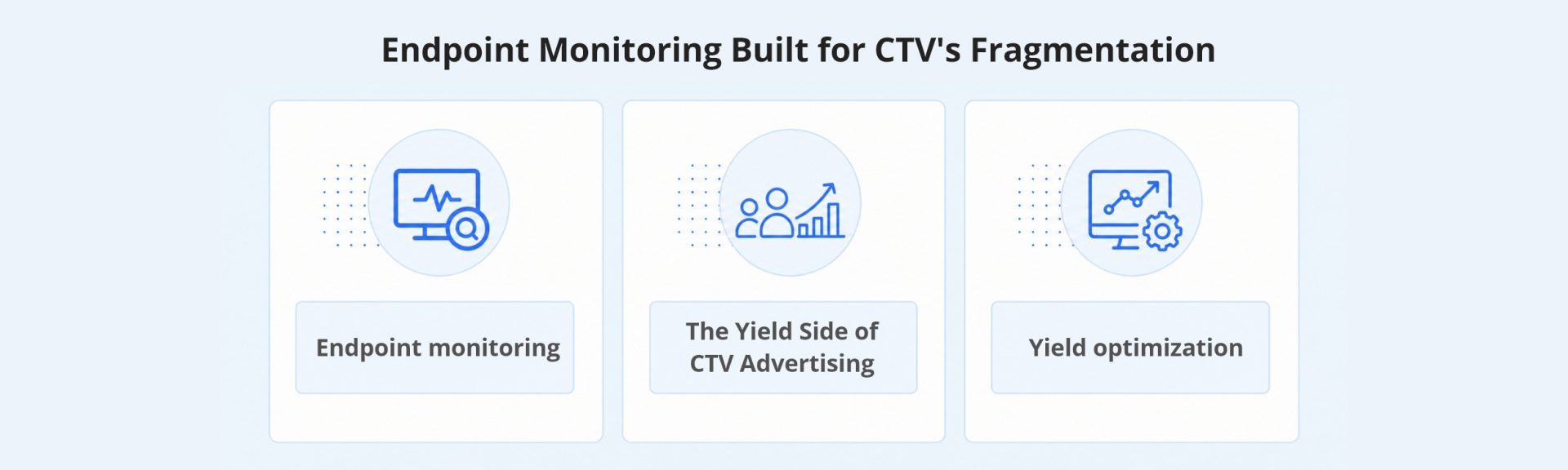
Endpoint Monitoring Built for CTV’s Fragmentation
Endpoint monitoring for CTV has to cover more ground than a typical display stack — every ad server, SSP, DSP, measurement vendor, and device integration a publisher’s CTV inventory touches, validated continuously against expected thresholds rather than through a periodic spot-check that leaves gaps between checks.
What happens after something breaks is where the real difference shows up. A generic error log tells an ops team that something failed; it doesn’t tell them what to do next. This is precisely the gap AdSentinel is built to close:
- Anomalies classified automatically — sudden drops, formatting errors, bot-driven invalid traffic
- Alerts routed with root cause context and an affected-revenue estimate already attached
- No raw log entry to interpret from scratch after an advertiser has already noticed
- The team starts from “here’s what broke, here’s roughly what it’s costing, here’s where to look” — not from zero
In production, AdSentinel has cut missed ad integrations by 89% and moved resolution from a multi-day audit cycle to same-day — recovering an estimated $1.2M in annual revenue that would otherwise have gone unnoticed until an advertiser flagged it.
On the delivery side, CampaignNova Autopilot watches a related but distinct problem:
- Endpoint health asks whether the technical connection is actually working
- Delivery pacing asks whether the campaign is on track to deliver what was promised
- CTV needs both watched at once — a healthy connection delivering the wrong volume is just as costly as a broken connection delivering nothing
- CampaignNova catches under-delivery within hours of onset, not at the end of a campaign flight when there’s nothing left to recover
The Yield Optimization of CTV Advertising
Monitoring and delivery reliability solve half the problem. The other half is yield, and CTV inventory behaves differently there too. Fragmented across apps and devices, CTV inventory is harder to forecast than a single linear feed, and much of it moves through programmatic channels where pricing is set auction by auction rather than negotiated once per quarter. A single household’s inventory can be worth a meaningfully different amount from one viewing session to the next, depending on which app, which device, and which audience segment is actually watching in that moment — a level of granularity linear pricing was never built to reflect. For how CTV and OTT inventory is bought and priced in the first place, see our guide to OTT advertising.
Yield optimization for CTV means treating forecasting as a continuous, real-time discipline rather than a static planning exercise — catching under-delivery while there’s still time to remarket the unsold inventory, instead of discovering the gap after a campaign flight has already closed and the opportunity to recover it is gone. This is where Inventory Optimisation Multiplier does its work, applying that same real-time discipline specifically to CTV’s fragmented inventory picture.
Put the three pieces together and the pattern is clear: AdSentinel handles endpoint monitoring, CampaignNova handles delivery pacing, and Inventory Optimisation Multiplier handles yield forecasting. Three different angles on the same underlying reality — CTV doesn’t forgive the assumptions linear could get away with, and treating any one of these three as optional is how publishers end up explaining a shortfall after the fact instead of catching it while there’s still time to fix it. Yield isn’t just about pricing and pacing — it’s also about whether the content itself is tagged well enough to justify a premium in the first place, which is its own separate operational gap most publishers haven’t closed.
CTV Ad Operations Checklist: 10 Questions Publishers Should Ask
- Can we see inventory performance by app, device, content, and demand path?
- How quickly can we detect campaign under-delivery?
- Are ad-server and VAST errors monitored continuously?
- Can we identify suspicious traffic and supply-quality issues?
- Are frequency caps working across devices and platforms?
- Can we distinguish unique reach from duplicated impressions?
- Which inventory is going unused?
- Can we forecast inventory around live events and major releases?
- Can we connect delivery problems to revenue impact?
- Can operations teams act without manually reconciling multiple reports?
A modern CTV operation should not only show what happened. It should help teams identify what is changing, understand the revenue impact, and act before the opportunity is lost.
CTV Advertising Metrics That Matter to Publishers
| Metric | What It Tells the Publisher |
|---|---|
| Fill rate | How much available inventory is monetized |
| Completion rate | Whether viewers watched the ad through |
| Ad error rate | Whether technical issues are affecting delivery |
| Campaign pacing | Whether delivery is on track |
| Under-delivery | Potential make-good or revenue risk |
| Revenue per thousand impressions | Monetization efficiency |
| Yield by app, device, and content | Where inventory performs best |
| Invalid traffic rate | Whether inventory quality is being compromised |
| Reach and frequency | Whether audiences are being reached efficiently |
| Unused inventory | Potential monetization opportunity |
What CTV-Scale Infrastructure Actually Costs
Running real-time monitoring across fragmented CTV inventory is also a cloud cost optimization problem, not just a delivery one. CTV’s uneven, event-driven traffic pattern is exactly what generic cloud cost tooling — built for steady-state workloads — handles poorly, since it’s optimized for an average day rather than the load spikes CTV actually produces around live events.
In one engagement, a broadcaster recovered more than $1.5 million a year in cloud costs by right-sizing infrastructure to CTV’s real, event-driven load instead of worst-case peaks.
This is the discipline Cloud-FinOps Media applies specifically to media’s peak-driven infrastructure pattern. As a Databricks Silver Partner, Infocepts builds this monitoring, delivery, and cost infrastructure natively on the Databricks Data Intelligence Platform — one governed environment underneath all three problems, not three separate systems bolted together after the fact.
CTV vs. Linear vs. Web Display: What Actually Changes
| Linear TV | Web Display | CTV | |
|---|---|---|---|
| Delivery unit | Fixed schedule, national/local breaks | Individual browser impression | Individual streaming session |
| Inventory volatility | Predictable, planned months ahead | Moderate, real-time bidding | High – shifts by device, app, household |
| Fraud surface | Minimal (closed system) | Browser-based bots | App and device fragmentation, SIVT risk |
| Traffic pattern | Scheduled | Relatively steady | Sharp event-driven spikes |
| Yield discipline needed | Quarterly pricing review | Real-time bidding | Continuous, real-time forecasting |
The Real Shift in CTV Advertising
The publishers actually pulling ahead in CTV aren’t the ones with the most inventory. They’re the ones who’ve stopped treating CTV as a bigger version of web display or a smaller version of linear, and started building monitoring, delivery, and cost infrastructure specifically for how CTV traffic actually behaves – fragmented across devices, spiking around live events, and vulnerable to failure patterns neither linear nor web display ever had to solve for.
That’s not a one-time fix. It’s the operating model CTV advertising now requires.
Frequently Asked Questions
Optimize CTV Advertising with Real-Time Intelligence
Monitor fragmented inventory, detect delivery risks early, and maximize yield across CTV, linear, and digital ecosystems with AI-powered advertising operations.
The Infocepts Media & Entertainment COE helps streaming, publishing, and content businesses harness data to grow audiences and optimize revenue. The team specializes in content analytics, subscriber intelligence, ad tech data, and building the data foundations modern media companies need to compete.
Read Full BioRecent Blogs



The Enterprise AI & Data Transformation Partner. Delivering measurable business impact globally.
#1 on Gartner Peer Insights · 97.2% client retention