Services › Data & AI Strategy Consulting

Data & AI strategy consulting, grounded in where you actually stand

4.9/5

from 55 verified client reviews on Gartner Peer Insights, Data and Analytics Service Providers – as of July 2026

We assess your data and AI maturity across ten areas, then design, build, and operate the roadmap ourselves. The same team, from first diagnostic through production.

4.9/5

Gartner Peer Insights, 55 reviews

1,300+

Data & AI professionals across 8 global regions

97.2%

Client retention

2004

Building production data platforms since

Definition

What is a data and AI strategy?

A data leader reviewing analytics dashboards on a multi-screen workstation

A data and AI strategy is a plan that connects how an organization captures, governs, and uses its data to the AI-driven decisions it wants to take. It aligns three things that usually get planned separately: the data foundation, the use-case portfolio, and the operating model that has to run both.

A complete strategy answers five questions: what business outcomes are we buying, what state is our data actually in, which use cases earn investment first, who owns and governs what, and in what sequence does any of it get built.

Generative and agentic AI make the foundation matter more, not less. They need governed, well-documented data, clear ownership of model risk, access controls, and a defined way to evaluate and monitor what the models produce. We build those responsible-AI guardrails into the roadmap from the first diagnostic, so they are designed in rather than added after the first incident.

For organizations building on Databricks, our Databricks-certified strategists bring implementation experience into the planning conversation itself, not a generic framework applied afterward. As a Databricks consulting partner, we align your data and AI roadmap to what the Databricks Data Intelligence Platform can actually deliver, so strategy and execution are never two separate conversations.

Most data and AI strategy engagements end at the roadmap. The distinction that matters to a data leader isn’t strategy versus AI strategy — it’s whether the team that writes the roadmap is accountable for running what it recommends.

Infocepts point of view

How is it different from a data strategy alone?

A data strategy governs supply - quality, access, architecture, stewardship. An AI strategy governs demand - which decisions get automated or augmented, and at what risk. Planned apart, they fail predictably: governed data nobody uses, or AI pilots resting on data that can’t support them in production. A combined strategy sizes supply against real demand.

What makes it different from an AI pilot plan?

A pilot plan proves one use case works. A strategy defines the governed foundation, operating model, and prioritization method needed to scale many use cases reliably - the difference between one experiment and a repeatable system.

The problem

Why most data and AI strategies stall

Rarely from a lack of ambition. Almost always from an unclear picture of where the organization actually stands when the plan gets written.

01

Fragmented ownership

Data sits with IT, use cases with the business, risk with compliance. No single role can approve a sequence, so nothing sequences.

02

Unprioritized use cases

A portfolio of pilots chosen on enthusiasm rather than on feasibility against the current data foundation. Most cannot scale.

03

Governance bolted on late

Quality, access, and model risk get addressed after the first production incident rather than designed into the roadmap.

04

The delivery handoff

The roadmap arrives as a deck. The team that wrote it leaves. Whoever inherits it re-litigates every assumption from scratch.

Gartner predicts organizations will abandon 60% of AI projects unsupported by AI-ready data through 2026, and 63% lack, or are unsure they have, the right data management practices for AI. Gartner, Feb 2025

It also predicted that at least 30% of generative AI projects would be abandoned after proof of concept by the end of 2025, over poor data quality, weak risk controls, rising costs or unclear value. Gartner, Jul 2024

Services

Data & AI strategy services

Whether you are starting a strategy, correcting one already in flight, or need senior capacity for a single decision – start with the engagement that matches the question in front of you.

01

Data strategy assessment

The full State of Data & AI diagnostic. A scored baseline across ten areas, benchmarked against comparable organizations, with an adaptive roadmap you can fund.

02

Data governance strategy

Governance designed as an operating capability rather than a policy document — ownership, quality controls, access, and the model-risk guardrails AI workloads require.

03

AI strategy and value identification

Find where AI earns its investment. We size candidate use cases against your data foundation and business value, then sequence the ones that can reach production.

04

Data fluency assessment

Assess how well your teams read, question, and act on data across six areas — objective, quality, tech, people, process, and culture — then close the gaps that matter.

05

Fractional advisory (AIRcover)

Senior data and AI leadership on a fractional model. Advisory, consulting, and coaching when you need the judgment but not the full-time headcount.

Not sure which applies?

Most engagements begin with the assessment because it makes the rest of the sequence obvious. Thirty minutes with a practice lead will tell you whether that is true for you.

The assessment

The State of Data & AI assessment

Before we recommend anything, we score where you stand. Ten areas, four dimensions, evidenced through stakeholder interviews, system review, and a read of your existing data estate. It produces your Data & AI Readiness Score, and it is complimentary. It exists to answer four questions honestly.

Q1Where does our data and AI capability actually stand today?

Q2What is holding adoption back — people, platform, or process?

Q3What will it cost to close the gap, and what does it return?

Q4Who owns what, and is the leadership team aligned on it?

Ten areas, scored 1–5Maturity scale1 Ad hoc2 Repeatable3 Defined4 Managed5 Optimized

PE·01Dimension 1 · People

Leadership and sponsorship

Whether data and AI decisions have an accountable executive owner and a funded mandate.

3.0

PE·02Dimension 1 · People

Skills and data fluency

How well teams interpret, question, and act on the data already available to them.

2.0

PR·01Dimension 2 · Product

Data products and ownership

Whether critical datasets have named owners, defined consumers, and a service standard.

3.0

PR·02Dimension 2 · Product

Use-case portfolio

How candidate AI and analytics use cases are sourced, sized, and selected for funding.

4.0

CA·01Dimension 3 · Capability

Platform and architecture

Whether the data platform can support production AI workloads without rework.

2.0

CA·02Dimension 3 · Capability

Quality and governance

Trust in the data itself: lineage, quality controls, access, and model risk management.

3.0

CA·03Dimension 3 · Capability

Engineering and operations

The ability to ship, monitor, and sustain data and AI workloads once they are live.

4.0

BV·01Dimension 4 · Business value

Value measurement

Whether outcomes are defined before build and measured after release.

2.0

BV·02Dimension 4 · Business value

Decision adoption

Whether the people the work was built for changed how they actually decide.

3.0

BV·03Dimension 4 · Business value

Operating model and funding

How the work is staffed, funded, and decided on once the programme is running.

2.0

What the output looks like

Your Data & AI Readiness score on one view

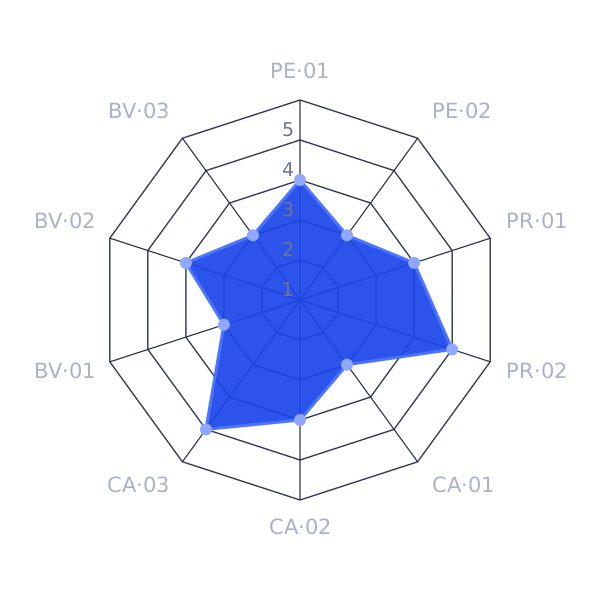
Your Data & AI Readiness Score plots all ten areas on one view, so the sequencing argument makes itself. The profile below is an illustrative sample, not client data.

Sample Data & AI Readiness ScoreIllustrative

Radar plot of ten maturity areas, scored between 2.0 and 4.0 out of 5

Illustrative sample profile
· scored 1–5 · not client data
2.8Overall readiness · out of 5

Ten areas

  • PE·01Leadership and sponsorshipDefined3
  • PE·02Skills and data fluencyRepeatable2
  • PR·01Data products and ownershipDefined3
  • PR·02Use-case portfolioManaged4
  • CA·01Platform and architectureRepeatable2
  • CA·02Quality and governanceDefined3
  • CA·03Engineering and operationsManaged4
  • BV·01Value measurementRepeatable2
  • BV·02Decision adoptionDefined3
  • BV·03Operating model and fundingRepeatable2

Read this way, the sequencing argument is obvious: an ambitious use-case portfolio scored at 4 sitting on a platform scored at 2 is the reason pilots stall. The foundation work has to come first.

What you get

Your Data & AI Readiness Score across all ten areas, a prioritized use-case shortlist, and a sequenced roadmap with costs and dependencies.

How long

Three to four weeks, running alongside your team rather than pausing it.

What it costs

Nothing. The assessment is complimentary, and you keep the roadmap whether or not you engage us to build it.

The method

How we work: assess, prioritize, design, build, operate

Five stages, run by one accountable team. The last two are the ones most strategy engagements do not include.

01Strategy phase

Assess

Score the ten areas. Establish an evidenced baseline and surface where leadership disagrees about it.

Most strategy engagements end here, after Stage 03. Delivery transfers to a systems integrator or back to your team, and the assumptions behind the roadmap get re-litigated by people who never made them.

Stages 04 and 05 are where our accountability continues.

Stages

0102030405

The decision

Strategy-only engagement vs. strategy and delivery

If you are comparing a global strategy consultancy against a delivery partner, this is the difference that shows up eighteen months later.

Dimension Strategy-only engagement Infocepts: strategy and delivery
Where it ends Roadmap, business case, and target architecture. Delivery transfers out. Same team continues through build and into production operations.
Who carries the assumptions Whoever inherits the deck, usually without the original context. The people who made the assumptions are accountable for them.
Feasibility testing Assessed on paper against a reference model. Assessed by engineers who will have to build it.
Time to first production value Restarts with a new vendor selection and discovery cycle. Continuous — build begins against a roadmap already validated.
Governance Designed as policy, implemented later by someone else. Designed and then operated, with the controls actually running.
Commercial shape Fixed advisory fee; delivery procured separately. Staged — assess, then commit to build with costs already evidenced.

Industries

Where we do this work

Maturity means different things in a regulated trial environment than it does in a retail promotions cycle. Assessment criteria are weighted by sector.

Decisions that turn over weekly, on data that arrives faster than governance usually does.

  • Demand forecasting
  • Promotion and markdown optimization
  • Assortment and inventory intelligence
  • Store and field operations analytics

Retail analytics

Proof

Independently rated, not self-declared

4.9Out of 5 · 55 reviews

Gartner®

Gartner Peer Insights

Data and Analytics Service Providers market, as of July 2026. Read the reviews on Gartner.

Highest rated in the category in Gartner’s Voice of the Customer report for Data and Analytics Service Providers, 2022

Strategy (formerly MicroStrategy) North American Partner of the Year 2025

Databricks Silver Partner

Building production data platforms since 2004, from delivery centres across the US, Canada, LATAM, UK, Europe, Middle East, APAC and India

97.2% client retention

What this has produced

Assessment and roadmap

Broadcast control room, the client environment for the analytics modernization programme

Analytics modernization improves ROI without the typical risks & user resistance

Annual savings of $600K in license and platform support costs, 37% fewer reports and a 1.3x increase in user adoption.

Data fluency

Two analysts exploring data on a transparent display

Data fluency improves business outcomes & fuels innovation

Data comprehension and adoption improved among 1,100+ users at a global retailer.

Governance

Banking and finance icons around a monitor and a smartphone

AI-powered model risk management improves banking efficiency & compliance

60% less time spent identifying and fixing model data quality, drift and fairness issues.

A data leader at a multi-monitor analytics workstation, seen from behind

Infocepts has transformed the way we operate. Our teams have gained unprecedented levels of trust & clarity in the data we use to drive discussions and make adjustments in our business.

SVP of Store OperationsFortune 250 Retail Company

Awards & Recognitions

Complimentary — no fee for the assessment

Three to four weeks, alongside your team

You keep the roadmap either way

4.9 / 5 from 55 verified reviews on Gartner Peer Insights

Start here

Start with an honest baseline

Ten areas, scored and evidenced, in three to four weeks. Complimentary. Then a roadmap we are prepared to build ourselves.

Questions

Frequently asked questions

Twelve questions data leaders ask before commissioning an assessment.

Last reviewed October 2026 by the Infocepts Data & AI Strategy practice.

A data and AI strategy connects how you capture, govern, and use data to the AI-driven decisions you want to make. They belong in one plan because they constrain each other: AI demand that outruns the data foundation stays stuck in pilots, and a governed foundation with no prioritized demand produces expensive infrastructure nobody uses.

Ten areas across four dimensions — people, product, capability and business value. Each is scored 1–5 against a defined maturity scale and evidenced through stakeholder interviews, a system review and a read of your existing data estate, so the score is defensible rather than impressionistic.

The assessment runs three to four weeks alongside your team rather than pausing it. Prioritization and design typically add four to eight weeks, depending on the size of the estate and how many business units are in scope.

Both. Stages 04 and 05 are delivery: the same team builds the data products, platform work and models, then operates them in production. That continuity is the reason the feasibility calls made during strategy hold up.

A strategy practice ends at the roadmap and hands delivery to someone else. We test feasibility with the engineers who will have to build it, and stay accountable through production. The comparison above sets out the six differences that show up eighteen months later.

Each candidate is scored on business value and on feasibility against your current data foundation. The use cases the foundation can already carry are funded first; the rest are sequenced behind the specific foundation work that unblocks them.

Most organizations do not need a new title. What they need is one accountable owner with a funded mandate covering both data and AI. Where that can sit with an existing CDO, the assessment says so — and where it cannot, it says why.

Decision rights, the funding model, team topology, the governance that has to run alongside delivery, and the service standards data products are held to. It is the answer to who owns what once the roadmap is live.

Outcomes are defined before build and measured after release. For the strategy stages that means an evidenced baseline, a funded sequence and leadership alignment on it; for delivery it means the production measures the use cases were funded against.

A score for each of the ten areas, an overall readiness figure out of five, a prioritized use-case shortlist, and a sequenced roadmap with costs and dependencies. The illustrative profile on this page shows the shape of it.

A thirty-minute call with a practice lead to confirm scope and the stakeholders worth interviewing. The assessment starts from there.

Nothing. The assessment is complimentary, and you keep the roadmap whether or not you engage us to build it.

Book a Data Strategy Meeting Today

Insights

Related reading

Blog

Building a Data-Driven Organization: Why your Tech Solutions are Failing?
Read More

Guide

Top 5 Data and AI Initiatives to Drive Business Growth in 2024 & Beyond
Read More

Guide

Navigating Generative AI: A 3-Step Guide for Data Leaders to Move from Hype to Results
Read More

Blog

Scaling Data Analytics: Are these Challenges holding your Enterprise back?
Read More

We'd Love to Hear from You!

Open Popup