
Most leaders looking at agentic AI for enterprise aren’t asking for another slide on “what is an agent.” They’re trying to fix something concrete: slow analytics cycles, clunky reporting workflows, or decisions that still depend on tribal knowledge instead of data.
The promise of agentic AI is simple: AI agents that don’t just answer questions, but take actions across your enterprise systems, coordinate with each other, and keep humans in the loop. Done well, they change how data is used, how analytics runs, and how decisions get made day to day.
From Static Dashboards To Agentic AI For Enterprise
Most BI and analytics stacks inside large organizations are still built around one-off questions and static dashboards. An analyst pulls data, builds a view, pushes it to business users, and hopes they look at it before making a call.
Agentic AI for enterprise flips this model. Instead of people hunting for insight, AI agents monitor data, spot patterns, trigger workflows, and surface recommended actions directly inside the tools where people work.
What Enterprise AI Agents Actually Do
Enterprise AI agents are software entities that can interpret intent, reason over data, call tools, and take bounded actions on behalf of a user or a team. They sit between your people and your systems, orchestrating work that used to require human glue.
In practice, that can look like an agent watching daily revenue by product line and automatically flagging anomalies, another agent drafting follow-up emails based on CRM changes, and a third coordinating both so sales and finance stay aligned.
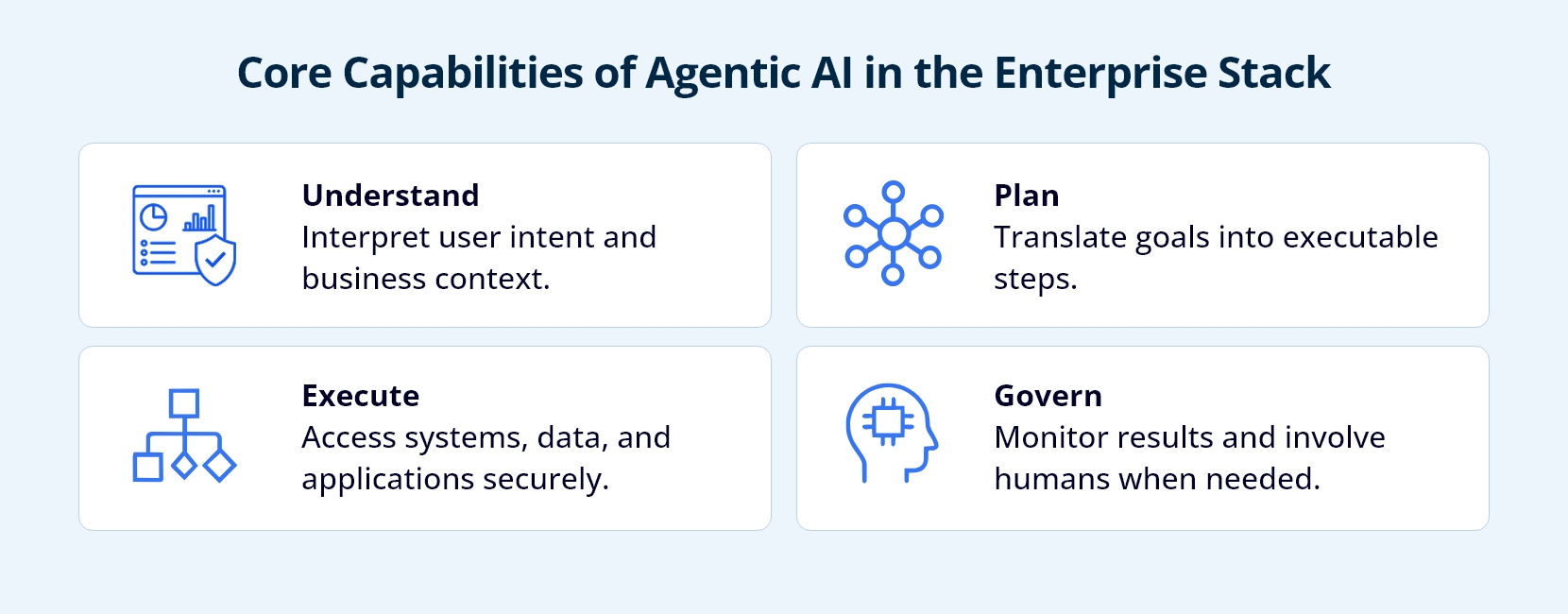
Core Capabilities Of Agentic AI In The Enterprise Stack
To move beyond chatbots, agentic AI needs a clear set of capabilities that make sense inside enterprise constraints: security, compliance, and existing tech debt. This is where teams often underestimate the design work and overestimate what a large language model can do on its own.
The most effective AI agents for business combine language understanding with strong guardrails, explicit tool access, and opinionated workflows that mirror how your teams already operate, not how a lab demo behaves.
Inside A Practical AI Agent Architecture
A workable AI agent architecture for a large company usually has four layers: intent understanding, planning, tool execution, and feedback. Each layer has its own logging, governance, and failure handling.
At the intent layer, the agent interprets what the user or system event is asking. Planning then turns that into steps, tool execution hits APIs and data services, and the feedback layer decides what to do next or when to hand off to a human.
Autonomy, Guardrails, And Human Oversight
Fully autonomous AI agents sound attractive until they start scheduling meetings with the wrong clients or updating production configs on a bad signal. The reality for most enterprises is constrained autonomy with human checkpoints.
Autonomous AI agents in regulated industries typically operate inside tightly scoped domains: propose adjustments to marketing budgets, draft but don’t send vendor emails, or update forecast assumptions but await approval before changing the official plan.
High-Value Agentic AI Use Cases Across The Enterprise
The easiest way to judge agent opportunities is to look for repetitive, rules-heavy, cross-system work that still requires human judgment at key points. That combination of structure and nuance is where agents shine.
Below are patterns that appear across data, analytics, and operations, and that usually pay back quickly once the plumbing is in place.
From Reports To Continuous Decision Support
Classic analytics teams ship monthly reports and hope decision-makers read them. An agentic approach replaces this with continuous decision support that watches metrics and nudges the right people when something actually needs attention.
Enterprise AI agents can, for example, monitor margin drops by region, match them against supply chain events, and push a prioritized summary and options into a leader’s collaboration tool instead of burying it in a dashboard folder.
AI Workflow Automation In Data And Analytics
AI workflow automation goes beyond basic RPA by letting agents reason about context, not just follow a fixed script. This matters when data quality is patchy or when business rules change more often than IT release cycles.
Common patterns include agents that triage data quality alerts, auto-generate exploratory analysis for new product launches, or prepare tailored briefings ahead of recurring leadership meetings.
Enterprise Automation That Respects Reality
Enterprise automation efforts often stall because they ignore messy human steps: side conversations, undocumented exceptions, and political constraints. Agentic systems work better when they model those constraints instead of pretending they don’t exist.
Well-designed AI agents for business will propose actions with rationale, document trade-offs, and capture human overrides. Over time, this feedback loop makes the agents’ recommendations closer to how the business actually runs.
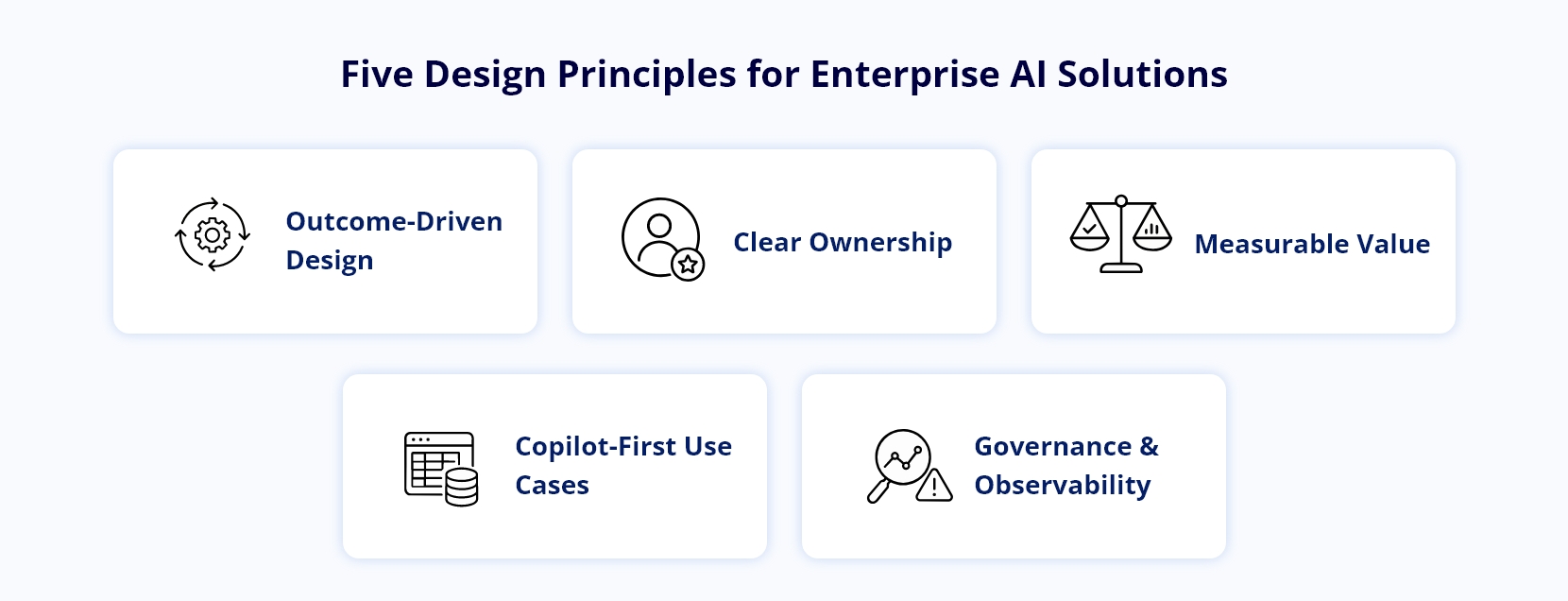
Design Principles For Enterprise AI Solutions
Agent projects that succeed in large organizations start from business outcomes, not from model capabilities. Teams that lead with “we have a model, what can we do with it” usually ship prototypes that never leave the lab.
Successful enterprise AI solutions share three traits: clear ownership, measurable value, and tight integration into the tools and channels people already use to make decisions.
Picking The Right Agent Use Cases First
A good starting rule: pick use cases where agents can act as copilots before giving them any power to update systems directly. That keeps risk manageable and gives you real usage data fast.
Strong agentic AI use cases include alert triage for incident management, root-cause analysis suggestion for KPI drops, and assisted forecasting in planning cycles where analysts are drowning in scenarios.
Data, Governance, And Observability
Agent projects fail quietly when no one can see what the agent did, why it did it, or what data it touched. Treat agents the way you treat critical applications, not side experiments.
That means explicit data contracts, access control, observability, and documented hand-off points to humans. Skipping this step leads to shadow systems that security and compliance teams will eventually shut down.
Organizational Impact And Change Management
Agentic AI doesn’t just change workflows; it changes who has access to insight and who feels in control of decisions. That has real organizational consequences if you introduce it without a plan.
Leaders need to be explicit about how roles will shift, what “AI-assisted” accountability looks like, and how performance expectations will change for teams that now have smarter tools.
Skills, Teams, And New Operating Rhythms
As agents take over repetitive analytics work, the mix of skills inside data and operations teams changes. You need fewer people rebuilding the same reports and more people framing questions, curating data, and stress-testing agent behavior.
Enterprise AI agents also force a new operating rhythm. Instead of waiting for quarterly business reviews, teams start responding to prompts from agents mid-cycle, testing small changes, and measuring results faster.
Conclusion
Agentic AI for enterprise is not about replacing people with bots. It’s about building AI agents that live inside your data and decision flows, handle the repetitive glue work, and keep humans focused on judgment and strategy.
Done thoughtfully, this shift turns analytics from a reporting function into an operational partner, with agents coordinating data, context, and action across teams. If you’re ready to explore where this fits in your environment, start small, measure hard, and work with a partner like Infocepts that knows how to ship real outcomes, not just proofs of concept.
Frequently Asked Questions
Accelerate Decision-Making with Agentic AI
Deploy intelligent AI agents that automate workflows, deliver actionable insights, and drive smarter business outcomes across the enterprise.
Recent Blogs



Infocepts