
A leader’s view on AI predictive maintenance in manufacturing
What is predictive maintenance in manufacturing?
Predictive maintenance in manufacturing spots failure early. AI reads the signals machines already send. Vibration, heat and pressure all tell a story. Most plants do not hear it in time. Our Predictive Maintenance Intelligence Agent changes that. It targets seven to 14 days of warning. That is enough time to plan the fix.
A 3 a.m. phone call nobody wants
Every plant leader knows this call. A critical line is down. A bearing failed without notice. Or so it seems.
The next morning, someone pulls the data. The warning signs were there all along. Vibration had crept up for a week. Temperature drifted a few degrees. The CMMS showed a skipped inspection. Nobody connected the dots in time.
This is not a people problem. Your teams work hard. They are simply buried in data. SCADA says one thing. MES says another. The maintenance log sits somewhere else. No one person can watch it all.
So the plant pays. It pays in overtime and rush-shipped parts. It pays in missed orders. It also pays in customer patience. That is the hardest cost to rebuild.

What does unplanned downtime really cost?
The numbers are hard to ignore. Siemens studied the world’s 500 largest companies. Downtime costs them about $1.4 trillion yearly. That equals 11% of their revenue. Large automakers feel it most. They lose $2.3 million per hour of downtime.
You may run a smaller operation. The ratio still stings. Every lost hour hits margin directly. Hidden costs pile up behind it. Think idle crews, premium freight and contract penalties.
Here is the harder truth. Much of that loss is avoidable. The machines give notice. We just need to hear it.
Think about your own last major outage. How much did it really cost? Add the scrap and the restart time. Add the overtime and the expedited parts. Add the credit notes to customers. Most leaders find the true figure surprising. Few ever see it in one report.
Why run-to-failure and calendar maintenance fall short
Most plants mix two approaches today. Some assets run until they break. Others get serviced on a fixed calendar. Both feel familiar. Neither is efficient.
Run-to-failure invites the 3 a.m. call. Calendar maintenance wastes good parts and labor. You replace components with months of life left. You still miss failures between service dates.
Condition monitoring was the next step. It helped, but it relies on fixed thresholds. Thresholds catch problems late. Once an alarm trips, damage has started.
Predictive maintenance works differently. It learns what normal looks like. It does this for every asset. Then it watches for small drifts. Those drifts often appear days early. That is well before a threshold breaks.
How the Predictive Maintenance Intelligence Agent works
We built the agent around your existing systems. There is no rip and replace. It connects to SAP, Oracle or Microsoft Dynamics. It reads MES, SCADA and IoT sensor data. That is IIoT analytics put to work. It pulls history from your CMMS or EAM.
From there, the work runs in six steps. First, it connects your data sources. Second, it monitors asset health across plants. Third, anomaly detection flags abnormal patterns early. Fourth, it forecasts failure risk. It also estimates remaining useful life. Fifth, it recommends the right maintenance action. Sixth, it raises work orders and tracks impact.
Your teams can also ask it questions. A built-in copilot answers in plain English. Which pumps are at risk this week? Why did line four trip again? Answers come back in seconds, not days.
Root cause analysis runs alongside every alert. Technicians see why the risk rose. That builds trust in the model. It also speeds up the repair itself.
What changes for your maintenance team?
Technology only matters if the floor feels it. So what does a normal week look like?
Monday starts with a ranked risk list. It is not a wall of alarms. It is a short list of assets. Each one needs attention this week. Each comes with a clear reason. Each carries a suggested action.
Planners schedule the work around production. They order parts on standard lead times. Supervisors know what is coming. Nobody is surprised on Thursday night.
Reliability engineers get their time back. They stop chasing spreadsheets. They start fixing chronic failure modes. Senior technicians pass on what they know. Their know-how shapes how alerts get tuned.
Over time, the culture shifts. Firefighting gives way to planning. Stress on the night shift drops. Good people stay longer.
What results should leaders expect?
We prefer honest targets over bold promises. Results depend on your data and baseline. Still, our platform benchmarks are clear.
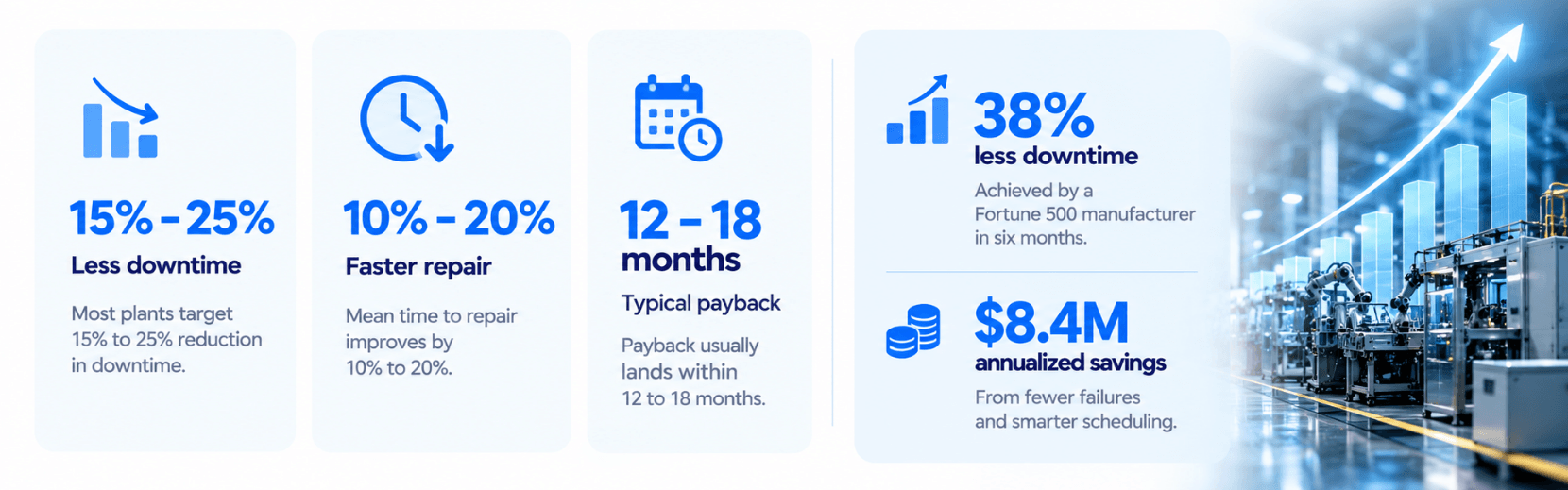
Plants often target 15% to 25% less downtime. Mean time to repair improves 10% to 20%. Payback usually lands within 12 to 18 months.
Some clients have gone further. One Fortune 500 industrial manufacturer worked with Infocepts. Unplanned downtime fell 38% in six months. Infocepts work has also delivered bigger numbers. One result was $8.4 million in annualized savings. It came from fewer failures and smarter scheduling.
These gains compound over time. Asset reliability improves year after year. Planned work costs less than emergency work. Parts arrive on normal freight. Crews work normal shifts. Customers get their orders on time.
Why a shared data foundation matters
Many predictive maintenance pilots stall. The model works in one plant. Then it struggles in the next. Usually, the data definitions differ.
One site defines downtime one way. Another site counts it differently. Leaders cannot compare results. Trust erodes quickly after that.
That is why the agent sits inside ManuAI. ManuAI is our manufacturing intelligence platform. Eight specialist agents share one semantic layer. Every agent uses the same governed KPI definitions. More than 200 manufacturing KPIs come pre-built.
So downtime means the same thing everywhere. The maintenance agent agrees with the OEE agent. Your finance team sees the same numbers. That is how pilots become programs.
Security stays tight throughout. Access is role-based. Every decision has lineage and audit logs. Models are validated per site before go-live.
How to start without betting the plant
Careful leaders ask the right question. What if this does not work here? Our answer is to start small.
Pick one critical asset class. Choose one line or one plant. Prove the value in weeks, not years. Then scale with evidence in hand.
Our outcome-based engagements run four to 12 weeks. The agent runs on Microsoft Azure today. It also ports to AWS and Google Cloud. It can even run on your own Kubernetes. You avoid single-cloud lock-in.
You keep control at every step. Humans approve the work orders. The agent informs the decision. Your people make the call.
The cost of waiting another quarter
Your machines are sending signals right now. Some point to next month’s failure. The only question is who hears them first.
Every quarter without predictive maintenance has a price. You pay it in avoidable downtime. Your competitors are not waiting for perfect proof. Many are already testing industrial AI on lines.
Infocepts keeps 97.2% of its clients. We are the highest-rated data and analytics provider. That rating comes from Gartner Peer Insights. It has held three years running.
A pilot can go live before 2027 budgets. See how the agent would read your assets. Explore the Predictive Maintenance Intelligence Agent today. Then request a demo with our team.
Frequently Asked Questions
Are Your Machines Already Warning You?
See how the Predictive Maintenance Intelligence Agent would read your assets, and request a demo before your 2027 budgets lock.
The Infocepts Manufacturing COE partners with industrial and discrete manufacturers to build smarter, data-connected operations. From shop floor analytics and predictive maintenance to supply chain visibility and quality intelligence, the team helps manufacturers move from reactive reporting to real-time decision-making.
Read Full BioRecent Blogs



Infocepts