
Your models look smart on paper, but the results still spark debate in every steering meeting. The common thread is almost always the same: there is no shared definition of the data behind those predictions, and that is exactly where a semantic layer should sit.
Instead of arguing over whose dashboard is right, a semantic layer creates one business-wide vocabulary for data, models, and metrics. Once that foundation is in place, AI shifts from being a risky experiment to a governed capability the business can actually trust.
Why Enterprise AI Keeps Tripping Over Data Semantics
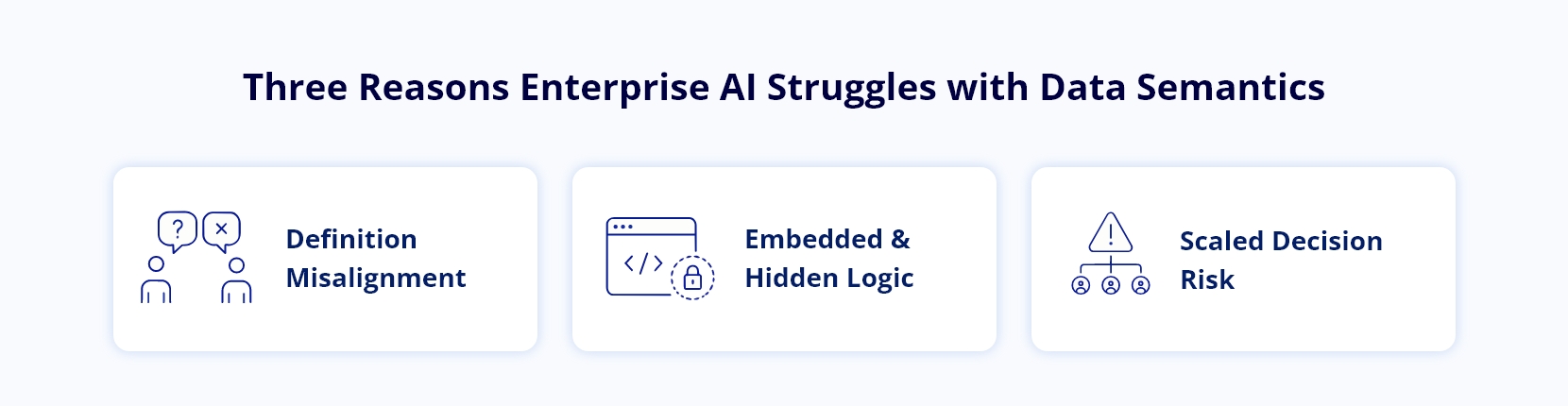
Most AI initiatives fall over long before the algorithm stage because teams lack a shared view of data semantics. Finance defines “customer” one way, sales another, and your data science team a third. The models may run, but the business cannot agree on what the outputs really mean.
Traditional data projects tried to fix this inside ETL jobs or BI tools. That approach worked when you had a handful of reports and a single data warehouse. In an environment of data lakes, SaaS sources, and streaming feeds, hiding semantics in code just creates technical debt and fragile dependencies.
On top of that, AI expands the blast radius. A misdefined metric in a manual report causes arguments. The same misdefinition feeding an AI model can steer discounts, risk scores, or supply decisions in the wrong direction at scale.
What A Semantic Layer Actually Is (And Is Not)
Under the buzzword, an enterprise semantic layer is a consistent, queryable representation of business concepts, metrics, and relationships, independent of any one storage platform. It sits between raw data and consuming tools, so everyone draws from the same definitions.
Think of it as the translation layer between how the business thinks and how data is stored. Instead of every data engineer encoding logic in SQL, the semantic layer exposes governed concepts like “Active Subscription” or “Net Revenue” as reusable objects.
Core Building Blocks Of A Business Semantic Layer
A modern business semantic layer includes a catalog of entities, metrics, and relationships that mirror real business processes. This catalog carries the rules that used to live in hidden places: spreadsheet formulas, ETL mappings, or BI tool calculations.
It also typically includes access policies, data lineage, and change management. When a metric definition changes, you can see who is impacted, roll it out in a controlled way, and avoid silent breaks across dozens of consuming systems.
From Data Modeling To Semantic Data Models For AI
Most teams already do data modeling in some form, but traditional star schemas alone are not enough for AI. A semantic data model adds explicit business meaning, hierarchies, and constraints that both people and machines can understand.
In practice, that means modeling entities such as customers, products, and contracts, then capturing the relationships and rules that govern them. Instead of a table called “cust_dim” with opaque columns, you get a graph of well-defined concepts with names aligned to business language.
How The Semantic Layer Guides Feature And Model Design
When data scientists explore through a semantic layer for AI, they are choosing from vetted concepts instead of raw tables. The layer exposes subject areas such as revenue, churn, logistics, or risk, with definitions attached.
This not only speeds up experimentation, it cuts rework. Features created from agreed definitions of churn reasons or risk categories carry the same meaning into every model that uses them, making comparison across use cases far easier.
Governed AI Starts With A Shared Semantic Foundation
Without a shared language, governed AI becomes a policy document that nobody can consistently apply. A semantic layer gives those policies a concrete anchor by binding rules to data entities, attributes, and metrics.
Access rules become more precise when they attach to concepts like “health data” or “credit risk” instead of to specific columns in one database. This is where an enterprise semantic layer starts to pull its weight across compliance teams, security, and data owners.
Making Governance Part Of Everyday AI Workflows
For governed AI to stick, controls have to live where people work. Tying model inputs and outputs back to semantic concepts lets you ask basic but powerful questions: Which sensitive attributes did this model use, and how are they defined in our catalog of data governance rules?
By wiring that mapping into your AI lifecycle tools, reviews stop being a manual scavenger hunt across dashboards and notebooks. A change in definition for a critical attribute triggers alerts across any AI project that depends on it.
Designing An Enterprise Semantic Layer For Real-World AI
Most organizations already have fragments of semantic logic spread across integration tools, marts, and reports. Building an enterprise AI architecture that truly relies on a semantic layer means consolidating those fragments into a coherent, actively governed asset.
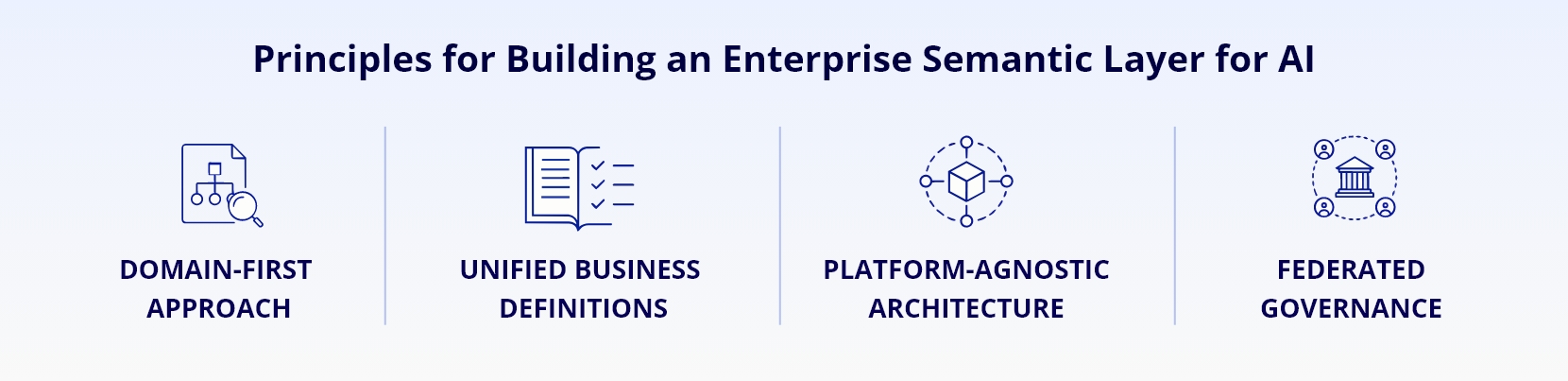
Successful teams usually start in one priority domain, such as pricing or customer experience, and build out the semantic layer around a handful of high-value metrics. Once that is stable, they extend the same patterns across domains and regions.
Key Design Principles For A Sustainable Semantic Layer
To stay useful, the semantic layer must be independent of any one platform and accessible from all major tools that consume data and AI outputs. Tight coupling to a single BI product or lakehouse vendor limits its reach and shelf life.
It also needs clear ownership. A federated model often works best: central data teams own the core semantic contracts, while domain experts propose changes and new concepts within guardrails aligned to broader enterprise AI architecture goals.
Making AI Outputs Explainable And Trustworthy
One of the hardest questions to answer in production is why an AI system took a specific action. A semantic layer makes explanations less about technical traces and more about business language people recognize.
Instead of saying, “The model used field X1 and X2 with weight 0.6,” you can say it relied heavily on late payment behavior, discount sensitivity, and tenure segments as defined in your enterprise semantic layer. That closes the gap between data teams and the executives who sign off on AI-based decisions.
Practical Steps To Put A Semantic Layer In Place
You do not need a complete redesign to start. Pick one use case where trust is low but impact is high, such as credit decisions or predictive maintenance, and build a minimal semantic layer for that slice of the business.
From there, connect AI pipelines, BI tools, and data catalogs to that shared layer. Over time, expand the scope, refine your semantic data model, and treat the layer as a living product instead of a one-off modeling exercise.
Conclusion
Trusted enterprise AI rests on more than accurate models; it depends on clear, shared meaning for the data flowing into and out of those models, and that is exactly what a semantic layer provides. By aligning technical pipelines with business concepts, you reduce rework, improve explainability, and cut down on the arguments that stall AI in committee.
As you plan your next wave of initiatives, treat the semantic layer as the foundation of your AI strategy, not an optional add-on, and consider how partners such as Infocepts can help you turn that foundation into a practical advantage.
Frequently Asked Questions
Create a Trusted Foundation for Enterprise AI
Standardize business metrics and deliver trustworthy AI-driven insights.
Recent Blogs



Infocepts