
Ask three people on a media ad sales team what last quarter’s “TV revenue” actually was, and if your company is like most, you’ll get one number, reported with total confidence, that’s secretly the sum of four completely different products sold four different ways. A linear spot sold eight months ago at an upfront rate. A CTV impression auctioned in real time last night. An OTT pre-roll served to someone’s phone during a commute. An addressable ad slotted into a household a set-top box flagged as in-market for a minivan. Four products, four pricing models, four promises made to four different advertisers – collapsed into one line on a spreadsheet that everyone nods along to in the Tuesday pricing meeting.
CTV, OTT, and linear TV are not interchangeable advertising categories. Linear TV delivers the same commercial to a broad, scheduled audience. OTT refers to video delivered over the internet across any device. CTV is a subset of OTT specifically on connected television screens. Addressable TV adds household-level targeting to linear infrastructure. All CTV is OTT, but not all OTT is CTV – and that distinction changes how each is bought, targeted, measured, and priced.
Here’s the direct fix: publishers who report linear, OTT, CTV, and addressable revenue separately – instead of blending them into one “TV” number – can see exactly which channel is underpriced relative to what the market would actually pay for it. One media company we worked with proved exactly how much that separation is worth: after unifying pricing, delivery, and demand data across linear and digital into one governed view, previously invisible pricing gaps surfaced immediately, and upfront-to-scatter decisions moved from a rule of thumb carried over from the prior year to data-backed calls made in real time. Publishers who don’t separate these channels are paying what this piece calls the blended-line tax, and most of them don’t know they’re paying it.
The Blended-Line Tax
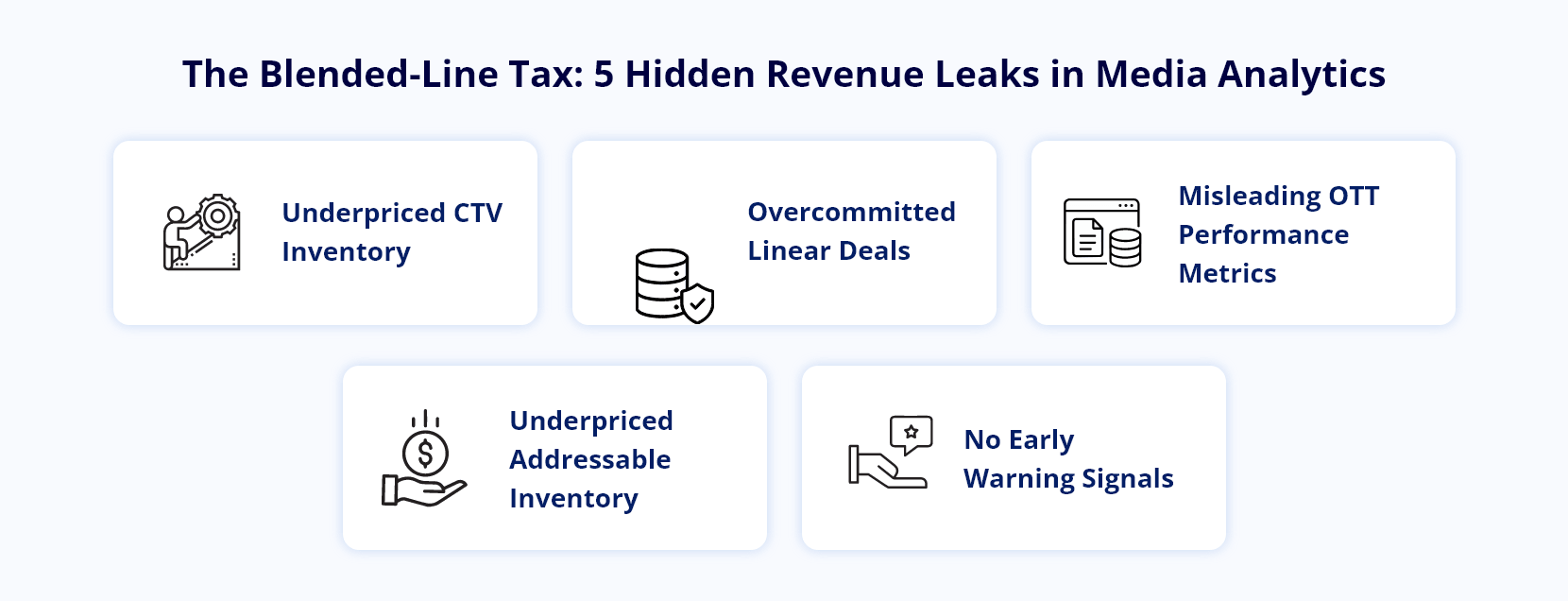
The blended-line tax shows up everywhere a media company reports TV revenue as a single figure, and it’s expensive in ways that rarely show up as an obvious line-item error:
Underpriced CTV: the channel commanding the highest real-world premium gets folded into the same average as lower-value inventory, so nobody notices it’s selling for less than the market would pay. In the engagement above, this was the first pricing gap the unified view actually surfaced – a channel earning less than comparable inventory elsewhere, invisible until it was reported separately.
Overcommitted linear upfronts: budget gets locked into upfront linear deals while addressable and CTV demand is running hot in the same window, and there’s no unified view to catch the mismatch.
Misleading OTT performance: a mobile viewer glancing at a five-second pre-roll and a living-room viewer watching a full 30-second CTV spot get averaged into one “OTT completion rate” that describes neither of them accurately.
Underpriced addressable inventory: the highest-margin segment of a linear footprint gets sold at standard linear rates because nobody separated it out to price it like the premium product it actually is.
No early warning: when pricing is wrong, the flattened number doesn’t tell anyone which channel is wrong – it just reports total revenue that’s quietly lower than it should be.
None of this is because ad sales teams are careless. It’s because the industry’s own language makes it easy to talk about “TV” as one thing – right up until an advertiser asks a pointed question about targeting, or measurement, or why one CPM is triple another.
Four Channels, One Wallet
Think of linear, OTT, CTV, and addressable like four different currencies sitting in the same wallet – a dollar, a euro, a yen, and a peso, all counted as “money,” all worth something different depending on where and how you spend them. Nobody would report a company’s finances by adding those four currencies together at face value and calling it a total. That’s effectively what happens every time a publisher reports “TV revenue” as one number.
Linear TV Advertising
The traditional broadcast model: the same ad plays for every viewer watching a channel at a given time, sold via GRPs through the annual upfront market plus closer-to-air scatter pricing. No individual targeting – an advertiser buys a demographic estimate, not proof a specific household saw the ad. Linear itself splits into three distribution paths: broadcast (ABC, CBS, NBC, FOX), cable (ESPN, HGTV, Discovery), and satellite (DirecTV, Dish) – same GRP logic, different reach-per-dollar profiles.
These differences also create real operational complexity for publishers running linear alongside streaming. Our guide to CTV ad operations explores how fragmented inventory, campaign delivery, fraud, measurement, and yield affect the streaming advertising model specifically – the operational side of the same pricing problem this piece covers.
OTT Advertising
Any ad delivered through video streamed directly over the internet, regardless of device – deliberately the broadest term of the four, spanning a phone during a commute to a laptop at a desk. That breadth is exactly why blending OTT into one performance number misleads: a mobile pre-roll and a living-room CTV spot are fundamentally different attention profiles wearing the same label.
CTV Advertising
The subset of OTT delivered specifically through connected televisions and streaming boxes – Roku, Fire TV, Apple TV, smart TV operating systems. Advertisers pay a real premium here because CTV combines the lean-back attention of a living-room screen with household-level programmatic targeting, a combination linear can’t offer and mobile OTT can’t fully match.
A viewer presses play on a connected TV device – a smart TV, Roku, Fire TV, or game console.
The stream hits an ad break, and the app sends a real-time bid request identifying the household, device, and content context.
Demand-side platforms bid on that specific impression in real time – the same auction mechanism used across digital advertising.
An ad decisioning system selects the winning, most relevant ad for that household.
The ad plays on the big screen with household-level targeting, milliseconds after the bid – the viewer never sees the auction happen.
Addressable TV Advertising
Delivers different ads to different households watching the exact same linear broadcast, using set-top box data to target by household rather than by program. It’s the bridge between linear’s reach and CTV’s precision – and usually the highest-margin segment of a linear footprint, since the same broadcast slot can sell a luxury car ad to one household and a budget SUV ad to another during the same commercial break.
What Is the Difference Between CTV and OTT Advertising?
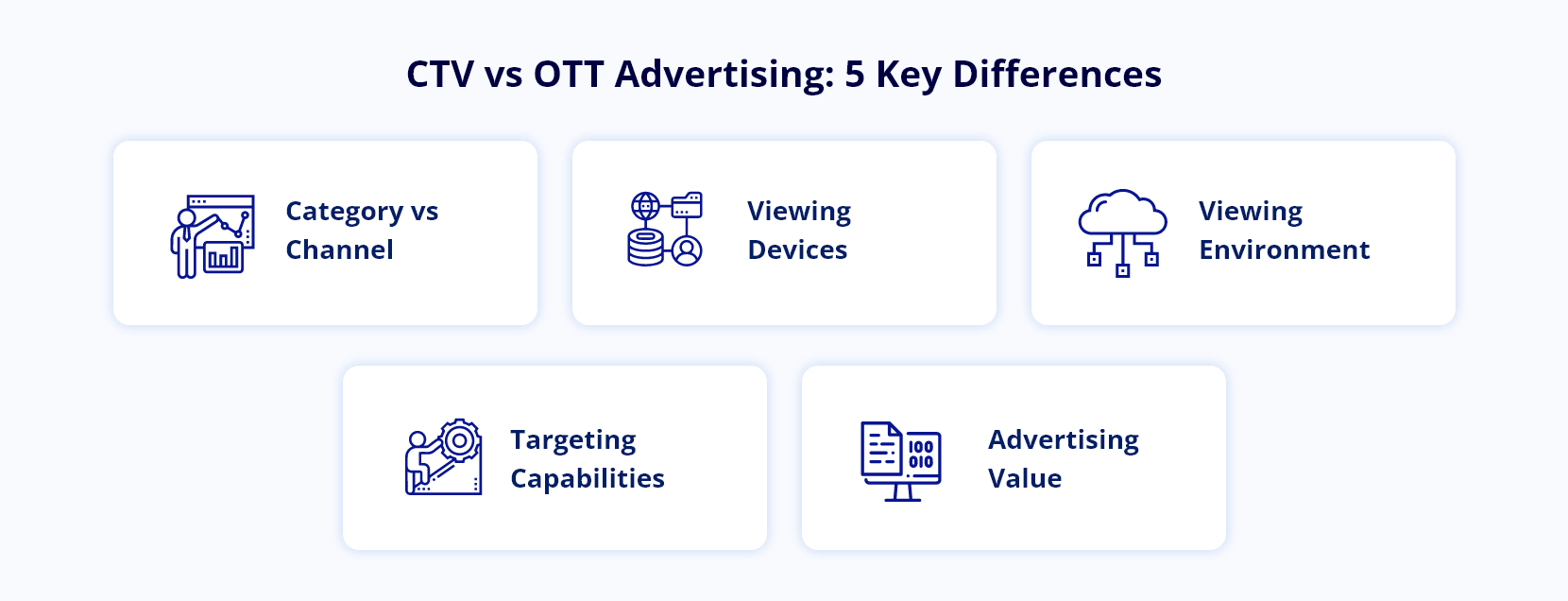
This is the question that trips up even experienced media buyers: OTT is the broader category – any video delivered over the internet, regardless of device. CTV is the subset delivered specifically through connected television screens, smart TVs, streaming devices, and game consoles. All CTV is OTT, but not all OTT is CTV.
| Comparison Area | OTT | CTV |
|---|---|---|
| Delivery | Internet | Internet |
| Devices | Mobile, desktop, tablet, and TV | Smart TV, streaming device, and game console |
| Viewing Context | Cross-device viewing | Primarily connected TV screens |
| Targeting | Digital audience signals | Household, device, content, and audience signals |
| Commercial Implication | Broad digital video category | Premium big-screen advertising environment |
The commercial gap between these two isn’t abstract. It’s the exact gap that let the underpriced-CTV problem happen in the case above – CTV inventory reported inside a broader “OTT” bucket, at OTT-level pricing, when it should have commanded the CTV premium on its own.
Old Way vs. New Way
Put side by side, the commercial differences are significant enough to justify separate pricing and packaging – not four rows on one blended rate card:
| Comparison Area | Linear TV | OTT (non-CTV) | CTV | Addressable TV |
|---|---|---|---|---|
| Reach | Broad, simultaneous | Medium, cross-device | Medium-high, living room | Broad, targeted delivery |
| Targeting | None, same ad to all viewers | Moderate, login and behavioral data | High, household-level targeting | Very high, set-top-box data |
| Priced On | GRPs | Impressions, completion rate | Premium CPM, programmatic buying | Premium pricing layered on linear TV |
| Sold Via | Upfront and scatter markets | Direct and programmatic deals | Programmatic and direct deals | Direct, using linear TV infrastructure |
| Best Proof Point to Advertisers | “This many people in this demographic saw the ad” | “This many viewers completed the ad on this device” | “This household saw the ad” | “This household saw a different ad than another household” |
How to Actually Decide Your Mix
Every guide on this topic stops at explaining what each channel is. The more useful question is which one fits a given goal:
Live or appointment content: sports, awards shows, breaking news – lead with linear, layer in addressable for the households you can target
Proof of individual-level reach needed: lead with CTV, where household-level measurement is native to the buy
Younger or cross-device audience: lead with OTT (non-CTV), priced and measured separately from CTV
Budget certainty months out: linear upfront; budget flexibility for in-season performance → scatter and programmatic CTV
Brand-safe scale plus precision in one buy: CTV is usually the best single answer, at a real cost premium
Getting the mix right is only half the job. CTV inventory and yield management is where that decision gets tested in practice — pricing CTV correctly only matters if delivery and yield actually hold up once the campaign is live.
Case in Point: Unifying the Revenue View Across Channels
A mid-size media company we’ve worked with kept hitting the same wall: ad sales leadership could see total revenue, but not which channel was actually driving it, or which was quietly underpriced. Pricing decisions were being made on the blended number because that was the only number anyone trusted enough to act on.
Challenge: Ad sales leadership could see total revenue but could not identify which channel was underpriced or underperforming – the exact blended-line tax problem described above, playing out in real budget decisions.
What changed: Infocepts helped unify pricing, delivery, and demand data across the company’s linear and digital inventory into one governed view – the same underlying approach AdScape 360 is built to deliver at scale.
Business impact: Pricing gaps between channels became visible for the first time. Upfront-to-scatter decisions moved from a rule of thumb carried over from the prior year to real data. Revenue performance could be evaluated channel by channel instead of through four separate, disconnected reports.
Read those together and the real headline isn’t any single metric – it’s that pricing accuracy and revenue performance improved at the same time. Normally that’s a tradeoff: price more carefully and something slows down; move faster and you lose precision. Here, both moved together, because the slow part and the imprecise part were caused by the same root problem: four channels reported as one number, with no single place to see where they diverged.
From One Unified View to Every Revenue Decision
Ad sales was the starting point, but a unified revenue view isn’t a one-team fix. AdScape 360 is built on exactly this idea: tracking pricing, delivery, and demand signals across linear and digital simultaneously, so the same governed view that catches underpriced CTV inventory also informs the upfront-to-scatter split, the addressable pricing strategy, and the case a sales team makes to an advertiser skeptical of a premium CPM.
Once linear, OTT, CTV, and addressable are priced from one view instead of four, extending that same foundation to the operational side – why streaming changed the ad operations playbook – is a natural next step, not a separate project from scratch.
Frequently Asked Questions
Want to See What a Unified Revenue View Could Show Your Ad Sales Team?
Discover how a unified revenue view can help your ad sales team uncover hidden pricing opportunities, identify underperforming channels, optimize inventory value, and make smarter revenue decisions across Linear TV, OTT, CTV, and Addressable TV.
The Infocepts Media & Entertainment COE helps streaming, publishing, and content businesses harness data to grow audiences and optimize revenue. The team specializes in content analytics, subscriber intelligence, ad tech data, and building the data foundations modern media companies need to compete.
Read Full BioRecent Blogs



Infocepts