
Your data governance framework is probably a slide, not a system. The moment AI pilots start, that gap shows up as conflicting metrics, missing permissions, and a long list of “not sure we can use that data” answers. If you want trusted, AI-ready data across the enterprise, you need more than policies and a committee.
This guide walks through how modern enterprise data governance works in practice: the decisions you have to formalize, the operating model that avoids endless review cycles, and the tooling that lets you move fast without losing control.
Why Enterprise Data Governance Must Change For AI
Most legacy enterprise data governance programs were built to pass audits, not to feed real-time analytics and machine learning models. They focus on static reports, manual approvals, and a small group of experts who act as gatekeepers.
That approach breaks down the second you introduce self-service analytics or AI that depends on constantly changing inputs. You need governance that supports experimentation, not one that freezes every new idea.
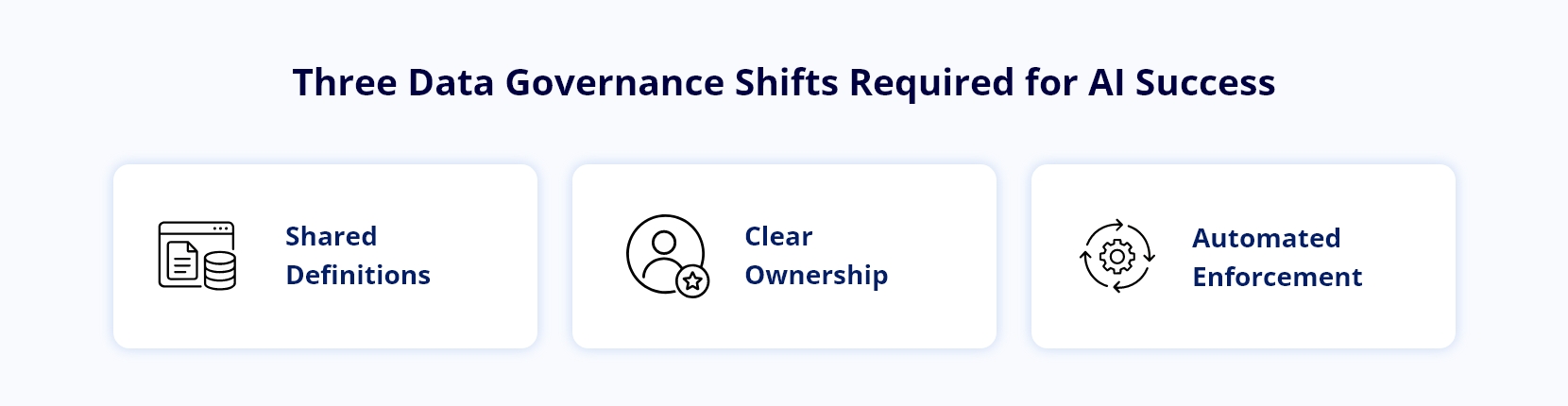
Modern enterprise data governance has three non-negotiables: shared definitions that business teams actually use, clear ownership for critical data, and automated enforcement close to where data is created and consumed.
Core Building Blocks Of A Data Governance Framework
A practical data governance framework is a set of connected decisions: who owns which data, how quality is measured, what access is allowed, and how changes flow into downstream systems. If any of those pieces are missing, you get data chaos dressed up with documentation.
Start by mapping your data domains to real business capabilities: customer, product, finance, operations, people. Then assign accountable owners for each domain, with authority to set rules and the budget to enforce them.
Every domain should agree on a small, visible set of standards that matter: data definitions, quality thresholds, privacy rules, and required controls for high-risk attributes. These become the backbone of your data management framework.
Key Roles And Operating Model
Governance fails when it becomes a side gig. You need a small, named team with time carved out and expectations set in performance reviews. Otherwise, decisions stall and tools sit unused.
At minimum, you need a central governance council to set direction, domain data owners to make trade-offs, data stewards to handle day-to-day rules, and engineering teams to bake controls into pipelines.
Agree upfront which decisions are made centrally and which stay with domains. If everything goes to the council, your data governance strategy will slow projects instead of guiding them.
Policies That Connect To Real Work
Policies people never see might as well not exist. Governance rules need to show up where work happens: in Jira stories, pipeline templates, code reviews, and data product checklists.
For example, your access policy should translate into concrete roles in your warehouse or lakehouse, not a PDF no one reads. Your data governance tools should enforce classification and retention as part of the technical workflow.
Making Data Quality Management Non-Negotiable
Poor data quality doesn’t just skew dashboards; it kills trust in AI outcomes. Once business leaders see one wildly wrong prediction, they start treating every model output as opinion, not evidence.
Effective data quality management is less about perfection and more about transparency. People need to know how reliable a dataset is before they use it, and they need a way to flag issues without opening a six-month project.
Start with a short list of critical data elements that drive key KPIs or AI use cases, then attach explicit quality rules to each: completeness, uniqueness, timeliness, and valid value ranges.
Practical Quality Controls For AI-Ready Data
Quality checks belong as close to data creation as possible. Waiting until the warehouse means you’re triaging issues after the fact, usually under time pressure from a go-live date.
For source systems, embed validations in the UI and APIs so bad values can’t be saved. In pipelines, automate tests for freshness and schema changes before jobs publish to analytics zones.
Most teams underuse the telemetry they already have. Log failed validations, volume spikes, and late-arriving data, then surface that in your data catalog so consumers can see health at a glance.
Using Lineage And Catalogs To Build Trust
AI initiatives fall apart when no one can explain where the data came from or how a feature was engineered. Data lineage is your change history and your safety net when regulations or business rules shift.
Clear data lineage helps you answer three questions fast: what feeds this dashboard or model, who owns those inputs, and what else breaks if we change this field. If you can’t answer those within minutes, you’re guessing in production.
Lineage alone isn’t enough, though. People also need a single place to discover, evaluate, and request access to data that’s already been vetted.
Designing A Catalog People Actually Use
Most data catalogs fail for the same reason corporate wikis fail: no ongoing ownership and no audience in mind. Treat your catalog like a product, not an inventory exercise.
Prioritize a small number of certified datasets tied to real decisions – forecasting, pricing, customer churn – then keep those entries clean, recent, and tagged. That’s how your enterprise data governance program proves value to business teams.
Every certified asset should have clear owners, contact channels, sample queries, data classification, and usage guidance. The more friction you remove up front, the fewer ad hoc Slack threads you’ll drown in later.
Governance For AI And Advanced Analytics
AI changes the risk profile of your data overnight. What used to be “just reporting data” can suddenly feed a recommendation engine, a pricing model, or a chatbot that customers see directly.
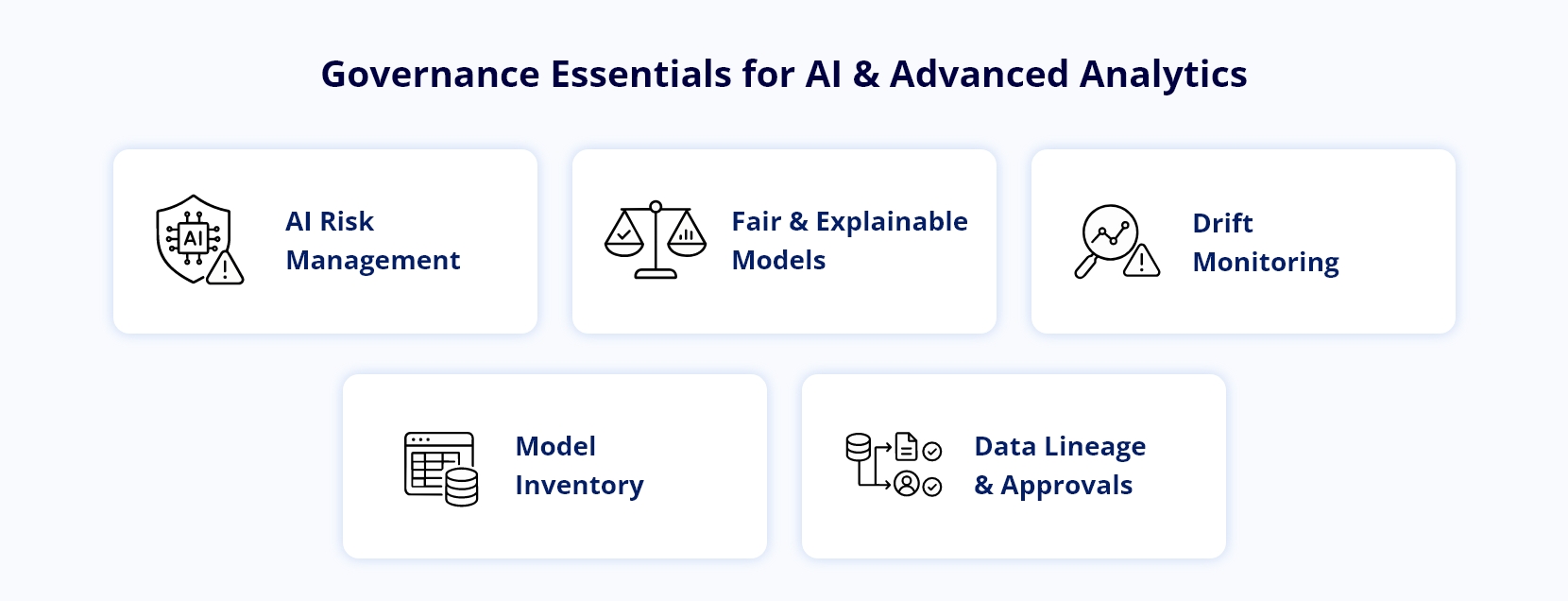
You need a specific AI data governance track that extends your core rules to cover model inputs, model outputs, and the feedback loops that retrain them.
That means thinking through bias, explainability, data retention for training sets, and how you’ll monitor performance drift over time.
Minimum Governance For Model Lifecycles
Don’t try to write a perfect model risk framework from day one. Define a minimum set of controls that apply to every model and raise the bar over time.
At a baseline, keep an inventory of production models, document intended use, track which datasets train each model, and record approvals for high-impact use cases.
This isn’t just good practice. It’s how your data governance consulting partners, auditors, and regulators will expect you to demonstrate control, especially in regulated industries.
Getting From Slideware To Execution
Many companies have beautiful diagrams and almost no change in behavior. The hard work is translating design into daily decisions: who says “no,” who can say “yes,” and which trade-offs are acceptable.
The first step is picking a limited number of use cases where governance will make a visible difference – think revenue forecasting, regulatory reporting, or a flagship customer AI initiative.
For each use case, define the data products involved, map owners, tighten access, and measure impact. This is where your enterprise data governance story shifts from theory to tangible outcomes.
Tooling That Supports The Operating Model
Tools don’t fix governance, but they do set the ceiling on what you can automate. Choose platforms that fit your operating model, not the other way around.
Look for solutions that connect policy to practice: automated access control, column-level lineage, active metadata, and no-code rules for business stewards. These are the traits of effective data governance tools that scale without adding more committees.
Pair technology decisions with training and clear playbooks so engineers and analysts know how to use what you’ve bought, not just where it sits in the architecture slide.
Conclusion
Trusted, AI-ready data doesn’t come from a one-time project. It comes from a data governance framework that balances control with speed, supported by clear ownership, practical rules, and automation where it counts most.
If you treat governance as an enabler for high-value analytics rather than a hurdle, you’ll see adoption rise and firefighting drop. Teams like Infocepts can help, but the real shift happens when your business sees governance as part of how work gets done, not a separate process.
Frequently Asked Questions
Build Governance That Enables AI at Scale
Establish secure, compliant, and trusted data practices for AI success.
Recent Blogs



Infocepts