
Data Foundation First, AI Second: Shashank Garg on Building AI-Ready Enterprises
THE CORE INSIGHT
Artificial Intelligence is transforming every industry, but most organizations are still overlooking the foundation that determines whether AI succeeds or fails: trusted, governed, and business-ready data.
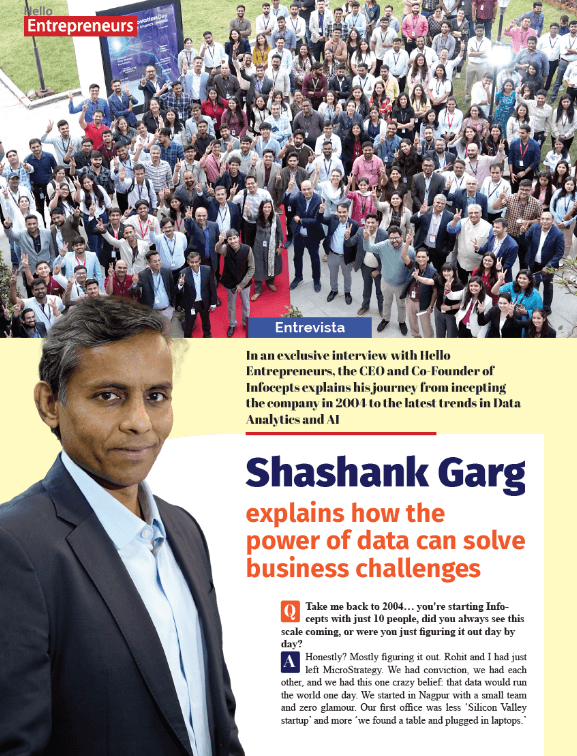
In an exclusive interview with Hello Entrepreneurs, Shashank Garg, Co-Founder & CEO of Infocepts, shares practical lessons from two decades of working with Fortune 500 companies and explains why many enterprises remain stuck between AI ambition and measurable business outcomes.
THE FRAMEWORK: DATA FOUNDATION FIRST, AI SECOND
What It Means
Data Foundation First, AI Second is a principle for enterprise AI deployment. It means establishing data governance, architecture, quality assurance, and organizational readiness before deploying any AI systems.
The alternative – rushing to AI while data infrastructure is fragmented – leads to models trained on messy data, confidently producing incorrect answers at machine speed.
Why It Matters
The quote that captures this best:
“The thing most CXOs still miss: AI is only as smart as the data feeding it. You can’t buy the fanciest AI model in the market and pour messy, untrusted, siloed data into it and expect magic. What comes out will be confident gibberish delivered at machine speed. Data foundation first. AI on top. In that order. Always.” Shashank Garg
THE PROBLEM: DATA-RICH BUT INSIGHT-POOR
Drawing on more than two decades of experience helping enterprises turn data into business value, Shashank highlights a paradox facing organizations today:
“The gap between ‘data-driven’ on a slide and ‘data-driven’ in a Monday morning meeting is enormous. First, they drown in dashboards. We’ve seen clients with 400 dashboards, and nobody opening most of them. At Infocepts, we call it being ‘data-rich but insight-poor.” Shashank Garg”
This perspective aligns closely with how Infocepts helps organizations modernize their data and AI ecosystems. Through solutions spanning Data Platforms, Data Engineering, Business Intelligence & Analytics, Artificial Intelligence, and Agentic AI, Infocepts enables enterprises to transform disconnected data into trusted intelligence that accelerates decision-making and business growth.
THE INTERVIEW: KEY TOPICS
In the full interview with Hello Entrepreneurs, Shashank Garg addresses:
Why Do AI Projects Fail?
Most enterprises skip the data foundation phase, jumping straight to AI pilots. The result: high-confidence models trained on messy, untrusted data – producing bad decisions at machine speed.
The Role of Data Governance in AI Success
Governance isn’t compliance theater. It’s the structural layer that ensures data is trustworthy, lineage is clear, and AI models operate within understood constraints. Governed data is the only data that should feed production AI systems.
Agentic AI: What’s Coming Next
Shashank discusses the emergence of agentic AI – autonomous systems that make decisions and take actions based on data – and why governance becomes even more critical as these systems scale.
The Skills Gap in AI-Driven Economies
Building AI-ready enterprises requires more than data engineers. It requires teams that understand both data infrastructure and business outcomes – people who can bridge the gap between “we have dashboards” and “we make better decisions.”
How to Avoid Costly Business Decisions
Data-driven insights should reduce uncertainty in decision-making. Shashank explains how enterprises can use analytics and AI to de-risk major business decisions – from M&A due diligence to market expansion to product launches.
Finding New Growth Opportunities
Beyond risk mitigation, trusted data infrastructure enables enterprises to identify new growth opportunities faster — in customer behavior, market trends, operational efficiency, and competitive positioning.
——————-
FREQUENTLY ASKED QUESTIONS (FAQs)
What does ‘Data Foundation First‘ mean in practice?
It means establishing data governance, data quality, modern architecture, and organizational readiness before deploying AI systems. In practice: clear ownership of data assets, documented lineage, quality rules, security controls, and team alignment on how data is used. Only after these foundations are in place should you build analytics platforms or AI systems on top.
How do you diagnose “data-rich but insight-poor” in your organization?
Signs include:
(1) You have 50+ dashboards but rarely use most of them,
(2) It takes 4–6 weeks to answer basic business questions,
(3) Different departments report different numbers for the same metric,
(4) Your dashboards are full of data but light on decisions or actions,
(5) Analytics projects take longer than expected because of data quality issues.
What’s the relationship between data governance and AI success?
Governance ensures data is trustworthy, traceable, and compliant before it feeds AI systems. Without it, AI models inherit data problems and amplify them. Governed data means: clear ownership, documented lineage, quality assurance, access controls, and compliance tracking. When governance is in place, AI systems can be deployed faster and with lower risk.
How long does it take to build a data foundation for AI?
Timeline depends on complexity and current state. A readiness assessment takes 2–4 weeks. A pilot data modernization program takes 3–6 months. Enterprise-wide foundation build-out takes 12–18 months. But most enterprises start seeing business impact within 6–12 months if they prioritize the foundation first.
Where do most enterprises go wrong with AI?
Three common mistakes:
(1) Deploying AI before data foundation is ready,
(2) Building point solutions instead of platforms (ending up with 400 dashboards),
(3) Not treating data governance as a business imperative. The winners do the opposite: foundation first, then AI, then at-scale deployment.
Can you retrofit governance into existing AI systems?
Yes, but it’s harder and more expensive than building it in from the start. You end up auditing historical decisions, rebuilding models with better data, and adding controls retroactively. It’s possible but painful. The “Data Foundation First” approach avoids this cost.
How does Infocepts help enterprises build AI-ready data foundations?
We deliver across Data & AI Strategy (assessment and roadmap), Data Modernization (architecture, engineering, governance, quality), Business Analytics (platform design and implementation), and AI services (platform development, governance, responsible AI). We help enterprises move from “data-rich but insight-poor” to “data-driven decision-making” with measured outcomes and long-term sustainability.
WHAT THIS MEANS FOR YOUR ORGANIZATION
If you recognize your organization in the “data-rich but insight-poor” diagnostic, the path forward starts with a data foundation assessment.
Schedule a Discovery Call
Let’s audit your current data landscape, identify your biggest foundation gaps, and outline a phased approach to building AI-ready infrastructure.