


How life sciences leaders move from experimentation to measurable outcomes – without losing trust, compliance, or adoption.
Why “AI pilots” aren’t the story anymore
Over the last year, the pharma conversation matured. The question isn’t “What did we pilot?” It’s “What’s running in the business and how do we control it?”
That shift matters because the biggest value leak in AI programs is not model performance rather it’s the gap between a working proof-of-concept and a capability that delivers outcomes across functions, markets, and audits.
In pharma, this gap compounds quickly. When AI doesn’t scale, teams fall back to manual work and fragmented views across discovery, clinical, quality, commercial, and patient operations – precisely where shared context is most needed.
From dashboards to decision intelligence
For years, most pharma analytics investment has culminated in dashboards – descriptive views of what already happened. While useful, dashboards rarely answer the most important question leaders face: what should we do next, and why?
Decision intelligence represents a shift from static reporting to AI‑assisted decision‑making. It brings together governed data, analytics, and machine learning to prioritise actions, explain recommendations, and embed guidance directly into day‑to‑day workflows – so decisions are traceable, reviewable, and safe to act on in regulated environments.
In pharma, this matters because decisions rarely sit within a single function. A launch adjustment affects market access, field execution, and patient support. A manufacturing signal influences quality, supply, and regulatory risk. Decision intelligence connects these choices with shared context – rather than leaving teams to interpret disconnected dashboards in isolation.
Why AI stalls in pharma: 3 limitations pilots don’t address
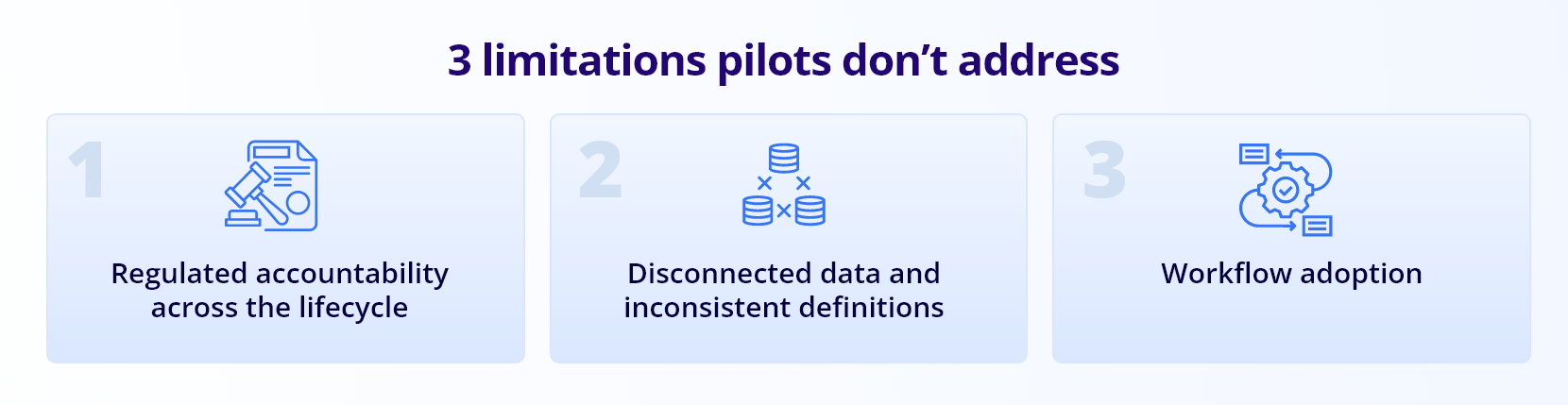
Most pilots succeed because they live inside a narrow lane. Production AI must survive three constraints that leaders deal with every day:
1. Regulated accountability across the lifecycle
Regulators are pushing lifecycle thinking – how models are designed, documented, monitored, and updated over time. The FDA has been explicit about lifecycle management expectations for AI-enabled software functions, including transparency and bias considerations.
2. Disconnected data and inconsistent definitions
Life sciences organizations are often data-rich but not “decision-ready” because functions operate with different datasets and different definitions. Infocepts frames this as a connected intelligence problem: teams need shared context across commercial, medical, market access, and patient operations – not more isolated dashboards.
3. Workflow adoption
AI doesn’t scale through dashboards alone. It scales when insight is embedded into the systems people use daily – CRM, patient support tools, medical operations workflows, and quality routines. This “operationalized, not theoretical” standard is central to how Infocepts describes real adoption in life sciences.
The future isn’t one use case – it’s connected intelligence across the value chain
The next phase of AI in pharma won’t be won by the team with the most pilots. It will be won by the team that connects decisions end-to-end: discovery informs trial design; trial evidence informs regulatory and access; manufacturing quality informs supply reliability; medical insights shape engagement; patient operations close the loop on persistence and outcomes.
This “connected intelligence layer” framing is also how Infocepts organizes life sciences capabilities across commercial, medical affairs, market access, patient operations, and data platform modernization.
A practical distinction: Dashboards show what happened. A connected intelligence layer enables decision intelligence – helping teams decide what to do next with prioritisation, explainability, and governance built in.
The connected intelligence layer is the foundation; decision intelligence is how value is realised across the pharma lifecycle.
Six shifts’ leaders are making, balanced end-to-end
In discovery, near-term value comes from shortening the cycle between hypothesis and next experiment by structuring evidence, improving access to relevant knowledge, and making decisions more repeatable. Industry leaders have pointed out that AI outcomes depend on workflow redesign – not adding tools on top of existing processes.
What changes in practice: decision checkpoints become explicit (what evidence is required, who approves, and how decisions are logged for reuse).
Clinical teams are under pressure to show operational impact: better planning cycles, faster iteration, and fewer delays caused by slow analytics. Multiple industry perspectives describe 2026 as a point where AI must produce concrete operational outcomes in trials, not just experimentation.
One example of “operational AI” is
modernising the analytics backbone that supports clinical operations and planning decisions . Infocepts’ life sciences case study on Migrating SAS Workflows to Dataiku reports lower analytics costs and significantly faster simulation runtimes – so insights arrive in time to influence decisions.
Regulatory guidance is increasingly emphasising lifecycle rigor. The FDA’s lifecycle orientation emphasizes how AI is managed over time, and the EMA outlines a structured approach to enabling AI while managing risk across guidance, tools, change management, and experimentation.
What changes in practice: intended use is defined early, and auditability is engineered in (lineage, access controls, monitoring, and change control).
In manufacturing and quality, AI earns its place when it helps detect issues earlier, speed root-cause analysis, and strengthen quality decisions. Pharma digital transformation discussions increasingly emphasize practical implementation: validation approaches, smart quality decisions, and disciplined scale.
What changes in practice: quality analytics evolves from reporting to decision support – grounded in data integrity and governance so actions are defensible.
In commercial and market access, timing is the advantage. Launch performance is shaped early, and the best teams treat launch as an intelligence program: account profiling, payer visibility, and claims feedback loops that surface access friction quickly. Infocepts’ launch and market access approach frames this as pre-launch intelligence plus real-time claims analytics.
What changes in practice: launch intelligence begins at Day – 90, connecting payer + claims + field execution so reallocation happens weekly, not quarterly.
Medical affairs is moving from activity reporting to scientific intelligence: identifying and segmenting KOLs at scale, tracking emerging themes across publications and congress outputs, and linking engagement to downstream patterns. Infocepts describes this shift through unified medical affairs intelligence and AI-enabled content and KOL insights.
On the patient side, the opportunity is prioritization and focus. Infocepts’ patient support approach describes real-time adherence risk scoring embedded into Salesforce workflows and connected order management for complex therapies – so teams spend time where it changes outcomes.
Industry momentum: what’s been clear since late 2025
A quick reality check on where the market is going comes from what leadership forums have been emphasizing:
· ISPE Annual Meeting (Oct 2025): Readiness, validation, and data integrity as AI moves into operations.
· ISPE Pharma 4.0 (Dec 2025): Case studies tied to compliance, quality decisions, and implementation discipline.
· HLTH (Oct 2025): Broad reporting on the shift from hype to practical objectives and accountable deployment.
· Pharma Meets AI (Apr 2026): A lifecycle-balanced agenda – discovery, clinical trials, commercial, and regulatory and ethical considerations in one forum.
What leaders should measure
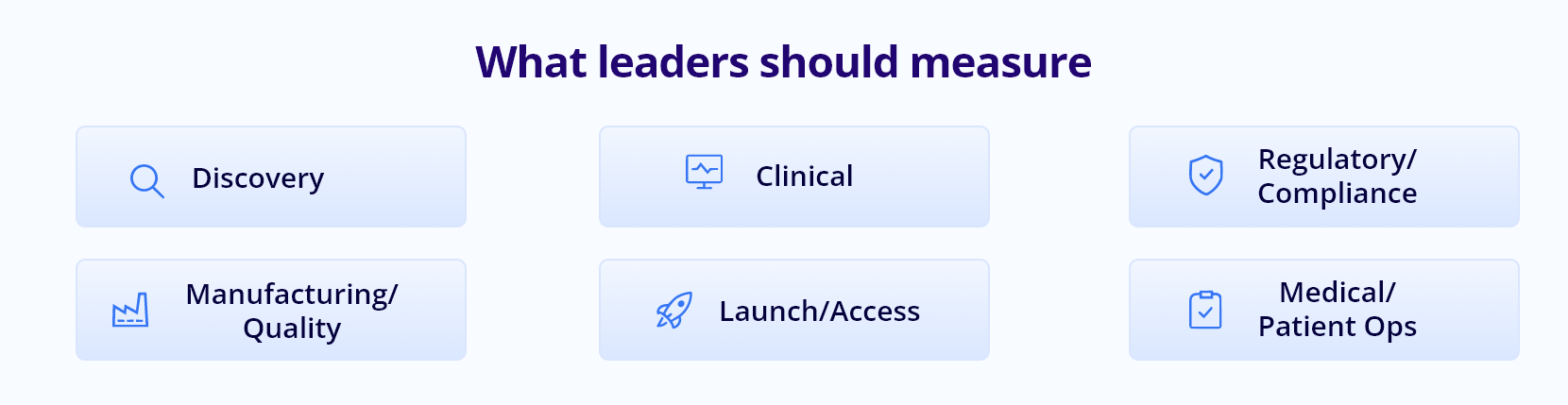
The strongest AI programs don’t stop at model performance. They measure operational and business outcomes across the lifecycle:
· Discovery: cycle time from hypothesis to experiment decision; reuse of evidence.
· Clinical: simulation runtime; time-to-insight for planning decisions.
· Regulatory/Compliance: traceable lineage; monitored performance; controlled change.
· Manufacturing/Quality: earlier detection; faster investigations; better quality decision confidence.
· Launch/Access: time to detect payer friction; speed of response to claims patterns.
· Medical/Patient Ops: workflow adoption; measurable adherence or operational efficiency gains.
How Infocepts helps
Infocepts supports life sciences organizations with a connected intelligence layer across commercial, medical affairs, market access, and patient operations – built for regulated environments and tied to measurable outcomes.
Want to see how Infocepts does this, click here.
AI in pharma is entering its operational phase. The winners won’t be the teams with the most pilots. They’ll be the teams that connect decisions across the lifecycle, build governed foundations, and embed decision intelligence into daily work so adoption and accountability scale together.
If you’re planning priorities across discovery, trials, manufacturing, launch, medical, or patient operations, Infocepts can help you identify the highest‑value decision loop, stand up the governed data layer, and operationalise workflows that drive measurable outcomes.
Book a Life Sciences AI working session with us.
See how pharma operationalizes AI across the value chain with governance and scale.

Bashdar Ismaeel brings over 25 years of experience across life sciences and healthcare, working at the intersection of data, AI, and advanced analytics. He partners with pharmaceutical and healthcare organizations to design and deliver intelligent, scalable solutions that connect R&D, medical...
Read Full BioRecent Blogs



The Enterprise AI & Data Transformation Partner. Delivering measurable business impact globally.
#1 on Gartner Peer Insights · 97.2% client retention