
The execution gap: Retail’s most expensive blind spot
Every major retailer has a strategy. Most have invested in analytics. Many have adopted cloud data platforms, demand forecasting models, and customer segmentation tools. Yet when it comes to AI store operations, walk into any store in any market, and the gap between what headquarters planned and what the store floor actually looks like remains one of the most persistent and costly problems in the industry.
This is the execution gap – the disconnect between strategic intent and in-store reality. Planograms are designed with precision in corporate offices but executed inconsistently across hundreds of locations. Promotions are negotiated with CPG partners and launched with marketing spend, only to fail at the shelf because pricing labels were never updated or promotional displays were never built. Store audits are scheduled quarterly but staffing pressures mean they’re often rushed, incomplete, or skipped entirely.
The financial toll is enormous. Beyond the direct cost of stockouts and missed promotions, the execution gap creates a compounding tax on every other investment a retailer makes. Marketing spend drives customers to stores where products aren’t available. Supply chain investments optimize delivery to stores where the product sits in the back room instead of on the shelf. Technology investments generate insights that arrive too late to be actionable.
At NRF 2026: Retail’s Big Show, the theme of “The Next Now” addressed this challenge directly. The newly launched AI Stage dedicated sessions to how retailers can move from AI experimentation to AI execution – a distinction that resonated deeply with operations leaders who have seen pilots succeed in controlled environments but fail to scale across real store networks.
Why manual store audits are fundamentally broken
The traditional store audit has been the primary mechanism for verifying in-store execution for decades. A district manager or field representative walks the store, checks displays against planograms, verifies pricing accuracy, notes stockouts, and files a report. This process has several structural problems that no amount of training or process improvement can fix.
- First, the coverage problem: A typical store audit covers a sample of the store, not the entire selling floor. Even a thorough audit might examine 20–30% of total shelf space in a given visit. Products outside that sample are invisible until the next visit.
- Second, the frequency problem: Most stores receive formal audits monthly or quarterly. In the days and weeks between audits, execution drifts without detection or correction.
- Third, the consistency problem: Human auditors bring subjective judgment to what constitutes compliance. One auditor might flag a minor planogram deviation; another might consider the same deviation acceptable. This variability makes it impossible to compare execution quality reliably across stores, regions, or time periods.
- Fourth, and most critically, the latency problem: Even when an audit identifies an issue, the finding must be documented, communicated to the right person, and acted upon. This cycle – from observation to resolution – can take days or weeks for routine issues. By the time the fix is implemented, the business impact has already occurred.
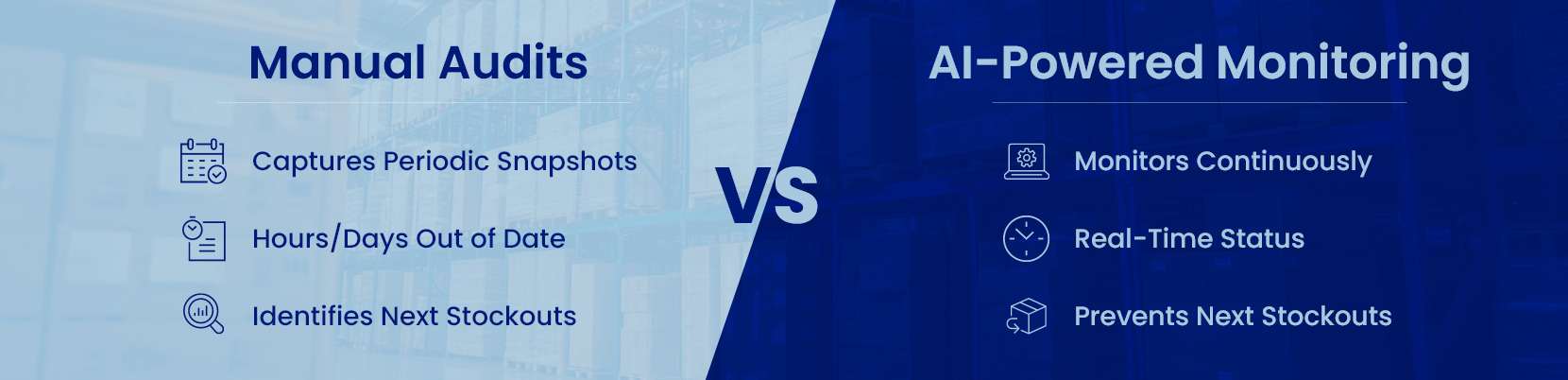
These limitations were a recurring theme at Shoptalk Spring 2026, where sessions on technologies driving operational efficiencies highlighted how AI is replacing sample-based, periodic auditing with continuous, comprehensive monitoring. The shift from “we check stores sometimes” to “we see every shelf all the time” represents a fundamental transformation in how retail operations work.
The AI store operations revolution: Computer vision meets predictive analytics
The technology that makes continuous store monitoring possible is the convergence of three capabilities: computer vision for shelf-level perception, predictive analytics for anticipating issues before they materialize, and generative AI for translating detections into actionable guidance for frontline teams.
Computer vision models trained on retail environments can analyze shelf images – captured from fixed cameras, mobile devices, or even associate smartphones – and instantly identify stockouts, low facing counts, misplaced products, incorrect pricing labels, and planogram deviations. Unlike human auditors, these models operate at 100% coverage and never fatigue. Every image captures the complete state of the shelf, and the analysis happens in seconds rather than hours.
Predictive analytics extends the value from detection to prevention. By correlating shelf-level data with POS trends, inventory signals, promotional calendars, and historical patterns, AI models can forecast which products in which stores are at risk of stocking out before the shelf actually empties. This shifts the operational paradigm from reactive (fixing problems after they occur) to proactive (preventing problems before they happen).
OptiStoreAI integrates all three capabilities into a single platform, built on the Databricks Data Intelligence Platform. The Databricks lakehouse architecture handles the data engineering challenge of ingesting and unifying heterogeneous data sources – structured POS data, semi-structured inventory feeds, and unstructured image data – into a single analytical layer. Databricks’ compute infrastructure provides the processing power for real-time AI model inference, while Unity Catalog ensures governance, data quality, and compliance across the entire data pipeline.
The Databricks Data + AI Summit 2025 highlighted how leading retail and CPG companies are building real-time data products that unify demand signals with shelf-level observations. The Retail & Consumer Goods Industry Experience at the summit featured sessions from PepsiCo, Skechers, and Five Below demonstrating how lakehouse architectures enable exactly this kind of cross-domain data fusion for operational intelligence.
Guided workflows: Turning intelligence into consistent action
The most sophisticated detection system is useless if the insight never reaches the person who can act on it, or if it reaches them in a form they cannot easily act upon. This is where many technology solutions fail – they produce dashboards and reports that add to the information overload rather than cutting through it.
OptiStoreAI takes a fundamentally different approach by embedding intelligence into the workflow. When the platform detects an issue – a stockout on a high-velocity SKU, a promotional display that doesn’t match the planned execution, a pricing label that conflicts with the current promotion – it does not simply log the observation. It triggers a prioritized task, assigns it to the appropriate store associate, and routes it through the workforce management system the associate already uses every day.
The generative AI component adds context that transforms a raw alert into an actionable task. Instead of telling an associate “Aisle 7, bay 3 has a stockout,” the platform can provide: “Aisle 7, bay 3: Brand X cereal out of stock. 24 units in back room as of last receiving. Suggested action: replenish from back room, verify shelf tag matches current promo price of $3.99.” This level of specificity dramatically improves task completion rates and reduces the time from detection to resolution.
The platform then tracks whether the task was completed, how long it took, and whether the issue was actually resolved. This creates an auditable trail that operations leaders can use to identify systemic patterns – stores that consistently struggle with replenishment timing, product categories that are chronically understaffed on the shelf, or promotional executions that repeatedly fail at specific locations.
Industry momentum: What leading events and forums are saying
The shift from manual to AI-driven store operations is not a fringe idea – it is rapidly becoming the industry consensus. A review of the major retail and CPG conferences and forums reveals a clear trajectory toward intelligent store execution.
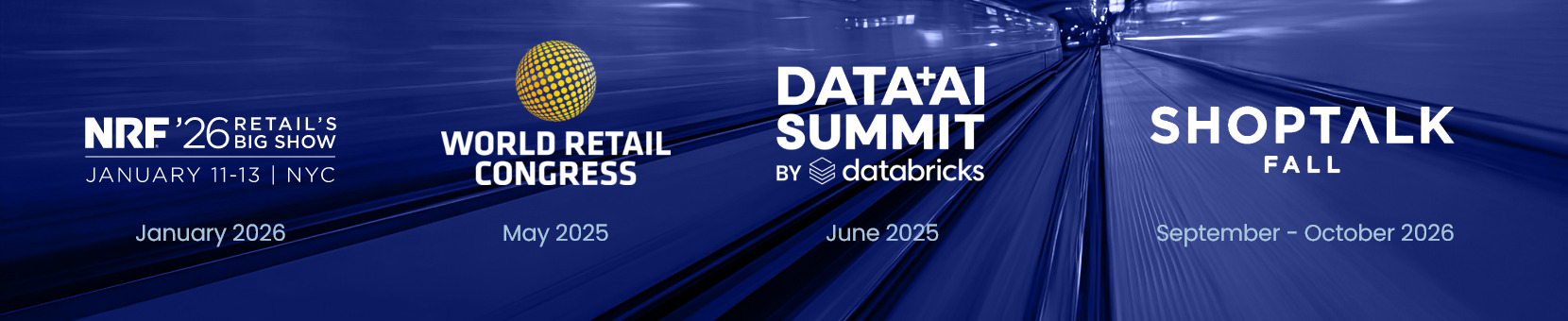
NRF 2026 (January 2026, New York) gathered over 40,000 retail professionals with AI as the dominant theme across all tracks. The new AI Stage was dedicated entirely to helping retailers move AI from concept to production. The World Retail Congress 2026 (themed “Retail’s Roadmap to 2030”) convened over 1,000 senior executives focused on the drivers of growth, with technology and operational models as core pillars. Shoptalk Spring 2026 (March 2026, Las Vegas) was themed “Retail in the Age of AI” with sessions on agentic commerce, operational efficiency technologies, and building next-generation shopping experiences.
The Databricks Data + AI Summit 2025 (June 2025, San Francisco) brought over 20,000 data and AI practitioners together, with a dedicated Retail & Consumer Goods Industry track featuring sessions on demand sensing, shelf intelligence, and AI agent systems for retail. The 2025 theme of “Data Intelligence for All” directly addressed the challenge of democratizing AI-driven insights across the organization – from data scientists to store associates.
Looking ahead, the Databricks Data + AI Summit 2026 (June 2026, San Francisco) is expected to expand its retail-specific programming with sessions on agentic AI, AI/BI, and real-time data applications. Groceryshop 2026 (September 2026, Las Vegas) and Shoptalk Fall 2026 (September–October 2026) will continue to spotlight store execution, AI-driven operations, and the convergence of physical and digital retail.
Building the business case: ROI of AI store operations
The financial case for AI-driven store operations rests on multiple value drivers that compound across the store network. Direct revenue protection comes from reducing stockouts and ensuring promotional compliance. Operational efficiency comes from automating audit processes and reducing the manual effort required for compliance verification. Labor optimization comes from replacing time spent on inspection with time spent on execution.
OptiStoreAI’s documented results provide a concrete baseline: 40% faster store audits, 75% reduction in manual effort, 50% improvement in task completion accuracy, and 25% increase in in-store execution efficiency. For a mid-size retailer operating 300 stores, these improvements translate to thousands of labor hours recovered, millions in prevented revenue leakage, and a measurable uplift in same-store sales driven by improved product availability and promotional execution.
The deployment model further strengthens the business case. OptiStoreAI works with existing infrastructure – smartphones, handheld devices, and in-store cameras that retailers already own. There is no requirement for specialized hardware, which means the initial investment is primarily in platform integration and configuration rather than capital expenditure on new equipment. Cloud or on-premise deployment options provide flexibility to match the retailer’s existing IT architecture.
Enterprise-grade security, role-based access controls, and compliance with organizational security standards ensure that the platform meets the requirements of large-scale retail deployments. The Databricks foundation provides additional confidence for organizations that have already invested in lakehouse architecture – OptiStoreAI extends the value of their existing data platform investment into a new operational domain.
The future of store operations is already here
The retail industry is at an inflection point. The manual, periodic, sample-based approach to store execution that has persisted for decades is being replaced by continuous, comprehensive, AI-driven monitoring and guided execution. The technology is mature, the business case is clear, and the competitive pressure is accelerating.
Retailers who invest in AI-powered store operations today are not just solving an operational problem – they are building a structural advantage. Every day of real-time shelf data they collect makes their predictive models more accurate. Every workflow cycle they complete refines their execution playbooks. Every issue they prevent rather than react to protects revenue that competitors are still losing.
The question for retail leaders is no longer whether to adopt AI for store operations. It is how quickly they can deploy a platform that delivers measurable results at scale, integrates with their existing technology stack, and empowers their frontline teams to execute with consistency and confidence. OptiStoreAI, built on the Databricks Data Intelligence Platform, is designed to answer that question.
The execution gap has been retail’s most expensive blind spot for decades. The convergence of computer vision, predictive analytics, generative AI, and unified data platforms like Databricks has finally made it solvable. The retailers who act now will define the next era of store performance. The rest will continue to count the cost of empty shelves.
Ready to eliminate blind spots in your store operations?
See how OptiStoreAI transforms retail execution

Nidhi Varshney is a Delivery Lead for Retail & Commerce at Infocepts, partnering with leading retailers to turn data and AI investments into measurable business outcomes. She brings deep expertise in driving large-scale digital transformation engagements across the retail value chain.
Read Full BioRecent Blogs



Infocepts