
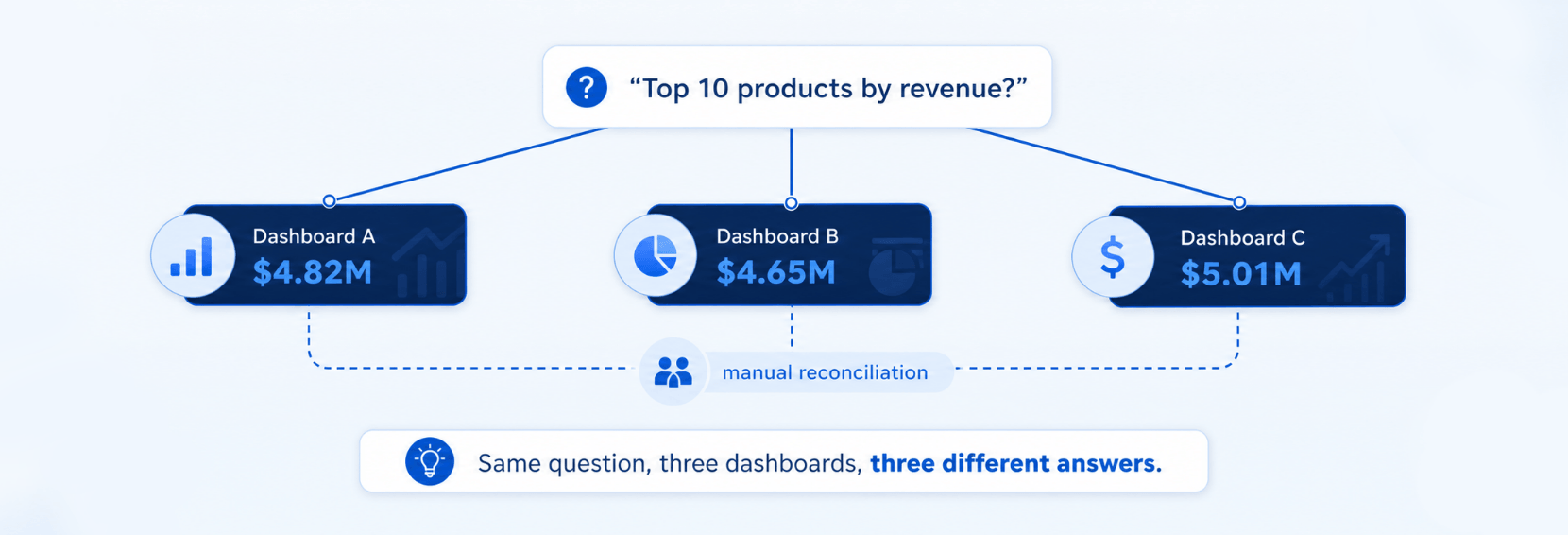
Ask three people on a luxury retail leadership team which pieces are actually selling at full price this season, and if your company is like most, you will get three different answers, from three different dashboards, none of which quite agree, and all of which took someone the better part of a day to assemble. That is not a data problem and a problem of governed semantic layer. That is a translation problem: the business speaks in “sell-through” and “top pieces,” the systems speak in table joins and column names, and somebody has to sit in the middle doing that translation, by hand, every single time.
Here is the direct fix: retail and CPG sales and inventory teams get faster, trustworthy answers by putting a governed semantic layer between their raw data and everyone who needs to ask it a question. A semantic layer defines each metric (revenue, margin, sell-through, year over year growth) exactly once, in the business’s own language, then lets an AI assistant answer plain-English questions against those definitions directly. No more many dashboards that each define “revenue” a little differently. One trusted number, one translator, answers in seconds instead of days.
The multiple-dashboard tax
Picture a Monday morning sales meeting at a large luxury retailer. Someone asks how a newly refreshed boutique is performing against the rest of its region. The room goes quiet, then someone says “let me pull that,” and pulling that means opening multiple dashboards, cross-checking the numbers in a spreadsheet because nobody fully trusts any one of them, and circling back with an answer two days later, by which point the meeting has moved on three times.
This is what we would call the multiple-dashboard tax, and it shows up everywhere in retail leadership:
The same question lives in several different tools, none of which agree, so someone has to reconcile them by hand.
Teams do not trust the dashboards enough to act without a spreadsheet double-check, which defeats the purpose of having dashboards.
The report answers last quarter’s question, not this quarter’s follow-up, so a new question means a new ticket.
Every new cut of the data needs someone who can write SQL, so every business question waits in a queue behind someone else’s
“What happens to revenue if we hold full price two more weeks” is a manual modeling exercise, not something anyone can just ask
None of this is because your team lacks tools. It is usually the opposite: too many tools, each with its own private definition of “revenue,” and no one place where “revenue” simply means one thing.
What luxury retail is actually solving for in 2026 and 2027
The multiple-dashboard tax stings more now than it did five years ago, because the questions have gotten harder and the clock has gotten faster. Heading into 2026 and 2027, sales and inventory leaders in luxury and premium retail are wrestling with a familiar short list:
-
- Protecting full-price sell-through: In luxury, margin lives on full-price sales. Catching a slow-moving line while there is still time to act, not after markdown season, is the whole game.
- Reacting to regional and channel demand that moves faster than the buy: Demand shifts between regions, boutiques, wholesale, and online mid-season. The buy was locked months ago. The gap is where margin leaks.
- Knowing true margin, not gross: Returns, discounts, and channel mix quietly reshape which categories are actually profitable. Leaders need the net picture, not the flattering one.
- Proving the ROI of store and experience investment: Renovations, clienteling, and new formats cost real money. Leaders are under pressure to show they pay back, in-season, not a year later.
- Forecasting past gut feel: Committing next quarter’s buy by region on instinct is expensive when it is wrong. The ask now is for forecasts anyone can interrogate, not a black box.
Every one of these is a question, not a report. And a question you have to wait two days for is a question you stop asking. That is exactly the behavior a semantic layer is built to change.
What a semantic layer actually is
A semantic layer is the translator that sits between your raw data and everyone who needs to ask it a question. It takes messy warehouse tables and turns them into business terms (revenue, profit margin, sell-through, conversion rate), each defined once, with the synonyms people actually use (“top pieces,” “best performers,” “hero products” all pointing at the same underlying metric).
Think of it like a good interpreter at a meeting between two companies that do not share a language. Nobody wants the interpreter to be creative. Everybody wants the same sentence translated the same way every time, no matter who is asking or which side of the room they sit on.
That consistency is the entire point: once “revenue” is defined once, in the semantic layer, everyone downstream (a dashboard, a report, an AI assistant) inherits that one definition instead of quietly reinventing it.
From a query to a conversation
A semantic layer by itself is still something only an analyst can query directly. The second half of the fix is putting a natural-language AI assistant on top of it, so a sales head can just ask, “which regions are growing fastest year over year,” and get a trustworthy answer back in seconds, because the assistant reads from the same governed definitions everyone else uses, rather than guessing at what “growth” means from scratch.
It helps to picture a good translator with a good dictionary at their side. Without the dictionary (the semantic layer), a fluent-sounding assistant can still mistranslate a business term with total confidence. With it, the assistant checks every answer against a single agreed source before it says a word. That pairing, natural language on the front and governed definitions underneath, is what turns “let me pull that” into “here is your answer,” without anyone losing trust along the way.
Old way vs. new way
| Comparison Area | Dashboards + Manual Checks (Old Way) | Semantic Layer + AI Assistant (New Way) |
|---|---|---|
| Time to answer | Hours to days, plus an IT queue | Seconds |
| Trust in the number | Cross-checked manually, often disputed | Built in, one certified definition |
| New question? | New report, new ticket | Just ask, no dashboard required |
| Forecasting & what-ifs | Manual, error-prone modeling | Built-in scenario answers on demand |
| Who can get an answer | Whoever can write SQL | Any business user, in plain English |
| BI tool adoption | ~25 to 30% of employees | 2 to 3 times higher |
A real proof of concept: a US luxury retailer
A US luxury retailer’s leadership team kept hitting the same wall: routine questions about top products, regional growth, and how renovated stores compared to the rest took days of dashboard navigation and analyst requests to answer. With store renovations underway and significant decisions riding on the comparison, “we will have an answer by Thursday” was not good enough.
Infocepts built a governed semantic layer covering Sales and Inventory, with every key metric (revenue, margin, growth) defined once, in the language leadership already used, and organized the way the business actually thinks: by product, store, region, channel, and fiscal calendar. On top of that, an AI assistant let any stakeholder ask their question in plain English and get a trusted, decision-ready answer back. No report to hunt for, no ticket to raise, no analyst queue.
The result, in the leadership team’s own words: what used to take days now takes seconds, renovation ROI is visible in-season rather than after the fact, and pricing scenarios that used to be manual exercises are now a question away.
See a related customer-side result in From Mass Marketing to Micro-Moments, where the same governed-definition approach powered real-time segmentation.
Reported outcomes from this engagement, a four-week proof of concept:
1. Days to seconds:
for routine leadership questions, with no more waiting on dashboard navigation or analyst requests.
2. In-season renovation ROI visibility:
Renovated vs. non-renovated store performance by region and channel, available on demand instead of after the fact.
3. Data-backed pricing and assortment decisions:
Highest-margin products and regional best-sellers surfaced instantly, replacing gut feel.
4. Built-in forecasting:
Next month’s sales and next quarter’s revenue by region, plus pricing what-ifs, modeled before decisions are made.
5. 2 to 3 times increase in data-driven adoption:
A natural-language assistant removes the usual barriers to BI adoption: training, navigation, and waiting.
Read those together and the real headline is not any single number. It is that speed and trust improved at the same time. Normally you expect a trade-off: answer faster and something gets looser; trust the number more and someone slows down to double-check it. Here, the same fix, one governed definition asked in plain English, delivered both, because the slow part and the untrustworthy part were the same root cause: too many private versions of “revenue,” with no one place where they were reconciled.
From one governed layer to every intelligence pillar
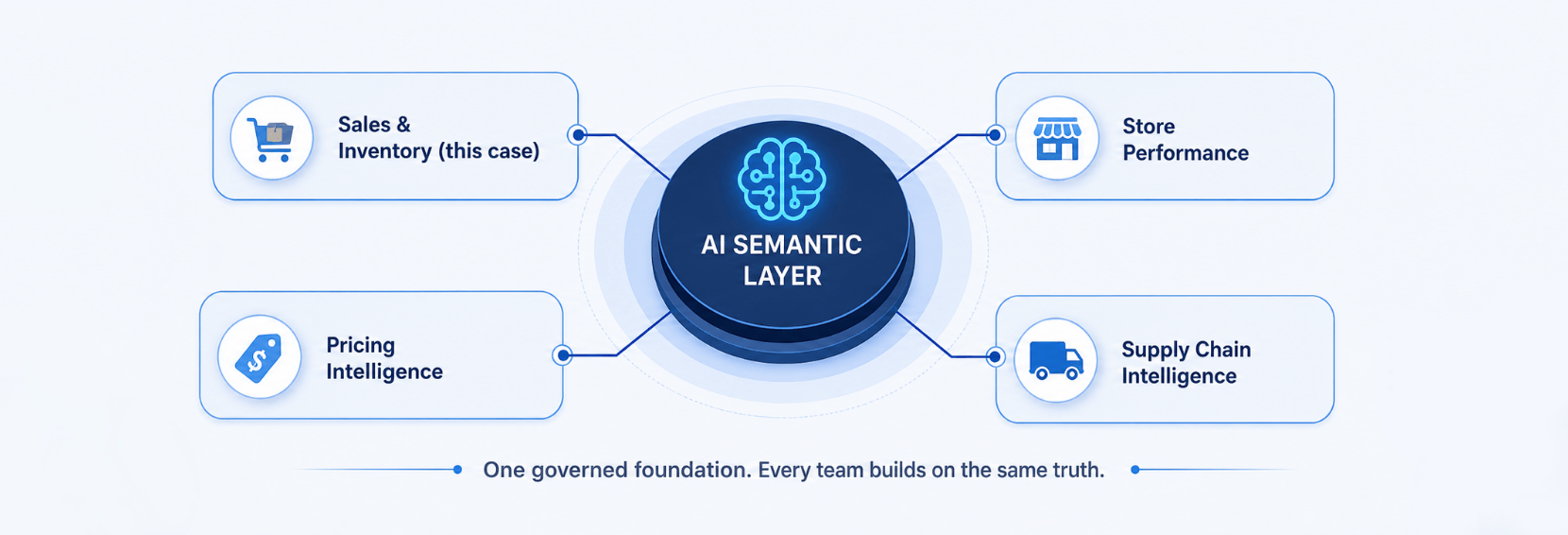
Sales and inventory were the starting point for this proof of concept, but a governed semantic layer is not a one-department tool. It is the foundation everything else in retail intelligence sits on. Infocepts’ AI Semantic Layer is built on exactly this idea: one retail ontology, SKU to category to assortment, store to region to channel, shopper to household, feeding every AI agent, dashboard, and query with the same governed answer, whether the question comes from a sales head, a merchandiser, a supply chain planner, or a store manager.
That is the difference between solving one team’s reporting headache and building the intelligence fabric the rest of the organization can stand on. Once sales and inventory trust the same numbers, extending that same governed foundation to demand forecasting, store performance, or pricing intelligence is an extension of what is already built, not a new project from scratch.
Want to see what a governed semantic layer
Could answer for your sales and inventory teams?

Author
Sushrit Moundekar is a Program Manager in the Retail & Consumer practice at Infocepts, bringing 11+ years of experience delivering data modernization, analytics, and AI led transformation programs. He leads strategic client engagements and mentors high performing teams, helping clients unlock value from their data. Outside work, he enjoys football, cooking, and long drives.
Read Full BioRecent Blogs



Infocepts