



I hear the same story everywhere I go.
This happens at DIA, BIO, and ISPOR events. Every commercial leader tells me the same thing. They have more data than ever before. Dashboards now sit across every function and team. But the real questions still go unanswered. Which channel mix is actually moving prescribing? Which territories are underperforming, and why exactly? How does medical affairs shape commercial outcomes? The honest answer is spreadsheets and gut feel. Someone always agrees to pull data offline. That is not an analytics problem at all. It is a connectivity problem, plain and simple. Leadership needs to frame it that way first. No new tooling will ever fix this alone.
The Real Issue: Disconnected Intelligence
The average top pharma company invests $200 billion. This covers annual US commercial operations spend. Much of that spend follows intuition, not analysis. It just gets dressed up as real analysis. Real precision needs data these systems don’t share. That data sits trapped inside disconnected data silos. Different teams govern each piece of that data. Each function measures success with its own KPIs. Those KPIs were built for one function alone. None were built for the whole enterprise together.
Your field force keeps CRM data inside Veeva. Marketing tracks engagement in Marketo or Salesforce. Medical affairs logs HCP interactions on another platform. Market access tracks payer coverage in yet another tool. Patient services runs its own separate hub system. That system was never built to connect elsewhere. Each function optimizes only for its own goals. The company as a whole sub-optimizes instead. We call this the Commercial Intelligence Deficit. It costs the industry more than anyone tracks.
Fewer than 11% of pharma firms deploy AI enterprise-wide. This happens despite years of strategy and pilots. The real barrier is almost never the AI. It is the broken data foundation beneath it.
What Connected Intelligence Actually Looks Like in Practice
At Infocepts, we have spent 21+ years building what we call a commercial intelligence layer – a governed data and AI architecture that sits across all commercial functions and creates shared context. Not another dashboard. The connective tissue that makes all your existing investments smarter, faster, and genuinely useful to the people who need to act on them.
Here is what that looks like in the real world. A global biotech client was making territory call-planning decisions based on Veeva CRM activity data alone. Prescribing decile determined call frequency. When we connected their digital engagement data – webinar attendance, email open patterns, medical portal logins, congress registrations – with their CRM activity and prescription data into a unified Snowflake-based platform, we found that HCPs with at least two digital touchpoints before a rep visit prescribed at 2.3 times the rate of HCPs who received cold rep contact only. The field team restructured call planning immediately. Year-1 sales increased 20% across 30+ countries. That outcome did not come from a better AI model. It came from connecting data that was already being collected but had never been joined at the HCP level.
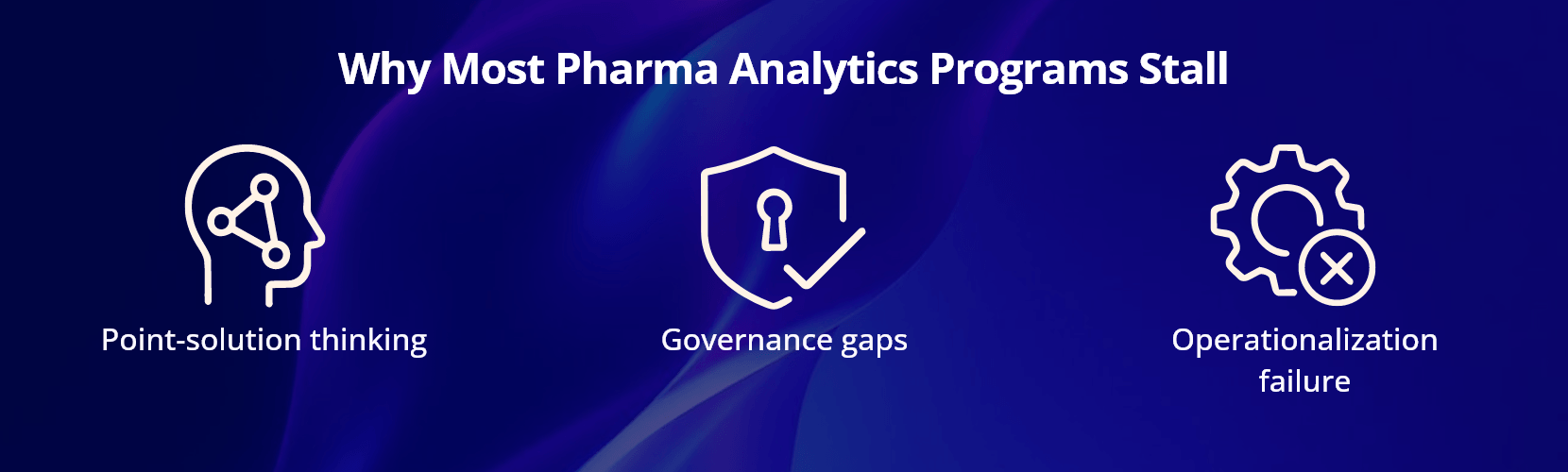
Why Most Pharma Analytics Programs Stall
Three barriers block true commercial intelligence maturity. These barriers are not hypothetical or rare. We see them at nearly every engagement start.
- Point-solution thinking: Every function buys tools for its own problem. This creates 20-plus disconnected tools across the company. None of them were built to connect. Maintaining that fragmented stack drains real engineering capacity. That capacity should go toward real analytics work. Work that would actually move the business forward.
- Governance gaps: Pharma is a heavily regulated, compliance-driven industry. Data needs documented lineage and role-based access. It also needs automated data quality monitoring. Without these, data becomes a compliance risk. Most programs bolt governance on at the end. By then, it gets retrofitted, not designed. That approach is expensive and often incomplete. It rarely satisfies real regulatory scrutiny either.
- Operationalization failure: Models get built, then sit on shelves. Dashboards go unused after just one month. A working prototype is not the same thing. Eight hundred field reps using it daily is different. That gap is about people, not technology. Most programs underinvest in change management badly. They skip adoption strategy and user training. They skip the feedback loops that matter too. Those loops keep the system genuinely relevant.
The Infocepts Commercial Intelligence Model
We are not a BI vendor. We are not staff augmentation either. Every engagement ties to measurable business KPIs. That commitment starts from day one, always. Think sales lift, rep productivity, adherence gains. Also patient enrollment acceleration, and similar outcomes. Compliance comes first here, never last. GxP, HIPAA, and GDPR live in the architecture. That happens during the first design conversation. Nothing gets retrofitted after the fact. Operationalization is a formal deliverable, always included. It is never treated as an afterthought.
Our client retention rate sits at 97.2%. We’ve also topped Gartner Peer Insights three years running. Those numbers reflect a deliberate choice we made. We tie investments to outcomes leaders actually care about, not to technical boxes IT can check. That’s why our partnerships last seven-plus years. These are not projects that close and disappear.
The Commercial Intelligence Diagnostic
Is your roadmap just function-specific tool upgrades? Heading into next year’s planning cycle that way? Then you are solving the wrong problem entirely. Start with a diagnostic instead of tools. Map exactly where your commercial data lives. Identify who actually owns each data source. Find where team definitions conflict with each other. Locate the decisions no current system answers.
That diagnostic usually surfaces three or four opportunities. Each one is a high-value connection point. That is where linking data across systems helps. It unlocks insight nobody can currently see, and that insight is directly actionable right away. These opportunities deliver the fastest return, period. The value is concrete and easy to measure. Stakeholders are also already ready to move.
Three Questions Worth Answering This Quarter
Can leadership see prescribing impact without pulling data manually? This means combining rep visits with digital touchpoints. Can medical affairs track MSL engagement with KOLs? Does that engagement influence prescribing in nearby geographies? Can market access give field reps real-time data? That means payer coverage data at account level. Before every sales call, not after it.
A “no” answer reveals a real commercial intelligence gap. That gap is costing your company real money. It is also your best starting point. This is where analytics investment shows quick ROI, real ROI within a single planning quarter. This is exactly where Infocepts comes in. This is where commercial data investment pays off.
Winning pharma companies won’t have the most dashboards. They will have one connected, governed customer view, and they will act on it in real time. That requires real operational systems, not just insight. Building this view is not a multi-year project. It is a decision for this planning cycle. That decision is available to you right now.
Ready to close your commercial intelligence gap?
Connect commercial, medical, and market access data to uncover actionable insights, improve field effectiveness, and accelerate revenue growth across your organization
The Infocepts Life Sciences COE is a team of domain and data experts working with pharma, biotech, and medical device companies to accelerate data-driven outcomes. The team covers clinical data management, regulatory analytics, commercial insights, and AI applications across the drug development and commercialization lifecycle.
Read Full BioRecent Blogs



The Enterprise AI & Data Transformation Partner. Delivering measurable business impact globally.
#1 on Gartner Peer Insights · 97.2% client retention