
5 Questions CISOs Must Answer Before 2027 Budgets Lock
When Infocepts validates security configurations inside enterprise environments, 55% of them turn out to be disabled or mistuned. The tools are installed. The licenses renew every year. The protection on the invoice is not the protection running in production.
That finding should change how you plan 2027. Most security leaders are building next year’s budget right now, and the instinct is to ask what to buy. The better first question is what you already own that isn’t working.
Gartner’s 2026 Leadership Perspective Survey of more than 1,600 CISOs points the same way. Enabling and protecting AI ranks first, assessing and managing cyber risk ranks second, and optimizing security tools and services ranks third (Evanta, a Gartner company). Two of those three priorities depend on knowing, with evidence, what your current stack actually does. Here are the five questions we think every CISO should be able to answer before the budget locks.
1. Are the controls we paid for actually on?
It sounds basic. Few organizations can answer it on demand. Wiz’s 2026 CISO Budget Benchmark found that 58% of organizations run more than 25 security tools, and nearly half of CISOs say that sprawl is actively holding their programs back (Wiz). Every one of those tools has its own console, its own definition of coverage, and its own way of failing quietly. An EDR policy flips to audit-only during a troubleshooting session. An email rule gets disabled for a partner and never comes back. Nobody gets an alert, because nothing broke. The control simply stopped working.
Here is where we disagree with a lot of current advice. The industry tells CISOs to consolidate. We’d say validate first. If you consolidate before you know which controls work, you risk cutting the tool that was doing its job and keeping the one that was switched off.
2. Where are we exposed right now, not last month?
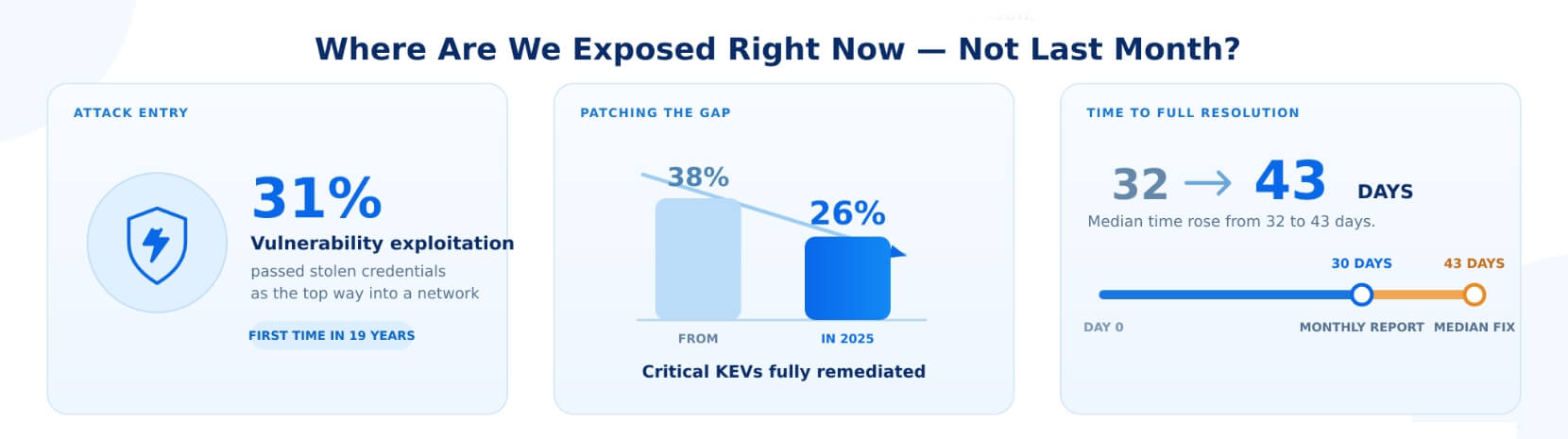
Attackers have changed how they get in. The 2026 Verizon Data Breach Investigations Report, built on more than 22,000 confirmed breaches, found that vulnerability exploitation (31%) passed stolen credentials as the top way into a network for the first time in the report’s 19-year history (Verizon). Defenders are falling behind on the fix. Only 26% of critical vulnerabilities on CISA’s Known Exploited Vulnerabilities list were fully remediated in 2025, down from 38%, and the median time to full resolution rose from 32 days to 43 (Verizon DBIR executive summary).
A posture report assembled by hand once a month cannot keep pace with a 43-day exposure window. That is the practical case for continuous threat exposure management. It is less about adopting a new framework and more about refusing to make decisions on 30-day-old data.
3. What does a gap cost us if someone finds it first?
IBM’s Cost of a Data Breach Report 2026 puts the global average breach at a record $4.99 million, up 12% in a year. One in four malicious breaches was AI-enabled, a 56% jump, and those breaches averaged $6 million (IBM).
North American companies have the most reason to pay attention. IBM X-Force found that North America accounted for 29% of all cases it observed in 2025, up from 24% the year before, and that attacks beginning with the exploitation of public-facing applications rose 44% (IBM X-Force). X-Force put the reason plainly: basic security gaps are leaving enterprises exposed. A disabled control is about as basic as gaps get.
4. Can we prove compliance without rebuilding it every quarter?
In most security teams, MITRE ATT&CK and CIS Controls evidence is reassembled for each audit and starts aging the day the auditor leaves. That is expensive, and it is fragile. The evidence describes the environment on the day someone exported it, not the one you’re running today.
Continuous mapping changes the job. When control status is tied to frameworks automatically, an auditor’s question becomes a query. Your governance, risk, and compliance team stops rebuilding spreadsheets and starts tracking drift.
5. Is the security spend working, and can we show the board?
Boards have stopped accepting tool inventories as proof of security. Directors want to know whether posture improved this quarter, what drifted, and what the spend delivered. IBM’s 2026 data gives CISOs one strong answer: organizations that use security AI and automation extensively cut breach costs by nearly $2 million on average (IBM). That is the kind of number a board understands. The harder part is showing your own version of it, from your own environment, every month.
How Cyber Vigilance 360 answers all five
We built Cyber Vigilance 360 at Infocepts to give CISOs those answers continuously instead of once a month. It connects to more than 108 tools across EDR, email security, identity, web, and vulnerability management, and it checks that each control is enabled, tuned, and current. AI-driven risk scoring ranks exposure across tools, assets, departments, and human risk, with the reasoning attached so your analysts can see why something ranks high. Control status maps continuously to MITRE ATT&CK and CIS. Board dashboards track posture improvement, coverage, license use, and stack ROI.
It doesn’t replace anything you own. It reads across your existing stack and works alongside your SIEM and XDR by validating the controls that feed them. Configuration takes about four hours, first results arrive inside a day, and sensitive data stays in your environment.

Why manufacturers can’t treat this as an IT problem
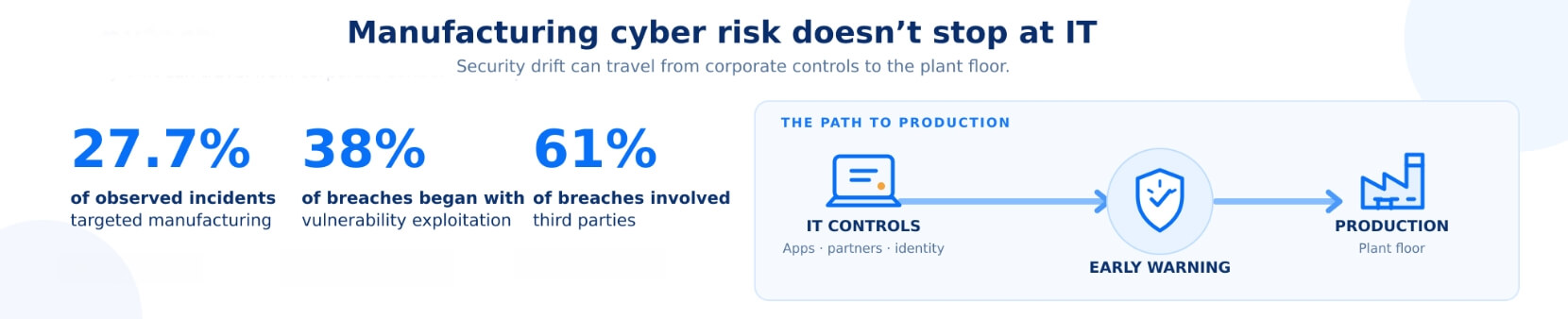
Manufacturing remains the most targeted industry. IBM X-Force attributed 27.7% of the incidents it observed in 2025 to manufacturers. Verizon’s 2026 DBIR counted 3,627 manufacturing incidents, with vulnerability exploitation as the leading way in (38% of breaches) and third parties involved in 61% (Verizon DBIR executive summary).
Those entry points are IT controls: exposed applications, partner access, and identity. They are also the road from the corporate network to the plant floor. Manufacturers already rely on industrial manufacturing analytics to flag the moment a production line drifts out of spec. Security controls drift too. Cyber Vigilance 360 gives plant and enterprise security leaders the same early warning for the identity, endpoint, email, and web defenses that stand between an attacker and production.
Meet the CISOs who are already asking these questions
Infocepts and Discern Security are hosting a CISO roundtable and dinner in New York on October 28, from 6:00 to 9:00 PM, in a private room at Tamarind Tribeca. Security leaders will compare notes on validating controls, cutting tool sprawl, and building a 2027 budget the board will fund. Seating in a private room is limited, and it fills with the peers you’d want at the table. Reserve your seat at the CISO Roundtable.
Can’t make it to New York? Book a 30-minute posture briefing with Infocepts. It is a working session, not a demo, and you will see what a snapshot of your own environment reveals before your next renewal goes through.
Frequently Asked Questions
Which of Your Security Controls Are Actually On?
Book a 30-minute posture briefing and see what a snapshot of your own environment reveals before your next renewal goes through.
Recent Blogs


Infocepts