
Every delivery marketplace wants the same thing from you (your products, your prices, your stock levels) and every single one wants it in a slightly different format, on a slightly different schedule, through a slightly different pipe. DoorDash isn’t Instacart. Instacart isn’t UberEats. Multiply that by six platforms, three countries, and 1,500 stores, and “just list us on the marketplace” quietly becomes one of the hardest data problems in the building.
Here’s the direct answer: retailers sell across many marketplaces at once by building two-way data integrations that push product, location, and price-inventory data out to each platform, and pull each platform’s sales data back into one central warehouse for reporting. Get that plumbing right and every marketplace runs off the same trusted product and price data, sales from all of them land in one place for finance and marketing to actually see, and adding the next platform stops being a from-scratch project. Get it wrong and you’ve got six spreadsheets, six formats, and no one who can tell you what you sold yesterday.
The universal-adapter problem
Anyone who has traveled internationally knows the drawer full of power adapters: every country wired its outlets differently, so you either carry one plug per country or you carry a single universal adapter that handles them all. Marketplace integration is the same problem, wearing a retail costume.
Each marketplace is its own “country” with its own wiring:
One platform wants a flat file, another wants an API call, another wants a feed structured its own particular way.
Prices and stock have to refresh on each platform’s schedule, not yours, or customers see the wrong price and the wrong availability.
Serving Canada, the rural US, and Puerto Rico means different catalogs, currencies, and coverage rules per region.
Every platform reports sales back in its own shape, so someone has to reconcile six sales feeds before anyone can answer “how did we do?”
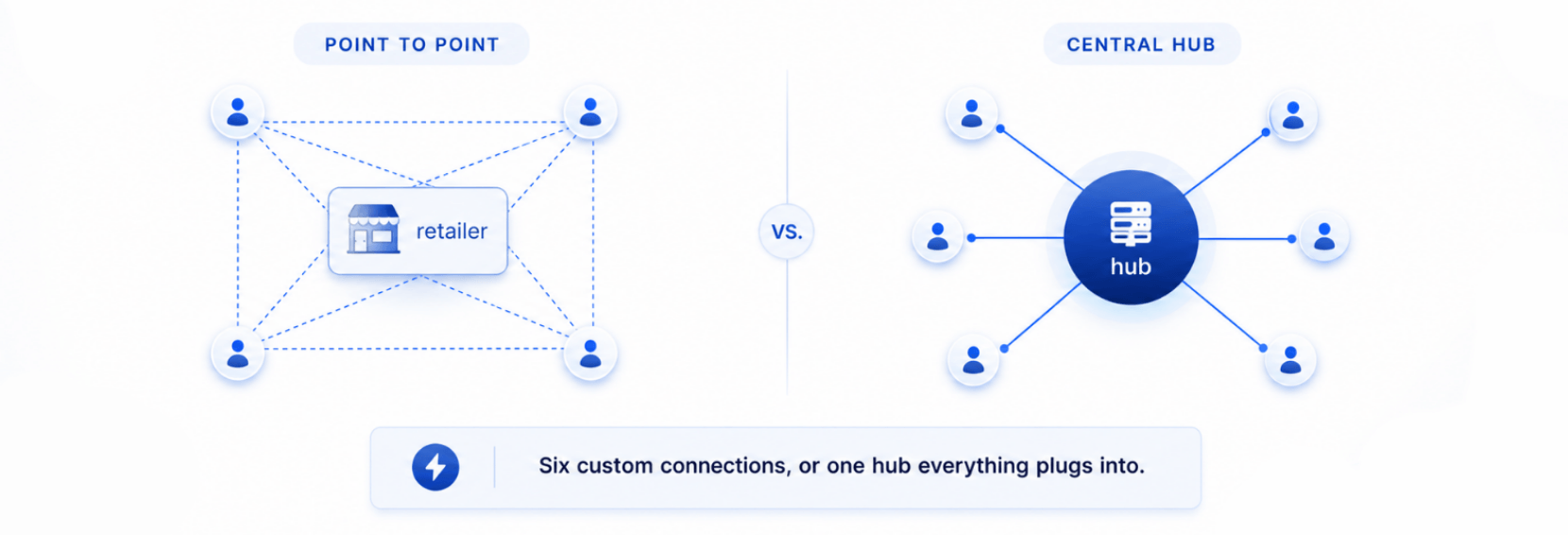
Carry a separate adapter for every marketplace and you drown in one-off connections. Build the universal adapter once, and every new platform just plugs in.
What marketplace integration actually means
Marketplace integration is the set of data pipelines that connect a retailer’s own systems to third-party selling platforms, so products can be listed, priced, and sold on those platforms and the results flow back for analysis. It has two directions, and both matter equally.
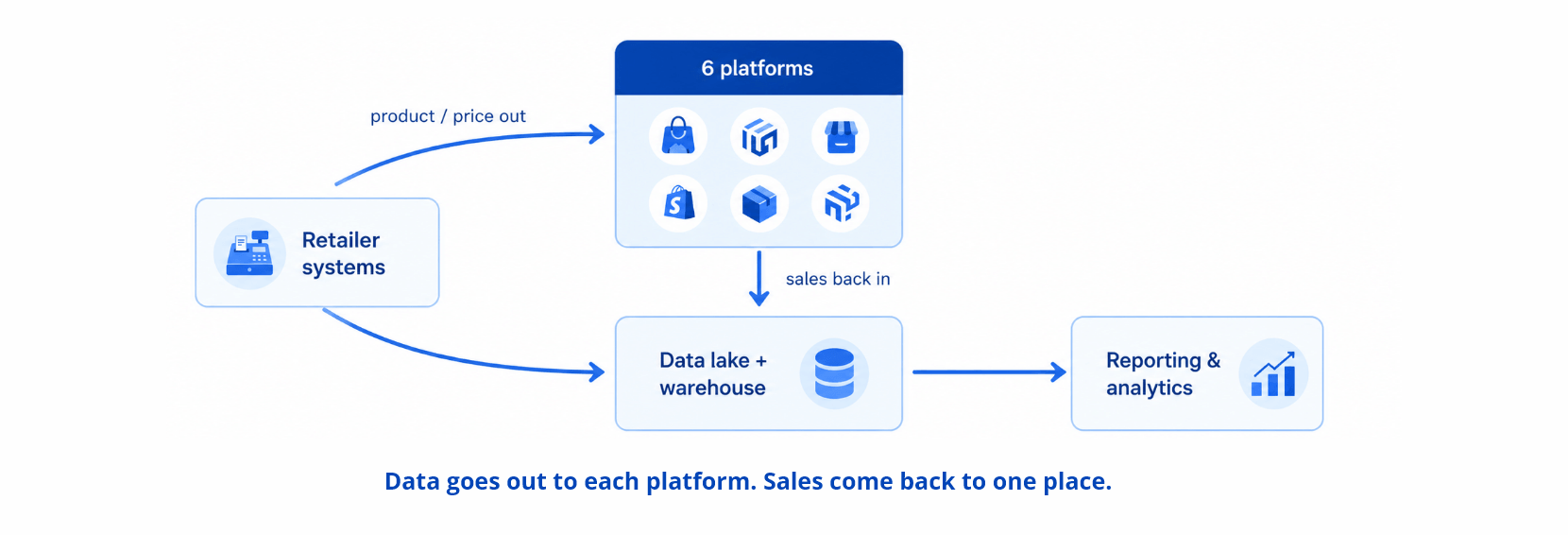
The outbound direction sends your data to the marketplace: product details, store and location coverage, and the price-and-inventory feed that keeps listings accurate. The inbound direction brings the marketplace’s data back to you: orders, sales, and performance, landed somewhere central so it can be reported on. Skip the inbound half and you can sell on ten platforms while remaining completely blind to how any of them are doing.
Data goes out, data comes back
A working marketplace integration is a loop, not a one-way broadcast. Think of it like a well-run kitchen pass: orders go out to the floor in a form each server can carry, and plates come back to be counted, all through one organized window instead of a free-for-all.
Here’s the loop in plain terms:
- Outbound feeds go to each platform: Product, site, location, and price-inventory files are formatted for each marketplace and delivered on its schedule, so onboarding a new platform and keeping listings live both just work.
- Inbound feeds come back into a central store: Each platform’s files are ingested and loaded into a data lake and warehouse, so all that marketplace data lives in one governed place instead of six inboxes.
- Reporting sits on top: Finance, omnichannel, and marketing teams get reports and analytics built on the combined data, so decisions run on one consistent view.
The whole thing depends on a solid modern data architecture underneath. The glamorous part is “we’re live on DoorDash.” The part that actually determines whether it works is the data engineering that moves files reliably in both directions, day after day.
Point-to-point vs. a central hub
| Business Scenario | Point-to-Point Integration | Central Integration Hub |
|---|---|---|
| Adding a New Marketplace | Build a new custom connection every time | Connect through the existing integration hub |
| Where Sales Data Lives | Scattered across multiple platforms | Centralized in a single data lake or warehouse |
| Reporting Across Platforms | Manual reconciliation of data feeds | One unified and governed view |
| Price & Inventory Management | Managed separately for each connection | Updated once and distributed everywhere |
| Multi-Country Expansion | Business rules duplicated per platform | Managed centrally with regional controls |
| Handling Format Changes | Individual integrations must be updated | Single mapping update within the hub |
A real story: a top pet retail chain
A top pet retail chain, with over 1,500 stores across the US, Canada, and Puerto Rico offering pet products and services like grooming, training, boarding, and veterinary care, set out to grow its digital sales through a marketplace program. The goal was straightforward to say and hard to do: expand market presence and make it easier for customers in diverse regions to buy.
The catch was integration. Growing digital sales meant plugging into multiple marketplace platforms (DoorDash, Instacart, UberEats, GrubHub, SHIPT, and Skip the Dishes), expanding into Canada, the rural US, and Puerto Rico through those partnerships, and standing up reliable data integrations so the whole thing actually ran instead of just launching and breaking.
Infocepts built the integration both ways. Outbound processes delivered product, site, location, and price-inventory data files to the marketplace vendors, enabling successful onboarding and launch across the external platforms. Inbound processes ingested and loaded the files coming back from those vendors into the data lake and Snowflake, centralizing reporting and making the data accessible for analytics. On top of that, reporting was built to support analytics and financial decision-making. The teams using it: finance, omni, marketing, and digital.
The reported business benefits of the program:
1. Broader customer reach:
Access to diverse marketplace customers, improving visibility and engagement.
2. Expanded market presence:
Using marketplace vendors to reach smaller markets where those vendors already have significant presence.
3. Revenue growth:
Substantial revenue growth, with all marketplaces contributing to the total. Source states the figure as a placeholder; no specific number is claimed.
4. Stronger marketing and promotions:
Using the marketplace integrations to run more effective marketing and promotional activity.
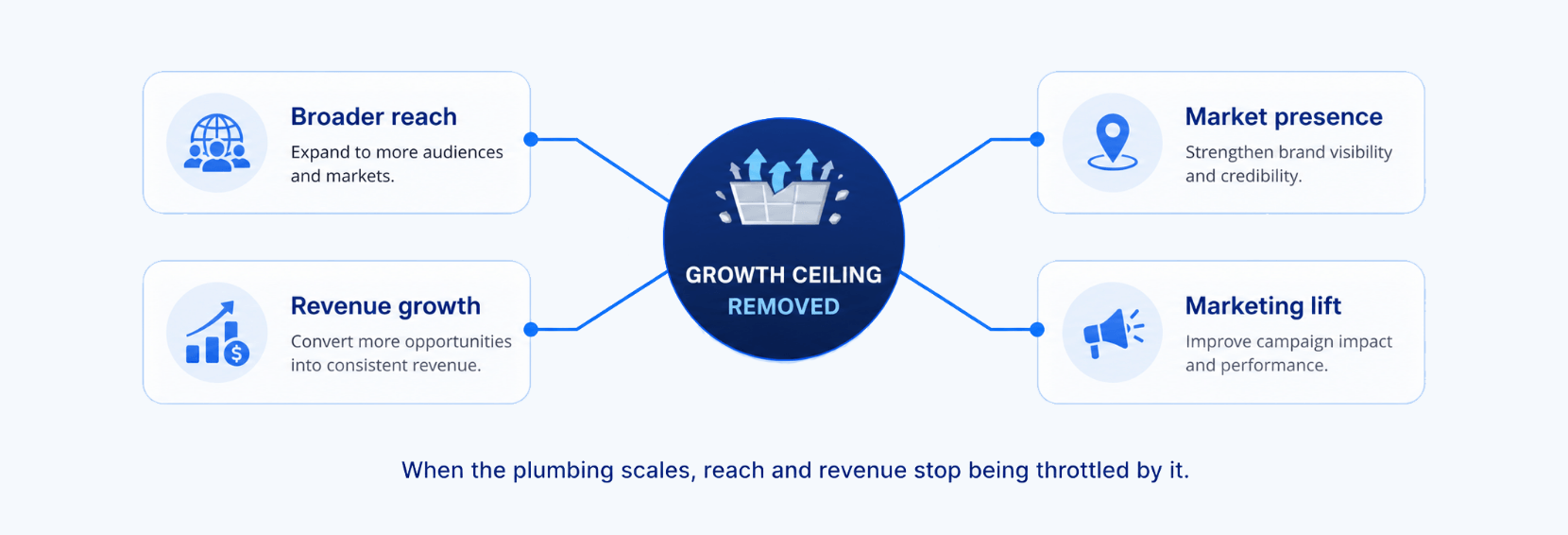
Read those four together and the throughline is one idea: reach and revenue both grew because the integration removed the ceiling on how many places the retailer could sell without breaking its own reporting. Adding customers in a new region or a new platform used to mean more manual mess; once the two-way pipes existed, growth stopped being throttled by the plumbing. The reach and the revenue are two views of the same unlocked constraint, not two separate wins.
From plumbing to marketplace intelligence
Getting the data flowing is the foundation. What you build on top of it is where the compounding value lives. That path runs through two parts of Infocepts’ Retail & CPG offering: the connective data layer and the intelligence that sits on it.
Once product, price, and sales data from every marketplace lands in one governed place, Infocepts’ AI Semantic Layer can define each metric (revenue, margin, channel contribution) once, so finance and marketing stop arguing about whose marketplace number is right. From there, Channel and Marketplace Operations intelligence turns that clean, combined data into the questions leaders actually ask: which platforms and regions are pulling their weight, where promotions are working, and which marketplace to add next. The integration is what makes the data trustworthy; the intelligence layer is what makes it answer questions.
Thinking about scaling your own marketplace program?
Build it to grow, not just to launch.
Recent Blogs



Infocepts