Snowflake migration keeps landing on your roadmap, but the risk column is always full of question marks. You know you need the agility and scale, yet the idea of moving years of enterprise data, fragile integrations, and mission-critical reports can feel like open-heart surgery.
The good news: you can migrate with far less drama than most teams experience, as long as you treat it as a structured program instead of a lift-and-hope exercise. This guide walks through how to plan, execute, and stabilize a low-risk move to the Snowflake Data Cloud.
Clarify Why You Are Migrating Before You Move Anything
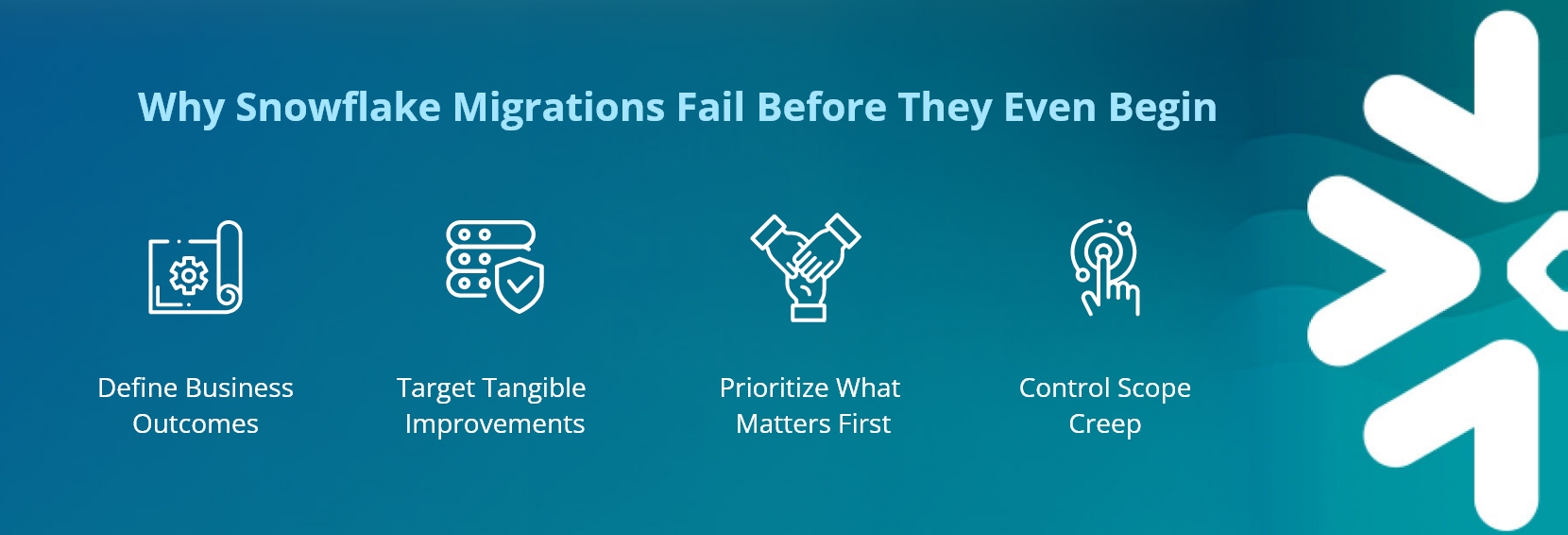
The least successful Snowflake data migration projects all have the same smell: vague goals like “modernize the stack” and a giant, undifferentiated backlog. That is how you end up moving everything, fixing nothing, and burning your team out.
Start by writing down 3 – 5 concrete business outcomes you expect from the new Snowflake data warehouse. For example: cut dashboard refresh time from 30 minutes to 5, retire $80K per year in legacy licenses, or support self-service analytics for 200 business users.
Those outcomes drive every major decision: what to move first, how much refactoring to do, and how you measure success. They also help you say “no” when stakeholders try to slip in pet datasets or last-minute scope changes.
Assess Your Source Landscape And Migration Complexity
Before you rush to migrate to Snowflake, take a hard look at the systems feeding your current warehouse. Underestimating complexity here is one of the fastest ways to blow timelines and confidence.
Inventory sources in three passes. First, list every operational system and file feed that lands in your current warehouse. Second, tag each by data volume, refresh frequency, and latency expectations. Third, flag snowflake risks: tightly coupled stored procedures, undocumented jobs, and business logic buried in ETL.
During this assessment, separate data that truly needs to be online from historical archives. Older data can often move later or into cheaper storage tiers during cloud data migration, which takes pressure off your initial cutover.
Classify Workloads By Risk And Reward
Not all workloads deserve equal treatment in a Snowflake migration. Trying to move everything in one big wave is how critical reports end up broken on Monday morning.
Group workloads into three buckets: high business impact (financial reporting, regulatory, executive dashboards), medium impact (departmental analytics), and low impact (ad hoc sandboxes, legacy reports rarely used). Tackle at least one medium-impact domain first as a pilot, so you can prove out patterns without putting your reputation on the line.
Design A Target Architecture That Uses Snowflake Well
Copying your legacy schema and ETL patterns into Snowflake defeats the point of Snowflake modernization. You will pay cloud bills without seeing the agility or performance you promised.
Define your zone strategy early: raw ingestion, standardized or curated layers, and presentation models for analytics and data science. Snowflake makes this easier with separate databases and schemas instead of giant monoliths, so use that to isolate concern areas and simplify access control.
Think through security and governance up front instead of as an afterthought. Role-based access, row-level policies, and data masking should be part of your initial Snowflake implementation design, not “phase two.” Retrofits in this area always cost more.
Choose The Right Migration Patterns Per Domain
There is no single “correct” way to complete Snowflake migration for every workload. Some data pipelines migrate well with a straight re-platform, while others need partial or full redesign.
In broad terms, you will use three patterns. First, rehost: move data as-is when logic sits mostly in upstream systems and your main goal is infrastructure offload. Second, replatform: keep business rules but rebuild the pipelines using Snowflake-native features and modern orchestration. Third, refactor: redesign where legacy structures block performance or self-service.
Plan A Phased, Test-Heavy Migration Execution
Once the target architecture is sketched, you need a realistic execution play. Large enterprise data migration programs fail less because of technology and more because testing and cutover plans were never detailed.
Define small, vertical slices through domains, not horizontal layers. For example, migrate “Order to Cash reporting” as a whole – from raw ingestion to final dashboards – instead of trying to move all raw tables, then all curated tables, then all reports.
For each slice, build an explicit migration runbook: what gets copied, what gets rebuilt, what is retired, and which teams need to sign off. Time-box the effort to 6 – 10 weeks so stakeholders can see progress without waiting a full quarter.
Build Strong Testing And Reconciliation Into The Plan
A low-risk Snowflake migration lives or dies on how you test. One-time spot checks are not enough when you are touching finance, regulatory, and customer-critical workloads.
Set up data reconciliation harnesses that compare record counts, key metrics, and business rules between legacy and Snowflake systems. Start with automated row counts and sums by day or month, then add domain-specific checks, such as margin calculations or customer balances.
Plan for parallel runs during a transition window. Keeping both warehouses in sync for 2 – 4 weeks allows business users to compare results and flag issues while your team can still fall back safely.
Control Performance, Cost, And Operations From Day One
Snowflake consulting teams see the same pattern over and over: the first month looks cheap, then costs drift upward as more teams onboard and workloads scale. Baked-in operational discipline prevents surprise invoices and user frustration.
Start with a simple but opinionated warehouse strategy. Create separate virtual warehouses for ingestion, transformation, and consumption, and size them based on tested workloads rather than guesswork. Enable auto-suspend aggressively, especially on development and ad hoc warehouses.
For ongoing optimization, instrument your environment. Use query history, resource monitors, and usage views to watch for long-running queries, warehouse queuing, and expensive cross-region traffic in your Snowflake services setup.
Prepare Your Team And Users For The New Platform
A technically perfect Snowflake data warehouse can still flop if people do not adopt it. Training and communication are as critical as pipelines and schemas.
Run targeted enablement sessions. Engineers need to understand Snowflake-specific features like micro-partitions and time travel. Analysts and BI developers care more about SQL differences, performance tuning, and new access patterns.
Give business stakeholders a clear transition story: when reports will move, how they can validate results, and where to go with questions. A concise FAQ and office hours calm nerves during the changeover.
Common Pitfalls And How To Avoid Them
Certain mistakes surface in almost every large Snowflake data migration, regardless of industry or region. Knowing them early lets you design around them instead of learning the hard way.
One of the biggest is skipping data quality remediation. Migrating bad data just moves your problems to a shinier platform. Build in profiling and cleansing steps for high-value domains as part of your migrate to Snowflake plan.
Another common trap is ignoring downstream integrations. Legacy tools, custom exports, and point-to-point feeds often depend on specific schemas. Catalog these early, test them in lower environments, and budget time to rebuild brittle interfaces as part of the Snowflake services roadmap.
Finally, teams often underestimate how long it takes to validate complex regulatory and financial outputs. Involve risk, compliance, and audit partners early so they can define acceptance criteria you can test against, instead of waiting to approve everything at the very end of the project.
Conclusion
A low-risk Snowflake migration is less about heroics and more about clear outcomes, structured execution, and honest communication. When you pair a sound architecture with phased moves, strong testing, and disciplined operations, the move to the Snowflake Data Cloud becomes manageable instead of daunting.
For enterprises across the USA and Europe, the right partner can cut months of trial and error and help your teams adopt best practices from day one, which is exactly where Infocepts focuses its work. If you are mapping your next migration wave, now is the time to turn that plan into a concrete, low-risk program.
Frequently Asked Questions
Migrate to Snowflake with Confidence
Reduce migration risk and accelerate data modernization with proven Snowflake strategies, governance, and implementation expertise.
Recent Blogs


Infocepts