



Your AI pilots worked. The proof of concepts checked every box. Finance loved the projections, IT approved the security protocols, and the board nodded along. Then nothing happened.
If this sounds familiar, you’re not alone. Walk the exhibit halls at any major pharma conference this year and you’ll hear the same story repeated in different accents. Companies have spent the last three years piloting AI tools for drug discovery, patient engagement, and commercial analytics. The technology delivered. But somewhere between the demo and deployment, momentum died.
The problem isn’t the AI. It’s the infrastructure underneath it.
The Real Blocker Isn’t Technical
At Pharma USA 2026 in Philadelphia, a VP of Commercial Analytics from a top 10 biopharma put it plainly during a breakout session: “We proved our patient engagement AI could improve adherence by 18%. Two years later, it’s still stuck in development because our data teams can’t agree on a single patient ID across our CRM, claims data, and hub services platform.”
That’s the disconnect. AI tools are ready. Your data architecture isn’t.
The pharmaceutical industry has entered what analysts are calling the “deployment gap.” According to recent industry research, AI could generate between $350 billion and $410 billion in annual value for pharma by 2026. But fewer than 11% of organizations have achieved enterprise-wide AI deployment. The rest are stuck in pilot purgatory.
Why? Because AI doesn’t fail on algorithm sophistication. It fails on data fragmentation, organizational silos, and the inability to connect insights across commercial, medical, and operational functions.
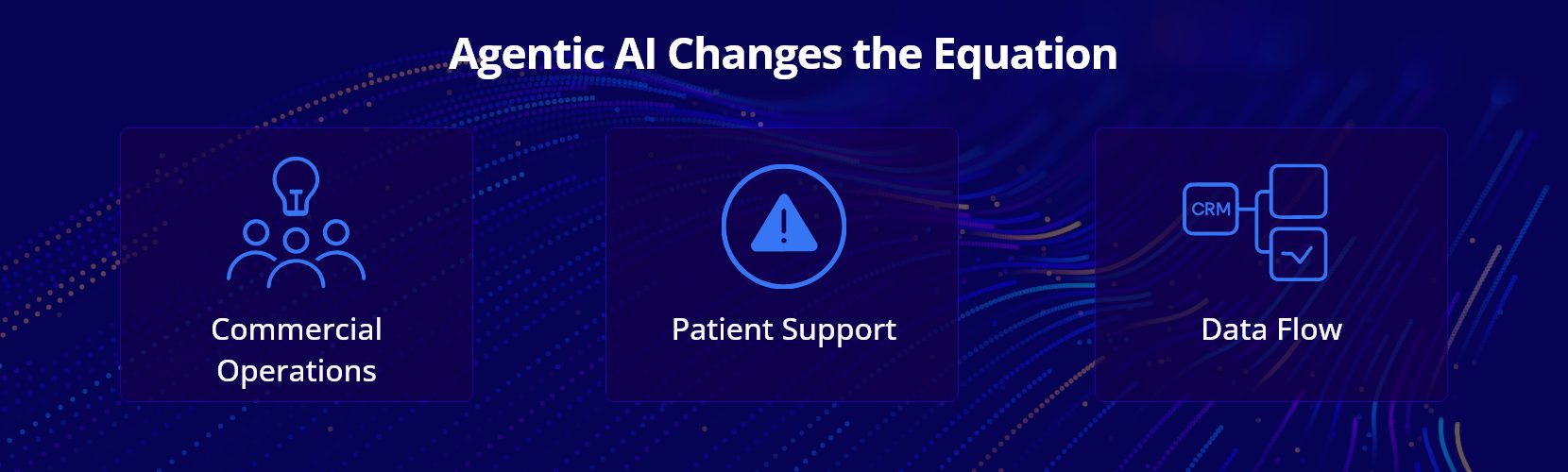
Agentic AI Changes the Equation
The next wave of pharmaceutical AI isn’t generative AI for marketing copy or chatbots answering basic questions. It’s agentic AI, systems that can analyse context, make decisions, and execute actions across multiple data sources without constant human oversight.
Think about what that means for commercial operations. Instead of a medical science liaison manually reviewing fifty publications to identify the right KOL for a therapy area, an agentic system scans medical literature, congress presentations, clinical trial participation, and social media activity in real time. It suggests the top three candidates, explains the reasoning, and drafts personalized outreach, all while adhering to compliance protocols.
The same logic applies to patient support. An agentic platform monitoring patient hub data could detect early adherence risk, cross-reference claims and EHR data, and trigger an intervention before the patient drops off therapy. No manual review. No lag time. No missed opportunity.
But here’s the interesting point, Agentic AI only works when data flows freely across systems. It needs access to your CRM, your medical affairs platform, your patient services database, and your claims analytics. If those systems don’t talk to each other, the AI can’t function.
The Infrastructure Problem No One Wants to Admit
Most pharmaceutical companies built their analytics environments the same way: function by function, system by system, vendor by vendor. Sales got its CRM dashboards. Medical affairs built its own KOL database. Market access negotiated its own claims platform. Patient services selected a hub management system.
Each department optimized for its own needs. Each created its own definitions, its own metrics, its own version of the truth. The result? A collection of disconnected data environments that look like an analytics capability but function like a compliance nightmare.
When pharma executives talk about “connected intelligence” at industry events, this is what they mean. The ability to link field force activity, digital engagement, medical insights, payer data, and patient outcomes into a single intelligence layer that every team can access.
It’s not a new idea. It’s just hard to execute.
What Connected Intelligence Actually Looks Like
A mid-sized biotech firm we worked with, had this exact problem. Their commercial team was preparing to launch a rare disease therapy with a $400,000 annual treatment cost. Success depended on coordinating three critical functions: field reps identifying patients, medical liaisons educating specialists, and market access securing payer coverage.
Each team had its own tools. Each tracked its own KPIs. None of them could see what the others were doing in real time.
We built them a connected intelligence layer that unified all three data streams. Field reps could see which physicians had attended MSL-led educational programs before making their calls. Medical affairs could identify which accounts were actively seeing eligible patients. Market access could track which health systems had approved pathways and which were stalled.
Within six months, launch velocity increased by 40%. Not because any single team got better at their job. Because they could finally coordinate based on shared intelligence instead of isolated reports.
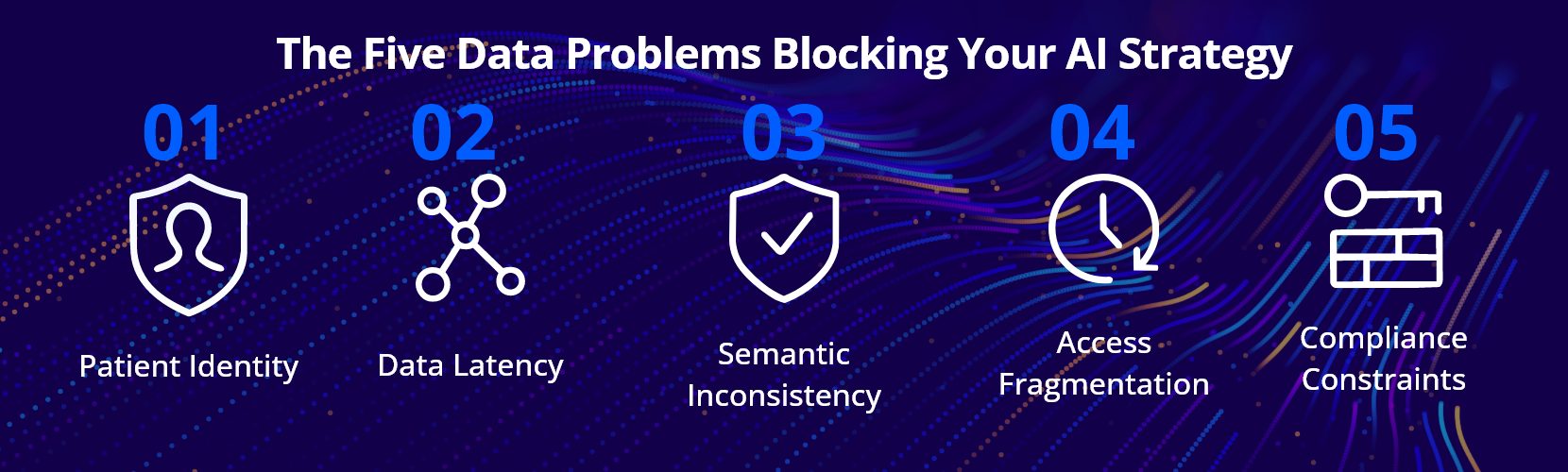
The Five Data Problems Blocking Your AI Strategy
If you’re struggling to move AI from pilot to production, the bottleneck probably lives in one of these five areas:
1. Patient Identity
You can’t build a 360-degree patient view if you can’t link a patient across your CRM, claims data, specialty pharmacy, and hub services. Most companies don’t have a master patient ID. They have five different patient IDs that sort of connect sometimes.
2. Data Latency
Real-time AI requires real-time data. If your commercial analytics team is working off monthly data refreshes while your patient services team is looking at daily updates, your AI will always be making decisions on stale information.
3. Semantic Inconsistency
When your sales team defines “engaged HCP” differently than your medical affairs team defines “active KOL,” your AI can’t unify those concepts. You need a governed semantic layer that standardizes definitions across functions.
4. Access Fragmentation
If your field force can’t access patient-level adherence data because it lives in a different system with different permissions, your AI can’t help them prioritize outreach. Data access has to match operational reality.
5. Compliance Constraints
GxP, HIPAA, and GDPR aren’t suggestions. Your AI architecture has to embed compliance by design, not retrofit it after deployment. That means documented lineage, role-based access, and audit trails baked into the data layer.
Why Most Pharma Data Modernization Efforts Fail
Here’s the uncomfortable truth: data modernization projects in pharma have a terrible track record. Companies spend millions migrating legacy systems to cloud platforms, only to recreate the same silos in a more expensive environment.
The mistake is treating data modernization as an IT project instead of a commercial intelligence project.
Moving your data from on-premises servers to Snowflake or Databricks doesn’t solve anything if you’re still operating with disconnected data models, inconsistent definitions, and function-specific access controls. You’ve just moved your problems to the cloud.
What works is starting with a clear view of the commercial intelligence you need, then building the data architecture to deliver it. That means understanding how your field force, medical affairs, market access, and patient services teams actually collaborate, then designing data flows that support that collaboration.
The Infocepts Approach: Intelligence Layer, Not Point Solution
This is where we differ from most analytics vendors. We don’t sell you a dashboard. We don’t augment your staff. We build the connective tissue that turns disconnected data into connected intelligence.
Our approach starts with mapping your commercial operating model. How do launch teams make decisions? What data do field reps need at the point of care? How do MSLs prioritize KOL engagement? We design the intelligence architecture around those workflows, not around vendor capabilities.
Then we build the governed data layer that supports it. That includes:
- Unified patient and HCP identifiers across all commercial systems
- Real-time data pipelines that eliminate latency
- A semantic layer that standardizes definitions across teams
- Role-based access that balances compliance with operational needs
- Embedded data quality and lineage tracking
Finally, we deploy the AI and analytics that sit on top of that foundation. Whether that’s next-best-action engines for field reps, KOL identification models for medical affairs, or patient risk scoring for hub services, the AI works because the data layer underneath it is built for connection, not isolation.
What This Means for Now
If you’re a commercial leader in pharma right now, you’re under pressure to show AI value. Your CEO read the McKinsey report about AI’s potential. Your board wants to know why competitors are moving faster. Your teams are drowning in pilot projects that never scale.
The answer isn’t more pilots. It’s fixing the foundation.
That starts with an honest assessment of your data architecture. Can your systems support real-time, cross-functional intelligence? Can your teams access the data they need when they need it? Do your definitions align across departments?
If the answer is no, you don’t have an AI problem. You have a data architecture problem. And no amount of sophisticated algorithms will fix that.
The Path Forward
The pharmaceutical industry is at an inflection point. The companies that will dominate over the next decade won’t be the ones with the most AI pilots. They’ll be the ones with connected intelligence that enables AI to work at scale.
That requires rethinking how you approach analytics. Not as a collection of departmental tools, but as an enterprise intelligence layer that connects every commercial function into a single, governed platform.
It’s not fast. It’s not cheap. But it’s the only way to turn your AI investments into actual business value.
The pilot phase is over. It’s time to build for real.
Ready to Move from Pilots to Production?
If your organization is struggling to scale AI beyond proof-of-concept, the problem likely isn’t your AI strategy. It’s your data infrastructure. Infocepts specializes in building the connected intelligence layer that pharmaceutical companies need to deploy AI at enterprise scale.
We’ve helped leading pharma and biotech organizations unify their commercial, medical, and patient support data into governed platforms that enable real-time decision-making across functions. From launch readiness to omnichannel analytics to patient engagement optimization, we build the data foundation that makes AI work.
Move AI initiatives from pilots to enterprise impact
Build connected intelligence to turn AI pilots into real-world impact
Recent Blogs



The Enterprise AI & Data Transformation Partner. Delivering measurable business impact globally.
#1 on Gartner Peer Insights · 97.2% client retention