
Banks don’t struggle with having data; they struggle with using it. Banking analytics promises sharper fraud detection, more accurate risk views, and deeper customer insight, but many teams are still staring at siloed reports and late files instead of real decisions.
If that sounds familiar, the problem usually isn’t the tools. It’s how data, models, and frontline processes fit together. This guide walks through practical, high-value ways to apply banking analytics with AI across fraud, risk, customer intelligence, and compliance so you can move from “interesting dashboards” to measurable impact.
Why Banking Analytics Projects Stall
Most banks have already invested in some form of financial services analytics, but impact often stalls after the first few use cases. You see a spike of activity around a new dashboard, then adoption flattens, and manual workarounds creep back in.
The root causes are predictable: fragmented data, models that don’t reach production, and analytics that sit outside day-to-day operations. Business teams are left reconciling numbers in Excel while data teams tune models that nobody uses.
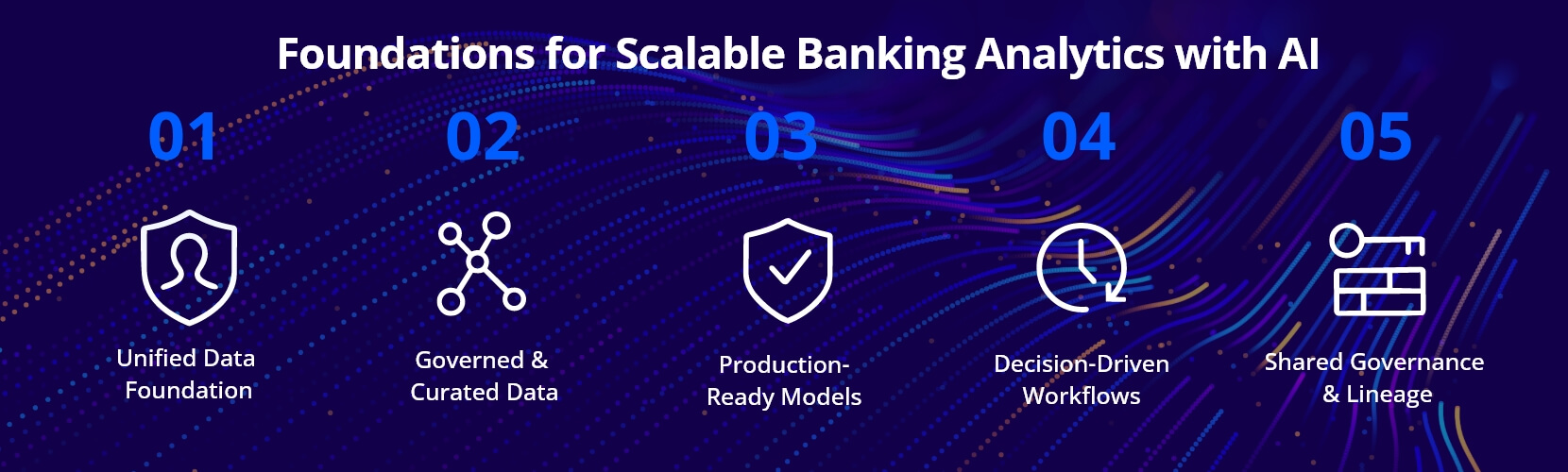
Foundations For Scalable Banking Analytics With AI
Before chasing advanced AI in banking, you need a few basics in place. These aren’t glamorous, but they’re the difference between a pilot and a platform that actually scales across products and regions.
First, you need a consistent data layer. A modern financial data platform that standardizes customer, account, transaction, and reference data across systems lets different use cases share the same definitions, controls, and lineage.
Data, Models, And Decision Flows
Strong banking data analytics programs line up three things: curated data, deployable models, and clear decision flows. Curated data means governed, documented sources, not just a dump from the core banking system.
Deployable models means you can move models into production quickly, monitor them, and retire them when performance drifts. Clear decision flows means defining exactly how model outputs trigger actions, such as a queue in the call center or a blocked transaction in the payments engine.
AI Fraud Analytics Use Cases That Actually Reduce Losses
Fraud teams don’t need more alerts; they need better ones. AI-driven fraud analytics can spot subtle patterns that rules miss, but only if models are wired into transaction flows and case management in a controlled way.
Start with supervised models that rank-risk card and account transactions in real time. Use past confirmed fraud and confirmed good behavior to train models that focus analyst attention on the riskiest 1–3% of transactions instead of a broad 10–15% slice.
From Rule Stacks To Adaptive Models
Most banks still rely on stacked rules that grow over time and generate inconsistent results. AI in this space should first target rule reduction and prioritization, not full automation. For example, use gradient boosting or neural networks to assign a fraud score, then use your existing rules as guardrails.
Track false positives at the segment level: customer tenure, product type, channel, and ticket size. Small changes in thresholds can free up analyst capacity, shave manual reviews, and improve approval rates on good transactions without increasing confirmed fraud.
Risk Analytics And Scenario Intelligence
On the risk side, teams want faster visibility into credit, market, and liquidity exposures without sacrificing control. Well-designed risk analytics can bring those views together on a single pane of glass while still honoring regulatory expectations.
A good starting point is automating data feeds from the core and trading systems into a controlled environment for risk analytics. That removes the fragile web of manual queries, desktop spreadsheets, and email-based approvals that still underpins many risk reports.
From Static Reports To Live Risk Views
Instead of waiting for monthly packs, risk leaders should be able to pull up a live view with drill-downs on sectors, counterparties, and regions. Here, AI in banking helps by clustering exposures and surfacing concentrations that might not appear in traditional hierarchies.
Scenario analysis also improves. Rather than a few hard-coded scenarios, you can simulate a range of macro and idiosyncratic shocks, then use machine learning to highlight portfolios most sensitive to those moves based on historical and modeled behavior.
Customer Intelligence And Personalized Banking Experiences
Most banks talk about “next best action” but still send broad campaigns based on simple rules. Customer analytics banking programs that work tend to start with a clear business problem: cross-sell within existing relationships, reduce churn in specific segments, or improve digital adoption among branch-heavy customers.
A practical pattern is to merge product, interaction, and digital clickstream data into a customer-level view. AI models can then predict likelihood to buy, propensity to churn, or propensity to adopt a channel, feeding those scores directly into your CRM and campaign tools.
From Insight To Action In Frontline Channels
One common failure pattern: insights stay in PowerPoint. To avoid that, embed recommendations where bankers and service staff already work. For branch and contact center staff, that’s usually the CRM or servicing screen. For digital channels, that’s the content and offer engines behind your app and website.
Measure impact tightly. Track not just response rates, but also margin, risk, and customer satisfaction after interventions. Banking AI solutions that look good in a pilot but damage trust or increase complaints will not survive beyond the first steering committee review.
AI-Driven Compliance, Reporting, And Regulatory Change
Compliance and regulatory reporting often feel like sunk cost, but they’re also where analytics can quietly save hundreds of hours a month and reduce exceptions. Many teams still reconcile source systems to regulatory templates by hand.
Banking AI solutions can help classify, match, and validate records before they reach reporting teams. For example, natural language models can tag transaction narratives for suspicious patterns and pre-fill certain fields in case management tools for review by human analysts.
Making Regulatory Reporting More Reliable
True automation in regulatory reporting is rare, but partial automation is realistic. Start by standardizing data mappings from source systems to regulatory forms so every field has a clear owner, rule set, and history of changes.
From there, you can apply analytics to track data quality trends, exception rates, and turnaround times. Use this to prioritize fixes where issues are frequent and material instead of chasing every one-off exception with the same intensity.
Governance, Risk Controls, And Change Management
Stronger AI means stronger controls. That starts with clear ownership of models, data, and processes across business, risk, and technology teams so you can explain outcomes to auditors and supervisors.
Risk analytics programs using AI should maintain inventories of models with their purpose, inputs, monitoring metrics, and validation cycles. This isn’t just for regulators; it helps internal teams trust the outputs and know when to challenge them.
Putting People At The Center Of AI Adoption
Change management is usually where analytics projects either scale or stall. End users need to see how models improve their job, not replace their judgment. In fraud and credit, for example, that might mean using AI scores to prioritize queues rather than auto-decline decisions.
Close the loop with feedback. Let frontline teams flag odd or wrong recommendations from AI, and feed that back into model refinement. Over a few release cycles, this builds confidence and improves outcomes in a way that static rules rarely can.
Conclusion
Applied well, banking analytics turns scattered data into practical tools for fraud detection, risk management, customer intelligence, and regulatory reporting. The common thread is less about algorithms and more about wiring insights into decisions, controls, and everyday workflows.
Banks that treat banking analytics as a living capability, not a one-off project, will see the biggest gains in loss reduction, capital efficiency, and customer loyalty. If you’re ready to move beyond pilots and slideware, partner with experts like Infocepts and start building use cases that deliver measurable value in months, not years.
Frequently Asked Questions
Banking analytics helps financial institutions transform customer, transaction, operational, and financial data into actionable insights. It improves fraud detection, risk management, regulatory compliance, customer experience, and business performance.
AI-powered fraud analytics identifies unusual transaction patterns, detects anomalies in real time, reduces false positives, prioritizes high-risk activities, and enables faster response to potential fraud threats.
AI supports credit risk assessment, portfolio monitoring, scenario analysis, liquidity risk management, stress testing, exposure monitoring, and early warning systems that help banks make informed risk decisions.
Banking analytics provides a unified customer view, enabling personalized offers, next-best-action recommendations, churn prediction, customer segmentation, and improved engagement across digital and branch channels.
AI helps automate data validation, transaction monitoring, anomaly detection, record classification, regulatory reporting workflows, and compliance investigations, improving accuracy and operational efficiency.
A modern banking data platform creates a trusted foundation for analytics by integrating customer, account, transaction, and risk data while enabling governance, scalability, model deployment, and real-time insights.
Infocepts helps financial institutions build enterprise data platforms, implement AI-driven fraud detection, develop advanced risk analytics, improve regulatory reporting, and deliver customer intelligence solutions that drive measurable business outcomes.
Unlock Smarter Banking Decisions with AI and Analytics
Empower fraud, risk, compliance, and customer teams with trusted insights that improve efficiency, reduce losses, and drive growth.
Talk to Our Experts
Frequently Asked Questions
Unlock Smarter Banking Decisions with AI and Analytics
Empower fraud, risk, compliance, and customer teams with trusted insights that improve efficiency, reduce losses, and drive growth.
The Infocepts Financial Services COE works with banks, insurers, and fintech firms to unlock the value trapped in financial data. The team\'s focus spans risk analytics, regulatory reporting, customer intelligence, and AI-led transformation across retail banking, capital markets, and insurance.
Read Full BioRecent Blogs



Infocepts