
A streaming platform’s ops team gets a page at 2 a.m. A metadata sync job that’s run the same way for six years just failed – again – and nobody on the current team wrote the original integration. The fix takes four hours, not because the problem is hard, but because the system was built for a catalog a tenth of today’s size, by someone who left the company three years ago.
Nobody budgeted for that 2 a.m. page. It’s not on any roadmap. It’s technical debt – the accumulated cost of systems built for yesterday’s data volume, still running today’s business. Multiply that one metadata job by every system a media company has patched, extended, and quietly held together since before streaming existed, and the real shape of the problem starts to show.
What Is Data Modernization in Media?
Data modernization is the work of replacing that patched-together infrastructure with a governed, interoperable data platform – one built for today’s content volume, real-time delivery, and cross-channel distribution, instead of the linear-era assumptions the original systems were built on. It’s different from a straight cloud migration: migration moves what already exists onto new infrastructure; modernization changes what that infrastructure can actually do once it’s there – governance, real-time access, and systems that can finally talk to each other.
Why This Gets Worse, Not Better, From Here
Global data volume is on track to more than double in the next few years, and media is one of the fastest-growing contributors – video, audio, and image libraries already make up the majority of that growth, with structured data (metadata, audience, engagement signals) close behind as AI adoption accelerates. Every media company’s data footprint is set to grow faster than the systems managing it were ever sized for.
This isn’t unique to media, but media feels it earlier than most industries. Gartner research indicates technical debt can absorb up to 40% of average IT budgets industry-wide – money that’s spent keeping old systems running rather than building anything new. In media, where content volume and distribution complexity are both compounding faster than the industry average, that ratio tends to run worse, not better.
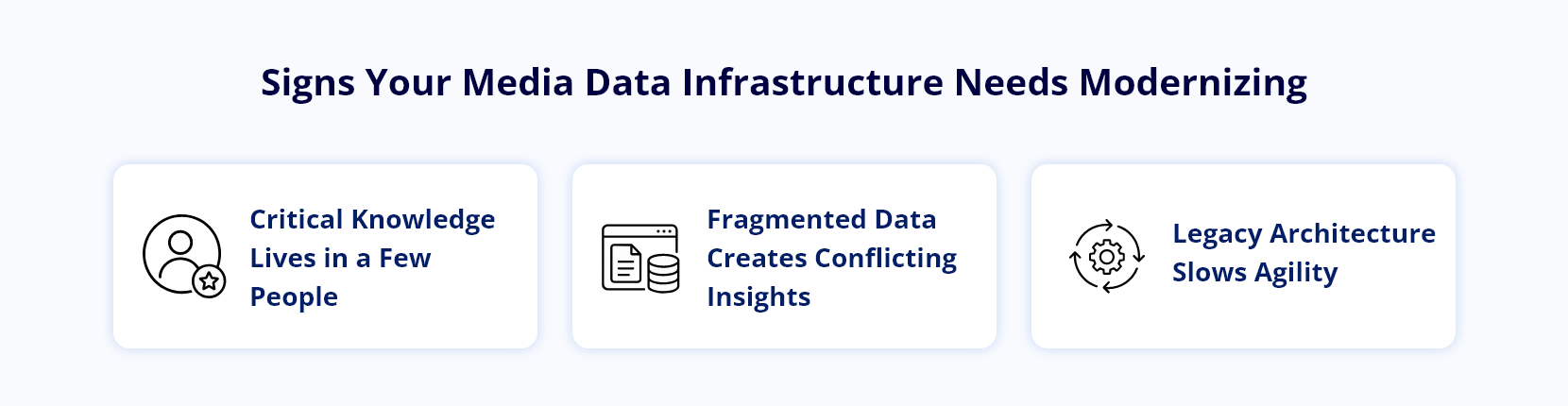
Signs Your Media Data Infrastructure Needs Modernizing
Some of this is easy to miss from inside the organization, because each symptom looks like a one-off problem rather than part of a pattern. A few signs worth checking against:
- A metadata or integration failure takes hours to diagnose because the person who understands the original system left years ago
- Content, audience, and campaign data live in three systems that each tell a slightly different story about the same event
- A “quick report” for leadership regularly takes days because someone has to manually reconcile numbers across systems that don’t talk to each other
- New content formats or distribution platforms require a custom one-off integration every time, rather than plugging into something already built to flex
- Nightly batch jobs increasingly can’t keep up with same-day audience or delivery decisions
- The team can name the exact legacy system everyone’s afraid to touch
Three or more of these showing up at once isn’t a coincidence – it’s the pattern this whole piece is describing.
Three pressures are converging on media companies at once, and each one makes the others worse:
- Content volume keeps compounding: Every new platform, format, and re-versioned cut of the same asset adds another layer to a catalog that already outgrew its original data model – a system built to track one master file per title now has to track a dozen variants, with no clean way to do that without a bolted-on workaround.
- Streaming and short-form have replaced predictable, scheduled distribution: A content supply chain designed for a fixed linear schedule doesn’t map cleanly onto a world where content goes live across a dozen platforms at once and audience behavior shifts hour to hour, not week to week.
- Acquisition costs and margin pressure make inefficiency actively expensive: A manual workaround that cost nothing when subscriber growth was covering for it now shows up directly in the P&L, because there’s no longer enough growth left in the business to absorb it.
None of this is optional to address. It’s a question of when the bill comes due, not whether it does.
What’s Actually Driving Technical Debt in Media
Technical debt in media data infrastructure isn’t one problem – it’s three compounding ones.
Legacy systems built for a different scale: Proprietary, in-house systems built for a specific use case years ago don’t flex when that use case changes. They were built to handle a defined catalog, a defined set of formats, a defined audience – and media has moved past all three definitions since.
Maintenance cost climbs as the people who understand the system leave: Every year a legacy system runs, fewer people on staff actually understand how it works. Support and upgrade costs rise steadily, not because the system does more, but because doing anything with it requires more specialized, harder-to-find expertise.
Vendors are moving away from on-prem, whether or not you’re ready: As more infrastructure and analytics vendors wind down on-premises support in favor of cloud-native versions, staying on legacy infrastructure increasingly means staying on infrastructure the vendor itself is deprioritizing.
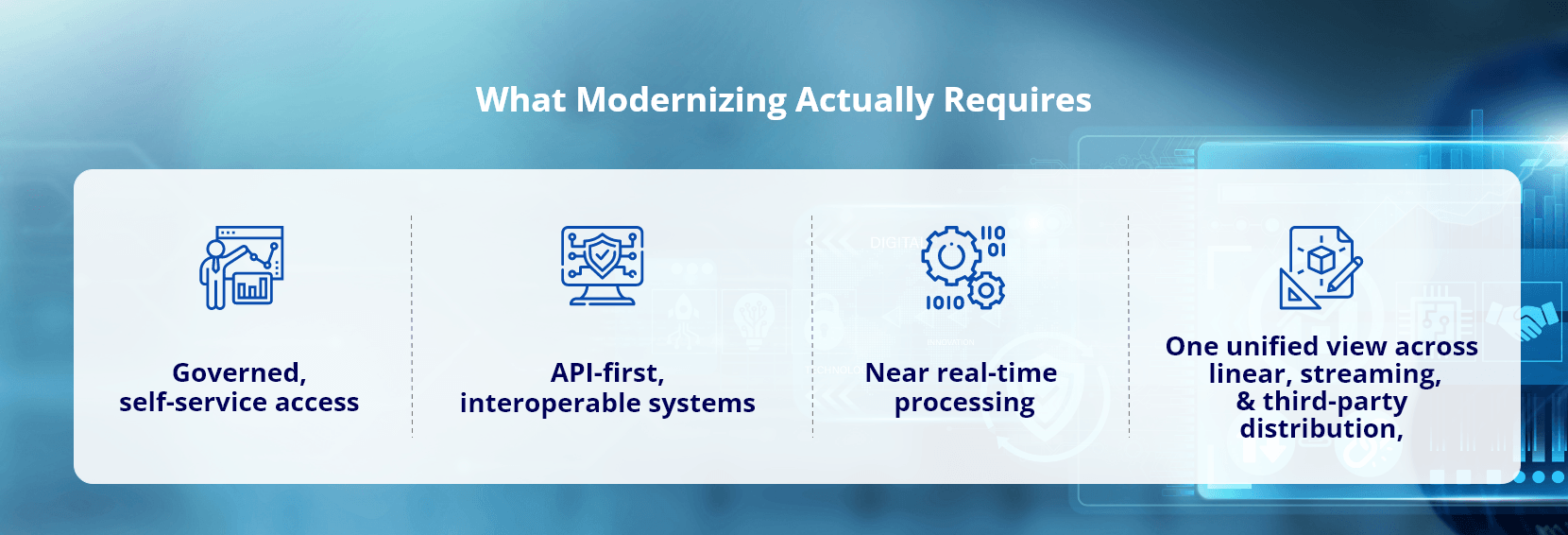
What Modernizing Actually Requires
Fixing this isn’t a lift-and-shift exercise, and it isn’t one change – it’s four, and they only work together:
- Governed, self-service access replacing the request-based model most legacy systems still run on, so a team that wants to query campaign data or pull an audience segment doesn’t have to route that request through whoever owns the system holding it.
- API-first, interoperable systems connecting the metadata layer, the audience layer, and the content layer directly, instead of the point-to-point integrations most legacy stacks accumulate – every one of those custom connections is another piece of the technical debt this problem is made of.
- Near real-time processing, because a report that’s accurate as of last night’s batch job increasingly isn’t accurate enough for same-day content, audience, and delivery decisions.
- One unified view across linear, streaming, and third-party distribution, replacing three separate reporting systems that were each built for their own channel and have never fully agreed with each other – the exact gap Intelligence Hub is built to close.
This is the same principle Databricks is building its own media-industry roadmap around – unifying monetization, audience, and content decisions on one governed platform rather than three disconnected ones.
The Governance Angle Media Often Underestimates
Most data modernization content treats governance as a generic security checkbox – encryption, access controls, compliance. Media has a version of this that’s easy to miss until it becomes a problem: content rights and licensing data. A piece of content’s usage rights, territory restrictions, and expiration windows are themselves data that needs to live somewhere governed and queryable, not buried in a contract PDF someone has to look up manually – the kind of metadata problem ContentIQ is built to solve. On the audience side, first-party viewer data carries its own regulatory weight – GDPR, CCPA, and platform-specific privacy commitments all apply to exactly the kind of audience and engagement data this piece has been talking about, which is why privacy-safe collaboration is core to how Audience Intelligence Platform is built rather than bolted on. Modernizing the infrastructure without building rights and privacy governance into it from the start just moves the same compliance risk onto faster infrastructure.
What Modernization Actually Delivers for a Media Business
The case for doing this work isn’t abstract, and it isn’t really about the technology at all – it’s about what a media company can and can’t do commercially once the infrastructure underneath it changes.
Revenue gets protected, not just reported on: Most of the cost of technical debt shows up as revenue quietly lost rather than a clear line item – a delivery failure caught days too late to fix, a yield opportunity missed because pricing decisions were made on stale inventory data, a make-good nobody saw coming until the advertiser flagged it. Modernized, near-real-time infrastructure is what makes solutions like AdSentinel and CampaignNova Autopilot possible in the first place – catching these gaps while there’s still time to act, not after the fact.
Monetization moves at the speed the market actually requires: New ad formats, new bundling strategies, and new distribution deals all depend on data that’s accessible and current. A pricing or packaging decision that takes two weeks because someone has to manually reconcile three systems is a decision made two weeks late – and in a market where competitors are moving faster, that lag has a real cost attached to it.
The organization survives its own biggest moments instead of just hoping to: Tentpole events – a major sports final, an awards show, a title launch – put more load on infrastructure in a few hours than the rest of the year combined. Systems sized for average-day traffic are the ones that fail exactly when the most revenue is on the line; modernized infrastructure is built to absorb that spike without a manual scramble.
Audience and content decisions get made on this week’s reality, not last quarter’s: Short-form and streaming behavior shifts fast. A recommendation engine, a content investment decision, or an ad-targeting strategy built on data that’s weeks old is already reacting to a version of the audience that’s moved on.
Legacy vs. Modernized Data Infrastructure
| Legacy Systems | Modernized Data Platform | |
|---|---|---|
| Data access | Request-based, routed through a system owner | Governed self-service |
| Processing cadence | Nightly or weekly batch | Near real-time |
| System integration | Point-to-point, custom-built | API-first, interoperable |
| Content supply chain view | Siloed by distribution channel (linear, streaming, third-party) | Unified across all channels |
| Cost trajectory as data grows | Rises faster than data volume (specialized maintenance) | Scales with usage, not headcount |
| Vendor support | Increasingly deprioritized (on-prem sunset) | Cloud-native, actively supported |
Where Modernization Efforts Typically Go Wrong
Most failed modernization attempts don’t fail on the technology. They fail on scope and sequencing.
Trying to modernize everything at once: A full replatform, attempted in one motion, takes long enough that the business requirements shift underneath it before it’s finished. The organizations that actually get through this treat it as a sequence of smaller, real wins – starting with the highest-friction system, not the whole estate.
Migrating without modernizing: Moving a legacy system’s data onto cloud infrastructure without changing how that data is governed, accessed, or processed just relocates the same limitations to a more expensive environment. The migration has to be paired with the governance and real-time access changes, or it’s an expensive move sideways.
Treating governance as a phase two problem: Access controls, lineage tracking, and compliance are much harder to retrofit once a platform is live and teams have built workflows around it. Building governance in from the start costs less than adding it later, every time.
A Practical Path: Where to Start
The realistic path through this is incremental, and it starts with migration – specifically, moving the highest-friction legacy system onto governed infrastructure first, rather than attempting a full replatform. Flash Migrate, Infocepts’ Databricks migration accelerator, is built for exactly this: moving legacy data workloads onto a governed Lakehouse foundation without a ground-up rebuild. Where the legacy layer in question is a reporting or BI system rather than the underlying data platform, Power BI Migration handles that specific migration path.
Once that foundation is in place, the same real-time processing requirement shows up on the operational side. Media companies handling live, tentpole-scale events need infrastructure that absorbs sharp traffic spikes without manual intervention, which is what Real-Time Data Streamer is built to do.
The cost side tends to surface once modernized infrastructure is actually running, and it’s worth planning for rather than discovering after the fact. In one media engagement, a broadcaster carrying $4.5 million in annual AWS spend recovered over $1 million in direct annual savings once the underlying infrastructure was modernized – not through a full replatform, but through four specific fixes: storage retention policies that hadn’t been revisited in years, ETL jobs moved from fixed schedules to event-driven triggers, legacy services retired once a modern platform already covered them, and auto-scaling right-sized to actual load instead of worst-case peaks. Efficiency gains on top of those four pushed total savings past $1.5 million annually. None of that required touching the parts of the system that were actually working – it required knowing which parts weren’t. Cloud FinOps for Media is the discipline built around finding exactly that.
Frequently Asked Questions
No. Most media companies modernize incrementally, starting with the systems that create the most friction. Structured migration approaches and migration accelerators allow organizations to modernize their environment without undertaking a costly full-scale replacement.
Build a Future-Ready Media Data Foundation
Replace siloed legacy systems with a modern, cloud-native data platform that enables self-service access, real-time insights, stronger governance, and seamless integration across streaming, linear, and digital channels.
The Infocepts Media & Entertainment COE helps streaming, publishing, and content businesses harness data to grow audiences and optimize revenue. The team specializes in content analytics, subscriber intelligence, ad tech data, and building the data foundations modern media companies need to compete.
Read Full BioRecent Blogs



Infocepts