
How one biopharmaceutical company traded fragmented dashboards for AI-powered self-service analytics, and what every launch team racing the clock can take from it.
Ask a launch readiness lead what keeps them up the night before a major product launch, and the honest answer is rarely the molecule itself. By the time a therapy reaches launch, the science has cleared trials, regulators, and internal governance more times than anyone can count. What hasn’t been solved, in a surprising number of biopharma organizations, is something far more basic: whether the business can see its own data fast enough to act on it.
That was the position a global biopharmaceutical company found itself in ahead of a major mid-2025 product launch. The company was not short on data. It had the opposite problem. Rich, diverse data sources sat across commercial systems, clinical repositories, and market intelligence feeds, but the insight they should have produced arrived late, in pieces, and only after someone had manually pulled it together. The company had invested in data. It had not yet invested in the ability to use that data at the speed a launch demands, and the fix that eventually worked was not a bigger warehouse or another round of dashboards. It was a fundamentally different relationship between the business and its own information.
The Launch Clock Doesn’t Wait for a Data Reconciliation Meeting
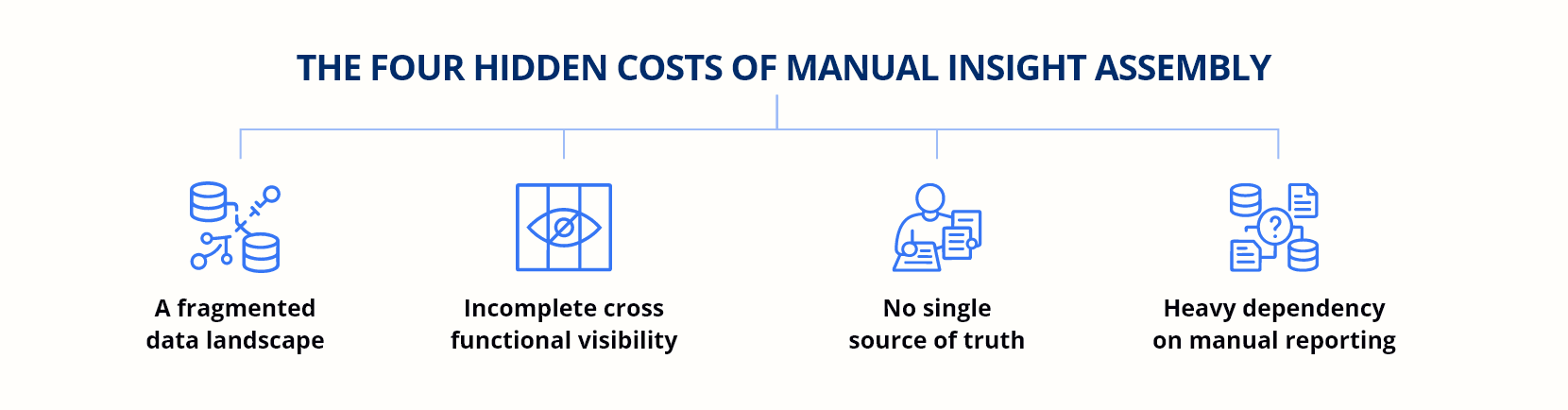
Launch planning runs on a compressed timeline where every function, commercial, medical, market access, and operations, needs the same current picture at the same moment. A payer objection surfaces on a Tuesday call. A competitor files an update. A field team reports a shift in prescriber sentiment. None of these events wait for a scheduled reporting cycle, and yet in most launch organizations, the answer to those signals still runs through a queue. When that picture has to be assembled by hand, the cost shows up in four predictable ways.
A fragmented data landscape
Key datasets lived in disconnected systems. Before any analysis could start, teams had to gather, reconcile, and validate information from multiple sources, which turned a same-day question into a multi-day exercise.
Incomplete cross-functional visibility
No group had a full view of launch readiness. Commercial teams saw their slice, market access saw theirs, and no one had the complete picture needed to make a confident go or no-go call on any given decision.
Heavy dependency on manual reporting
Existing dashboards covered the obvious questions. Anything outside that scope, which in launch planning is most questions, required a new request, a queue, and a wait for the analytics team to build something custom.
No single source of truth
Without one place to view and drill into performance metrics, different teams often worked from different versions of the same story, which is its own kind of risk during a launch window where alignment matters more than almost anything else.
None of this reflects a lack of effort or talent. It reflects a familiar structural problem: enterprise data maturity had outpaced the tools business users had to work with it. The data was there. The speed was not, and in a launch, window measured in weeks rather than quarters, that gap is where opportunity quietly leaks away.
Why This Keeps Happening Across Life Sciences
It would be easy to treat this as one company’s problem, but the pattern repeats across the industry for structural reasons. Life sciences organizations have built sophisticated data infrastructure over the last decade, much of it governed by IT and data engineering teams given the regulatory scrutiny that comes with clinical and commercial data. The unintended consequence is that access has lagged behind infrastructure. A well-governed dataset that only a handful of specialists know how to query is not meaningfully more useful to a launch team than a messy one; the business still has to ask, wait, and hope the answer arrives before the decision window closes.
Self-service analytics does not remove governance.
Done well, it sits on top of a governed foundation and extends access outward to the people who need to act on the answer. The platform built in this case did not loosen governance. It automated the parts of the process that used to require a person, and left the underlying data architecture, and its controls, intact.
From Reactive Reporting to Real-Time Decisioning
Rather than adding another dashboard to the pile, Infocepts worked with the client to rebuild the foundation itself. The result was an AI-powered self-service performance insights platform designed to put answers directly in the hands of the people making launch decisions, not just the analysts building reports for them. The goal was not simply faster reporting. It was a different operating model, one where insight generation stopped being a service business teams requested and became a capability they owned. As a strategic partner of both Snowflake and Databricks, Infocepts was able to build directly on the client’s existing platform investment rather than introducing a new layer of technology to manage.
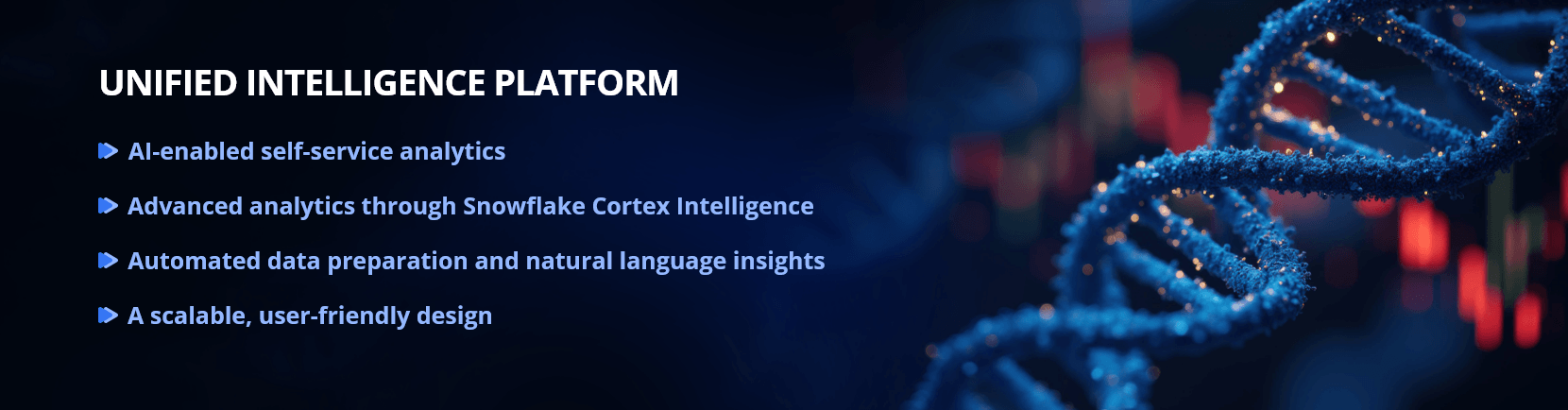
The platform combined four capabilities that, together, changed how the organization interacted with its own data.
AI-enabled self-service analytics: Business users could explore data and generate their own reports without routing every request through a technical team, which freed centralized analytics resources for higher-value work.
Advanced analytics through Snowflake Cortex Intelligence: By running AI and machine learning models directly on already-organized Snowflake datasets, the solution avoided the extra data engineering and integration cycles that usually slow this kind of build down.
Automated data preparation and natural language insights: Data organization and transformation ran automatically, and natural language querying meant a business user could ask a plain-English question and get an answer, not a ticket number.
A scalable, user-friendly design: The platform was built for non-technical users from the start, giving the organization complete visibility across domains with minimal training required to get value from day one.
Taken individually, none of these four capabilities is exotic: What made the difference was combining them into a single, coherent platform rather than treating each as a separate initiative competing for the same budget.
What Changed on the Ground
The shift from manual, fragmented reporting to true self-service analytics reshaped how the organization made decisions during one of the highest-stakes windows in a product’s life cycle, and the effects showed up quickly. Business users began exploring and interpreting data independently, which lowered the load on centralized analytics teams and shortened turnaround times across the board. Automating data preparation and removing redundant manual analysis reduced operational costs and let skilled teams redirect their time toward higher-value strategic work. Advanced AI and Analytics capabilities meant insights were available in real time rather than on a reporting cycle, supporting more informed, more timely decisions across planning, operations, and product strategy.
Just as important, stakeholders across different parts of the business could finally work from a single, unified insights platform. That kind of cross-functional visibility keeps commercial, medical, and market access teams aligned on the same facts, which matters enormously when a launch is unfolding in real time. The platform was also built to grow, on an architecture that can absorb new datasets and new analytical domains as the organization’s needs evolve well beyond this launch.
The Human Side of the Shift
It is tempting to describe a project like this purely in terms of architecture, but the most understated win here is adoption, and adoption is a human outcome, not a technical one. A platform built for non-technical users tends to get used. A platform built primarily to satisfy a data team’s sense of elegance tends to sit unopened after the launch celebration ends. Every business user who asks a question in plain language and gets a trustworthy answer becomes a little more confident asking the next one, and that compounding effect is what turns a self-service analytics platform from a tool into a habit.
The Bigger Lesson for Life Sciences Launch Teams
This story is specific to one company, but the underlying pattern is not. To know more about this success story, read here.
Across life sciences, launch excellence is increasingly a data infrastructure question as much as a commercial strategy question. Companies that treat self-service analytics as a nice-to-have are, in effect, deciding to make their most time-sensitive decisions with yesterday’s information, and hoping that yesterday’s information is close enough to today’s market to still be useful.
The organizations that pull ahead in the first ninety days after launch are rarely the ones with the biggest data teams. They are the ones where a business user can ask a question in plain language and get a reliable answer before the meeting where that question was raised even ends. That is not a technology preference. It is a competitive advantage measured in days, and in launch planning, days are the currency that matters most.
For biopharma organizations preparing for their next launch, the questions worth asking internally are straightforward. Can commercial, medical, and market access teams see the same data today, in the same place, without a request ticket? Can a business user get an answer without waiting on an analyst? Is the analytics foundation something the organization can build on for the launch after this one, or is it a one-off solution that will need to be rebuilt from scratch next time? If any of those answers is no, the gap is not a data problem. It is a launch readiness problem, and it is solvable well before day one.
Biopharma Launches: Beyond the Spreadsheet
ee how AI and connected data help accelerate launch planning and execution.
The Infocepts Life Sciences COE is a team of domain and data experts working with pharma, biotech, and medical device companies to accelerate data-driven outcomes. The team covers clinical data management, regulatory analytics, commercial insights, and AI applications across the drug development and commercialization lifecycle.
Read Full BioRecent Blogs

The Context Layer for Media & Entertainment: Why Smarter AI Models Aren’t Solving the Real Problem
July 27, 2026

Why Pharma Commercial Teams Have a Data Problem – Not an Analytics Problem
July 9, 2026

15% Lower Costs and 20% Faster Delivery in 8 Months: The Business Case for an AI-Ready Supply Chain Data Platform
July 7, 2026
Infocepts