
Your data team is drowning, your backlog keeps growing, and every project seems to stall at “we’re waiting on data.” That’s usually when data analytics outsourcing lands on the table, but it’s hard to know if it will fix the problem or just add another vendor to manage.
The reality is that data analytics outsourcing works very well in some situations and quietly burns money in others. The difference comes down to timing, scope, and how clearly you define what should stay in-house versus what a partner can run more efficiently — the same line Infocepts draws through its D&A operations and support model.
Why Enterprises Consider Data Analytics Outsourcing
Most enterprises don’t start with a grand plan to move analytics out of the building. They reach it after years of ad hoc hiring, tool sprawl, and pressure from the business to deliver faster insights with the same or smaller team.
Common triggers look similar across industries: missed deadlines for key reports, analytics leaders spending their week firefighting instead of shaping strategy, and project teams stalled because they can’t get clean, trustworthy data.
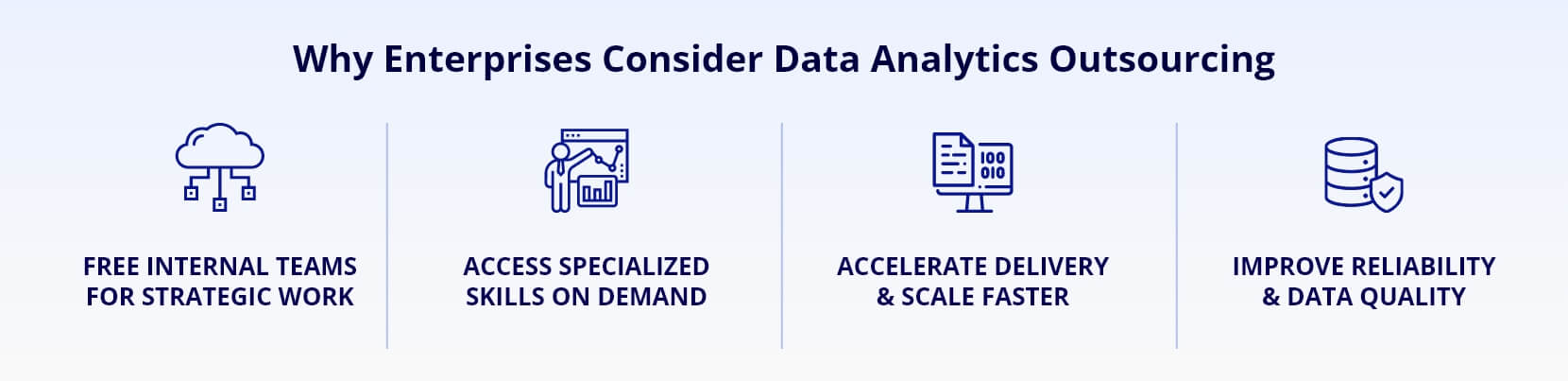
Typical Pain Points That Push Teams To Outsource
One of the strongest signals that you’re ready for analytics outsourcing is when 60–70% of your data team’s time is going into maintenance work instead of new capabilities. Think repeated dashboard fixes, manual extracts, or constant data quality triage.
Another sign is when specialized skills, like ML engineering or advanced data observability, are needed only a few months a year. Hiring full-time for that is expensive and often unrealistic, but relying on one overworked expert is a risk you feel every time they go on vacation — the exact gap elastic capacity is designed to absorb without a permanent headcount add.
What Parts Of Data And Analytics Are Best To Outsource
Not every data responsibility belongs with a third party. The sweet spot for data analytics outsourcing is recurring, well-defined, high-effort work that doesn’t shape your company’s strategic direction but absolutely affects reliability and speed.
Think in terms of layers: strategic ownership and “what should we measure” stay in-house, while “how the data gets cleaned, modeled, and delivered” can often be handled by a specialist partner.
What Stays In-House vs. What a Partner Runs
| Layer | Keep in-house | Good candidate to outsource |
|---|---|---|
| Strategy | Which KPIs matter, what “good” looks like, roadmap priorities | — |
| Architecture | Platform decisions, modeling patterns, design authority | — |
| Data stewardship | Policy and standards definition | Catalog curation, quality monitoring, routine remediation |
| BI and reporting | New use cases, stakeholder engagement | Platform administration, release management, break-fix support |
| Data engineering | Architecture decisions, key modeling patterns | Pipeline monitoring, job optimization, incident response |
| AI / ML operations | Model lifecycle ownership, use case selection | Feature engineering pipelines, drift monitoring |
Read the table by layer, not by team: almost every function here splits into a strategic half that stays and an operational half that doesn’t have to. Treating the whole function as one indivisible unit is what causes both over-outsourcing and refusing to outsource anything at all.
Operational Data Management And Stewardship
Keeping data discoverable, high quality, and properly governed is a grind that never ends. This is where data management services can stabilize your environment by handling catalog curation, data quality monitoring, and routine remediation work.
Outsourcing this layer works especially well when your internal owners define policies and standards, while the partner runs the day-to-day checks, applies rules, and feeds back exceptions and trends to your business data stewards.
Running And Supporting BI And Reporting Platforms
If your analysts spend half their week chasing permissions and fixing broken dashboards, that’s a poor use of scarce talent. Vendors offering managed BI services take over platform administration, release management, and break-fix support across tools like Power BI, Tableau, or Looker — the same tiered coverage Data Helpdesk is built around.
In practice, this often translates into a tiered model: the partner handles platform reliability and standard report changes under service-level agreements, while your domain analysts focus on new use cases and stakeholder engagement.
Data Engineering And Pipeline Operations
Data platforms rarely fail because of one huge issue; they suffer from hundreds of small, nagging problems that drain attention. This makes data engineering managed services a strong candidate for outsourcing, especially for pipeline monitoring, job optimization, and routine enhancements.
A good setup usually keeps architecture decisions and key modeling patterns with your internal lead, while the partner owns day-to-day operations for ingestion jobs, performance tuning, and incident response.
Where Managed Analytics Services Deliver The Most Value
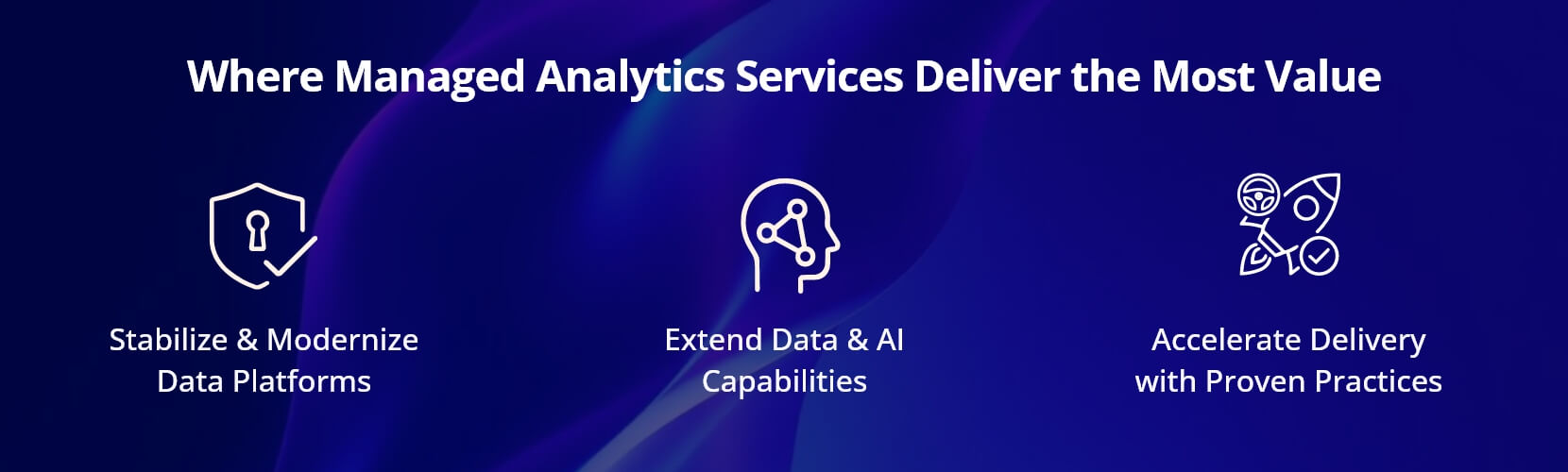
If you’ve only seen outsourcing as “extra hands,” you’re likely underestimating what a strong partner can bring. The most effective managed analytics services combine process discipline, automation, and cross-client experience.
They’re not just filling gaps; they’re often bringing methods and accelerators that would take you years and a lot of trial and error to build from scratch — the automation layer behind Infocepts HyperCare, which pairs self-healing pipelines with 24×7 support rather than a headcount-only staffing model.
Stabilizing And Modernizing Your Data Platform
Many enterprises carry years of technical debt across on-prem databases, cloud warehouses, and shadow IT projects. Providers that specialize in data operations services can take responsibility for monitoring, incident management, and routine tuning across this stack.
Over 6–12 months, this usually shows up as fewer outages, faster refresh times, and more predictable delivery windows for downstream analytics teams, which in turn reduces friction with business stakeholders.
Extending Data And AI Capabilities Without Overhiring
Advanced analytics initiatives often start strong, then stall when early pilots need to be operationalized and supported in production. This is where data and AI managed services can be effective, providing a standing team that knows both cloud platforms and model lifecycle management.
Instead of staffing a full internal squad for every AI use case, you can keep a smaller core team in-house and rely on your partner to handle repeatable patterns, from feature engineering pipelines to monitoring drift in live models.
Deciding Between In-House Teams And Managed Data Services
Before you call vendors, you need a clear view of which work you want to own and which you’re comfortable treating as a service. A quick mapping exercise can save months of frustration with misaligned expectations.
Start by listing your recurring analytics activities and classifying each as strategic, specialized, or operational. Strategic and deeply business-specific work usually stays inside; operational layers are prime candidates for managed data services.
Cost, Control, And Risk Trade-Offs
Done well, outsourcing certain operations can cut total run costs by 20–30%, mainly through better resource utilization, automation, and standardization — in line with what HyperCare clients see in practice: up to 30% lower costs with zero cost escalation year over year. That said, some companies assume savings that never materialize because they underestimate the internal time needed for oversight.
As you evaluate options, be explicit about data privacy, access controls, and compliance requirements. Good data operations services providers will welcome detailed questions on how they handle isolation, credentials, and audits, not brush them aside.
Signals That You Should Keep Work In-House
Not everything belongs in a contract. Some analytics responsibilities are too strategic, too sensitive, or too intertwined with your culture to hand off without losing something important.
This is usually where your unique competitive advantage lives: how you decide which metrics matter, how quickly you can test decisions, and how deeply your analysts understand the business they serve.
Strategy, Experimentation, And Product Analytics
Decisions about which KPIs to track, how to define success, and where to invest next are core leadership responsibilities. Outsourcing these would mean someone else is effectively choosing what “good” looks like for your company.
Similarly, product analytics that shapes customer experience tends to work best when analysts sit close to product managers and engineers, using analytics support services only for overflow work or very specific skills, rather than as a replacement for embedded teams.
Highly Regulated Or Sensitive Domains
If your datasets include health information, payment details, or classified data, outsourcing parts of the stack is still possible but requires more scrutiny. In these cases, you’ll likely keep governance decisions and final approval of data access inside the company.
Partners can still run controlled portions of data analytics outsourcing within dedicated environments, but you’ll want clear lines between what runs on shared infrastructure and what stays isolated under your direct control.
How To Structure An Effective Outsourcing Engagement
The worst outsourcing stories usually start with fuzzy objectives and end with finger-pointing over who owns what. A thoughtful structure up front does more for success than any individual SLA metric.
Spend real time defining business outcomes, not just technical tasks: reduced incident volume, faster report turnaround, or shorter lead time from request to insight.
Scope, SLAs, And Ways Of Working
Be very specific about the systems, data domains, and responsibilities included in your data management services or related agreements. “Support our data platform” is vague; “own monitoring, incident response, and routine enhancements for these pipelines” is workable — the model-specific version of this is Build | Operate | Transfer, where the exit criteria are agreed before the engagement starts.
Get joint dashboards in place early so both sides see the same reality on platform health, backlog size, and business satisfaction, rather than waiting for quarterly reviews to discover you disagree on basic facts.
Keeping Talent, Knowledge, And Architecture In Your Hands
No matter how strong your partner is, you don’t want to become completely dependent on them. Keep architecture decision rights internal, and make sure design documents, runbooks, and code repositories sit in your environment, not just the vendor’s.
That way, if you ever shift providers or bring functions back in-house, your data management services model doesn’t collapse because all the knowledge walked out the door with a single contract.
Where Infocepts Fits
Infocepts runs the operational layer so your team keeps the strategic one, with named services matched to each layer in the table above rather than one undifferentiated support contract.
- Rated #1 Data & Analytics provider on Gartner Peer Insights, three years running, with 97.2% client retention across 20+ years of delivery.
- HyperCare managed services, delivering up to 30% lower costs, 3x faster workflows, and 70% fewer recurring issues through self-healing automation rather than headcount alone.
- A named exit path through Build | Operate | Transfer, so bringing a function back in-house is a planned transition, not a knowledge-loss event.
- Proven at enterprise scale: Wilbur-Ellis selected Infocepts as its analytics managed services provider.
The Bottom Line
Outsourcing parts of data and analytics can feel risky, but with clear boundaries and outcomes, it becomes a practical way to stabilize operations, add scarce skills, and free your team to focus on higher-value work. The key is treating data analytics outsourcing as a targeted, thoughtful decision, not a blanket fix for every capacity problem.
Start small with clearly defined domains, test the model with a partner, and build from proven outcomes instead of promises. Done this way, outsourcing becomes one more tool to help your data function deliver the consistent, trusted insights your business needs.
Frequently Asked Questions
Find the Line Between What to Keep and What to Outsource
A layer-by-layer assessment of your data operations - what stays strategic, what a managed services partner can run reliably, and a named exit path if you ever need one.
Recent Blogs



Infocepts