
Your models will never fix a broken data foundation. If your AI initiatives are stalling, you don’t have a modeling problem — you have an AI ready data problem.
Most enterprises already have data platforms, BI reports, and integration tools. What they lack is a consistent way to move, clean, and serve data to machine learning systems without constant manual heroics. That’s a data engineering problem, and it lives or dies on how you design your pipelines.
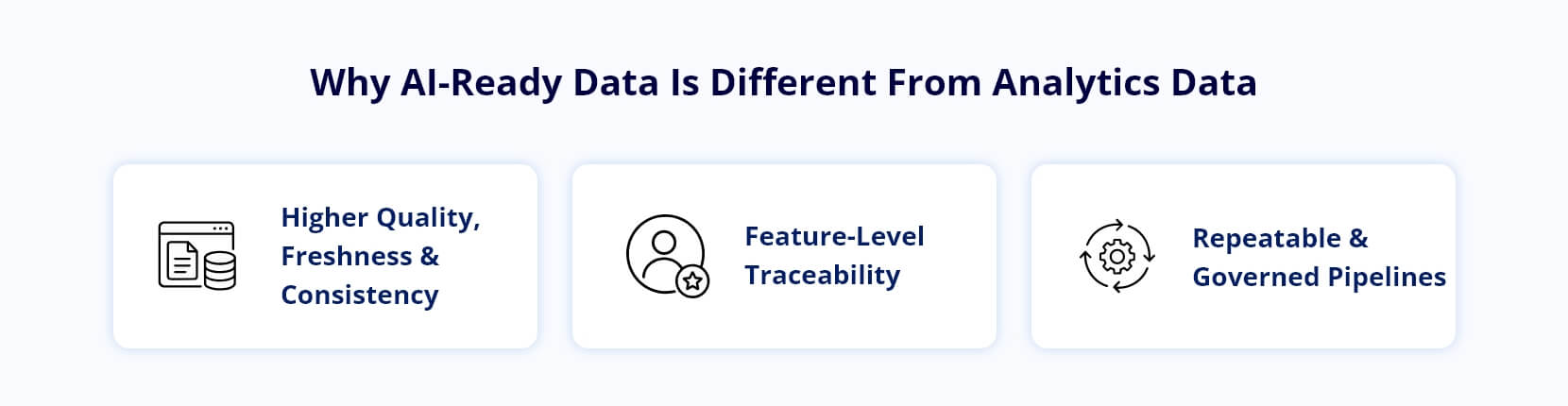
Why AI-Ready Data Is Different From Analytics Data
Traditional BI can live with nightly loads and a few messy edge cases. AI-ready data has tighter expectations: higher freshness, stricter consistency, and a clear path from raw events to features that models can consume.
Dashboards care about aggregates. Models care about the individual data points that created those aggregates, and how they change over time. That’s why the same warehouse that works well for reporting often struggles as the backbone of a machine learning data pipeline.
Key Characteristics Of AI-Ready Data
AI workloads bring specific demands that shape your data pipelines. You need repeatable transformations, predictable latency, and versioning of both data and logic. Most teams underestimate the operational side until a model fails because a “minor” schema tweak quietly broke a feature.
AI-ready datasets should be traceable from prediction back to source systems, auditable for compliance, and stable enough that retraining next quarter yields comparable behavior. That’s hard to retrofit; you design for it from day one. Traceability in particular is a build-time decision, not a reporting feature — see data lineage for AI and analytics for what that takes end to end.
Analytics Data Versus AI-Ready Data
| Requirement | Traditional BI data | AI-ready data |
|---|---|---|
| Grain | Aggregates and summaries | Individual events, plus how they change over time |
| Freshness | Nightly is usually fine | Predictable latency, set per use case |
| Schema change | Absorbed by a report edit | Breaks a feature silently unless versioned |
| Traceability | Report back to table | Prediction back to source system |
| Stability bar | Numbers reconcile this month | Retraining next quarter behaves comparably |
| Failure mode | Visible — a chart looks wrong | Silent — the model learns the wrong pattern |
The last row is the one that justifies the extra engineering. A broken report gets reported. A model quietly trained on bad inputs keeps serving confident predictions, and nobody finds out from the model metrics.
Core Architecture For Scalable Machine Learning Pipelines
A scalable architecture starts with clear separation of concerns: ingest, store, transform, and serve. Trying to do everything in one giant job works for proofs of concept, then explodes the first time someone asks for real-time scoring.
Think of your ML flow as a series of productized stages. Each stage should have a defined contract: inputs, outputs, SLAs, and owners. That’s the mindset that turns fragile scripts into a dependable machine learning data pipeline, and it is the starting point of any modern data architecture engagement.
Layering Your Data Platform For AI
Most successful teams converge on three or four logical layers in their enterprise data engineering stack. Raw data is kept largely untouched for replay, a standardized layer handles cleaning and conformance, and curated feature-ready data sits on top for model training and inference.
By isolating raw, standardized, and feature layers, you shield downstream models from upstream chaos. New data sources can land in raw and be gradually promoted as contracts stabilize. Which storage pattern carries those layers is a separate decision — data lakehouse choices covers how that one plays out.
Batch, Micro-Batch, And Streaming Decisions
Not every AI use case needs millisecond latency. Overbuilding here is one of the fastest ways to burn a data budget. For many enterprise scenarios, a mix of hourly micro-batches plus a small set of true real-time streams hits the mark for modern data engineering needs.
Start from the business requirement: what actually changes if predictions are 5 minutes, 1 hour, or 1 day fresher? Then align technology to that, not the other way around. Where a genuine streaming path is warranted, the Real-Time Data Streamer accelerator exists so that decision does not restart from scratch.
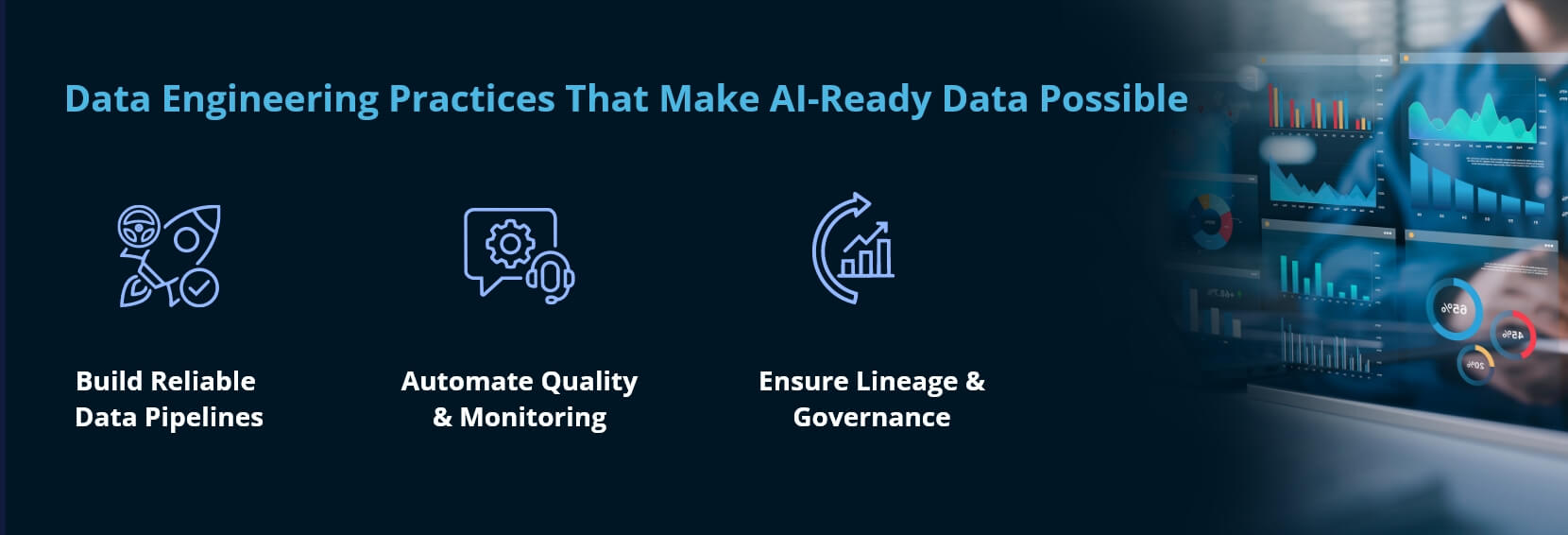
Data Engineering Practices That Make Data Truly AI-Ready
AI projects rarely fail because the model can’t learn. They fail because data is missing, late, or inconsistent. Strong data engineering services are about building guardrails that make good behavior the default, not about hiring a few SQL heroes.
The boring parts — schema management, quality checks, and lineage — are the parts that keep production models from quietly degrading over time.
Designing Pipelines As Products, Not Projects
When you treat AI data engineering as a one-and-done project, you end up with brittle jobs that no one wants to touch six months later. Treat each pipeline as a product with users, a roadmap, and SLAs. That mindset changes design decisions.
Product thinking pushes you to invest in observability, backfills, rollback strategies, and clear documentation because you expect change, not because an auditor asked for it.
Data Quality, Monitoring, And Lineage
For AI, data quality checks aren’t optional. They’re how you avoid silently teaching your model the wrong patterns. Put automated validations and anomaly detection on your critical cloud data engineering flows so bad data is caught before it hits training or inference. The data quality management playbook sets out which checks earn their keep.
Lineage matters too. When a regulator, customer, or internal stakeholder asks, “Where did this prediction come from?”, you should be able to answer in minutes, not days.
Automation And Governance For Enterprise-Scale Pipelines
Manual orchestration doesn’t scale. As data and models multiply, you need a clear strategy for data pipeline automation so that new features, sources, and models don’t require hand-wiring every dependency.
Done well, automation reduces toil without turning your stack into a black box. The trick is to keep humans in the loop at the right points: approvals, exceptions, and design decisions.
Orchestration, Templates, And Reuse
Standard pipelines for ingestion, conformance, and feature generation save months of engineering time across an enterprise. Good data engineering consulting often starts by defining a small set of opinionated templates that most teams can adopt.
Instead of every project reinventing its own folder structure and job patterns, they plug into shared modules for logging, error handling, and deployment. That’s where real reuse happens.
Governance That Enables, Not Blocks, AI
Governance has a reputation as the team that says “no.” Done well, it’s the team that says “yes, here’s the safe way.” For enterprise data engineering, that means standard policies on data classification, retention, and access that are easy to apply programmatically — the approach set out in this data governance framework for AI.
Engineers should spend their time building value, not arguing about which columns can be exposed. Clear rules, built into the platform, keep projects moving while still respecting risk.
From Proof Of Concept To Production: A Practical Roadmap
Every enterprise has a graveyard of successful AI proofs of concept that never reached production. The gap is rarely in the model; it’s in the plumbing, ownership, and process around it. Closing that gap is where modern data engineering teams earn their keep.
A straightforward, repeatable path from experiment to production not only saves time but also builds trust with business stakeholders who are tired of demos that never go live.
A Staged Approach To Productionizing Pipelines
Start simple: define a minimal data pipelines flow that can support one high-value use case. Prove that you can ingest, validate, transform, and serve data consistently, then harden that path with monitoring and alerting before adding more use cases.
Once the first use case is live, treat the pipeline as a shared asset. New models should reuse existing stages where possible, not create yet another parallel stack.
Team Structure And Operating Model
Technical design alone won’t give you reliable data engineering services. You need clear ownership: who runs the platform, who owns individual domains, and who supports models in production when behavior drifts.
Many enterprises succeed with a central platform team plus domain-aligned data squads. The center sets standards and builds common tooling; domains adapt those patterns to their data and business rules.
Where Infocepts Fits
Infocepts builds AI-ready data foundations as governed, platform-native engineering rather than one-off pipeline projects, so the first use case leaves behind a spine the next ten reuse.
- Rated #1 Data & Analytics provider on Gartner Peer Insights, three years running, with 97.2% client retention across 20+ years of delivery.
- 500+ dedicated data and AI engineers across 30+ countries, with platform-native delivery on Databricks, Snowflake, and Microsoft.
- Named services for each layer above — data engineering and integration, DataOps automation, and data science and machine learning — rather than a single undifferentiated engagement.
The Bottom Line
Building AI-ready data is less about exotic algorithms and more about disciplined engineering. The enterprises that win start by designing pipelines that treat data as a product, apply automation thoughtfully, and keep business needs front and center so AI ready data becomes a consistent outcome, not a happy accident.
If you’re serious about moving beyond isolated pilots, start hardening the parts of your pipeline that keep models from making it to production.
Frequently Asked Questions
Build A Data Foundation Your Models Can Trust
Governed, platform-native data engineering that turns pilots into production - layered architecture, automated quality checks, and lineage from prediction back to source.
Recent Blogs



Infocepts