
Your AI models are only as smart as the data you feed them, and master data management is the control point most enterprises skip until something breaks. The result is familiar: conflicting customer profiles, duplicate products, broken metrics, and AI outputs no one fully trusts.
If you are trying to scale AI across the enterprise and still arguing about which customer number or product code is correct, the problem is not your models. It is the lack of clear ownership, a governed single source of truth, and a practical plan for how core data will be created, maintained, and shared.
Why AI Initiatives Stall Without Master Data Management
Most AI roadmaps start with use cases, tools, and talent, but ignore the messy reality of core data scattered across CRM, ERP, billing, and source systems. When you try to stitch it together for AI, every inconsistency in your customer, product, and supplier records multiplies through the pipeline.
Teams end up spending 60–70% of their effort just cleaning and reconciling inputs before a model can be trained. That overhead is a symptom of weak data management foundations, not an unavoidable cost of doing AI work.
The Specific Ways Bad Master Data Breaks AI
Bad or inconsistent reference data creates silent failure modes in AI that are hard to diagnose from model metrics alone. A recommendation model trained on duplicated product entries, for example, may appear accurate on paper but behave erratically in production.
Customer-facing AI is especially sensitive to poor reference data management, because downstream systems will interpret each variation as a separate entity, leading to jarring experiences and misdirected interactions.
From Conflicting Records To A Single Source Of Truth
Enterprises that treat core entities as shared assets, rather than application byproducts, start by defining a clear design for their customer, product, and supplier domains. That design describes what attributes matter, who can change them, and how those changes propagate.
The goal is a governed golden record for each key entity, created through matching, deduplication, survivorship rules, and human stewardship where automated rules are not enough to decide.
What Mature MDM Solutions Actually Do
Good MDM solutions do more than store clean data; they orchestrate how master data is created, approved, and syndicated. They sit between source systems and consuming applications, enforcing quality rules at the point of capture and during ongoing updates. Which specific data quality checks belong at that point of capture is the practical question, and the data quality management playbook works through it.
In practice, that means continuous match-and-merge, reference data alignment, workflow for data stewards, and APIs or events to publish mastered data back into operational and analytical platforms.
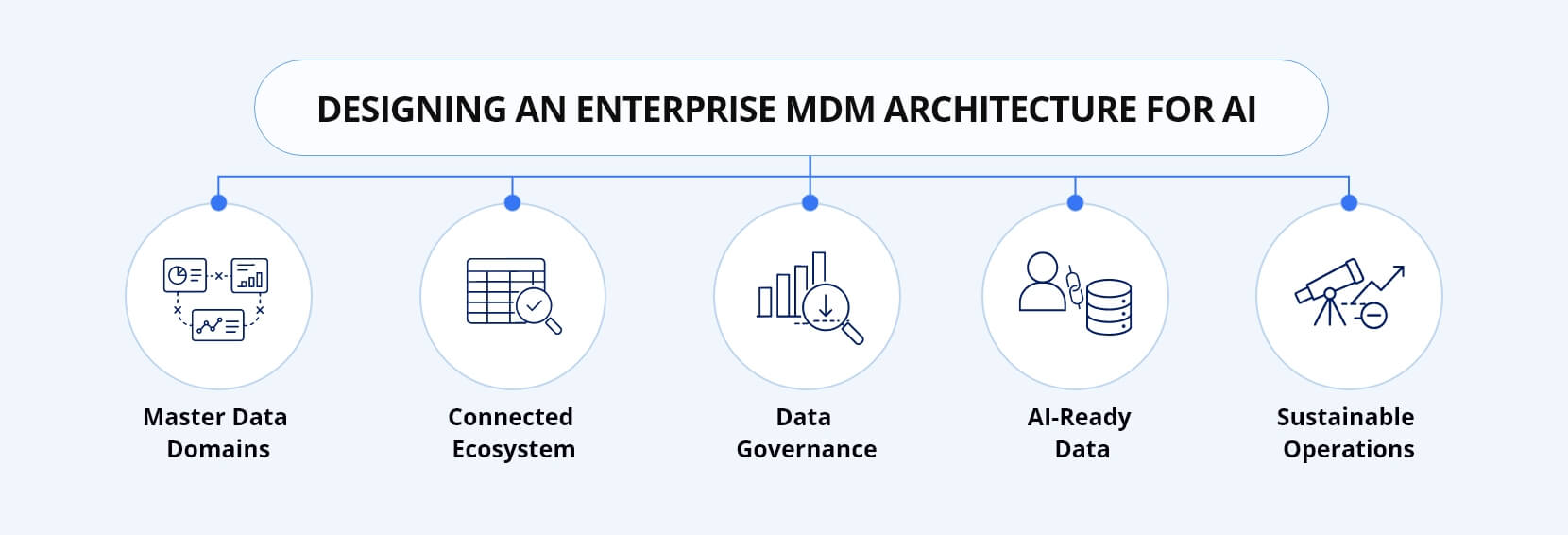
Designing An Enterprise MDM Architecture For AI
To support AI, enterprise MDM cannot be an isolated hub that only feeds downstream reports once a day. It has to integrate with data platforms, event streams, and model training pipelines so that mastered data is always the default, not an afterthought.
Architecturally, that usually means domain-oriented hubs for key entities, real-time synchronization, and clear contracts on how systems consume and contribute to those hubs. Those contracts are the same ones described in AI-ready data pipelines.
Core Components Of An AI-Ready MDM Strategy
An effective master data management strategy has four anchors: domains, governance, technology, and operating model. Miss any one of them and your AI program will rely on unstable foundations that keep shifting under new use cases.
The domains define what “master” actually covers, governance sets the rules and accountability, technology implements those rules, and the operating model keeps everything moving in line with business change.
| Anchor | What it settles | What it looks like in practice | What breaks without it |
|---|---|---|---|
| Domains | What “master” actually covers | Customer, product, and supplier designs naming which attributes matter and how changes propagate | Scope creeps until every table is a candidate and nothing is mastered |
| Governance | The rules and who is accountable for them | Named owners and stewards, decision rights, escalation paths for edge cases | The same arguments resurface with every new project and stakeholder rotation |
| Technology | How the rules get enforced | Continuous match-and-merge, survivorship rules, steward workflow, APIs and events | Clean data exists in a hub that no consuming system actually reads |
| Operating model | How it keeps up with business change | Incremental scope tied to use cases, auditability, a triaged backlog | A canonical model that was perfect for a business that has since moved on |
How MDM Feeds Data Science And ML Pipelines
Data science teams move faster when their feature stores start from mastered customer and product entities instead of raw system extracts. They spend less time on entity resolution and more on modeling, experimentation, and monitoring.
That shift often translates into quicker MDM implementation payback, because every new AI initiative taps into the same curated entities instead of recreating cleaning logic from scratch. That reuse rate is one of the KPIs worth tracking for AI ROI, precisely because it is what makes the foundation compound.
Building A Practical Master Data Management Roadmap
Trying to “fix all data” before delivering AI value is a recipe for never shipping anything, yet ignoring core data issues guarantees failed pilots. The middle ground is a roadmap that ties each MDM milestone to a critical AI or analytics use case — the same thin-slice logic behind a data strategy roadmap.
Start with one domain and a handful of consuming systems, then expand once you have proven that better master data improves a business outcome that leaders care about.
Prioritizing Domains And Use Cases
Most organizations see the fastest returns by starting with customer or product domains, because those tie directly to revenue, churn, and margin. The key is to pick scenarios where mastered data can clearly change a decision, not just tidy up reports.
Link each use case to specific MDM solutions capabilities, such as improving match rates, enforcing hierarchies, or standardizing life-cycle statuses.
Operating Model, Stewardship, And Change Management
Technology does not fix ownership gaps. You need named data owners, stewards, and escalation paths that define who decides when rules clash with edge cases or local needs. Clear accountability shortens debates and stabilizes your core data over time. How to establish those decision rights so they survive a reorganization is covered in this data governance framework for AI.
Without this, your MDM consulting partner will spend months in workshops while the same arguments resurface with every new project and stakeholder rotation.
Common Traps In MDM For AI Programs
One trap is treating MDM as an IT project centered on tools rather than business outcomes. When that happens, the program measures success by fields migrated, not by better AI performance or clearer operational decisions.
Another trap is over-focusing on batch integration and ignoring real-time needs, which leaves AI-driven applications operating on stale insights long after master data has changed.
Over-Engineering And Under-Governing
Some teams spend years designing the “perfect” canonical model, only to find that business units have moved on and adopted new systems in the meantime. Perfectionist designs rarely survive contact with live operations or constant change.
A more pragmatic enterprise MDM approach accepts that models will evolve, and focuses on governance, auditability, and incremental scope rather than theoretical completeness. Auditability in this sense means end-to-end traceability, which is what data lineage provides.
Ignoring Reference Data And Hierarchies
Companies often focus on names and IDs, but ignore codes, categories, and hierarchies that drive pricing, reporting, and access rules. Those look harmless until someone tries to roll up results across divisions, regions, or brands.
Targeting those structures explicitly in your data governance work avoids ugly surprises when AI models try to compare signals across inconsistent groupings.
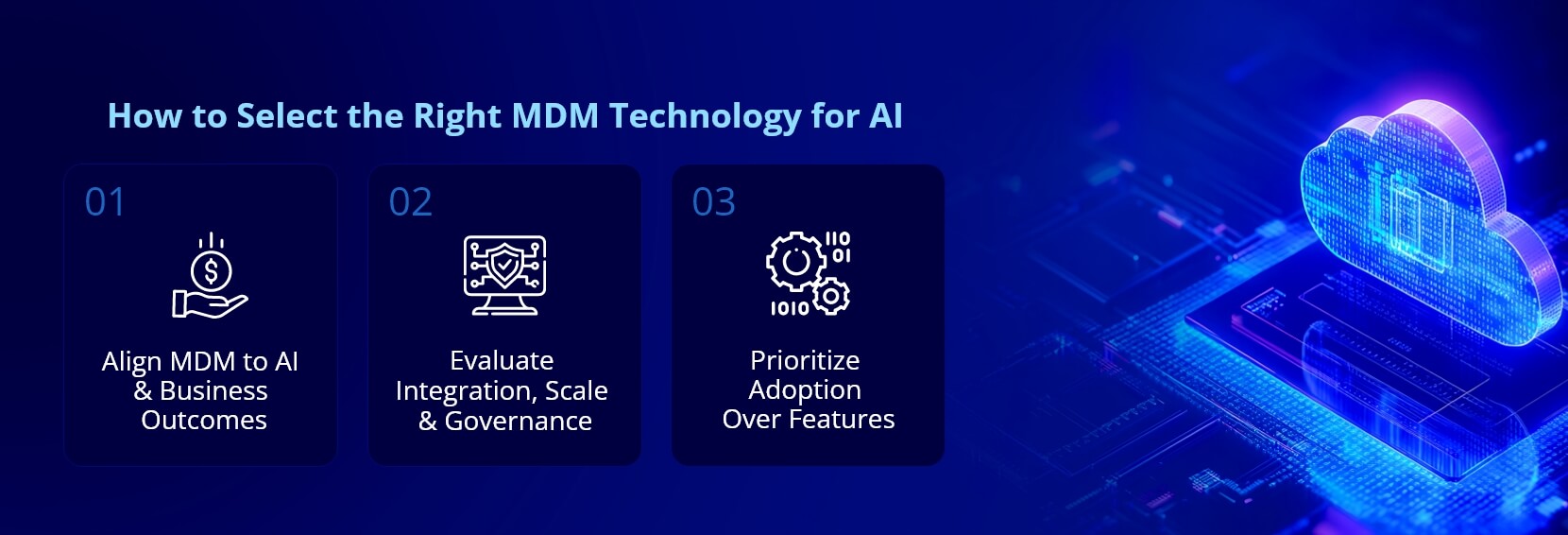
How To Select The Right MDM Technology For AI
Tool selection should start from your AI and analytics roadmap, not from a generic feature checklist. If your highest value use cases require near real-time personalization, look for strong event integration and API-first design.
If you are focused on governed reporting and regulatory submissions, prioritize survivorship transparency, lineage, and strong stewardship workflows when evaluating MDM implementation options.
Key Evaluation Criteria For MDM Platforms
Focus on four questions: how the tool models domains, how it scales, how it exposes mastered data, and how it supports human-in-the-loop decisions. Those answers will affect both adoption and long-term operating costs.
In many cases, a platform that is “good enough” on features but easy for stewards to use will outperform a technically impressive tool that no one outside IT understands as part of enterprise MDM adoption. A data catalog is usually the companion investment, since mastered entities are only useful if consumers can find and interpret them.
Working With External MDM Expertise
Most enterprises bring in outside help for initial roadmap design, tool selection, and early releases. The key is to treat these partners as guides while keeping ownership of decisions and knowledge in-house.
A strong master data management partner will press for clear business outcomes, not just a long list of requirements, and will help you connect MDM investments to AI performance.
Where Infocepts Fits
Infocepts ties each master data milestone to a named AI or analytics use case, so the programme is measured by decisions improved rather than fields migrated.
- Rated #1 Data & Analytics provider on Gartner Peer Insights, three years running, with 97.2% client retention across 20+ years of delivery.
- Named services for the four anchors above — data quality, data governance, data catalog, and a data governance strategy for the operating model.
- Platform-native delivery across Databricks, Snowflake, and Microsoft, so mastered entities are published into the platforms your models already run on rather than into an isolated hub.
The Bottom Line
Enterprise AI succeeds or fails on the quality, consistency, and trustworthiness of the data under it, which is exactly what master data management is designed to shape. Without that discipline, every new AI use case reopens the same arguments about whose numbers are right.
Treat master data management as a core capability, not a side project, and make it the backbone for your next wave of AI initiatives.
Frequently Asked Questions
Give Your Models One Version Of The Truth
Master data management scoped to the AI use cases that depend on it - governed golden records, named stewardship, and mastered entities published into the platforms your models already run on.
Recent Blogs



Infocepts