
Your data strategy roadmap probably exists as a slide somewhere, yet your AI plans still feel stuck in pilot mode. That gap between vision and execution is rarely about tools; it’s almost always about a missing data foundation that AI can actually trust.
The companies getting value from AI right now did the unglamorous work first: they fixed ownership, cleaned up core data domains, and aligned business and technology around a clear sequence of moves. You can do the same, but you need a realistic way to turn “be data-driven” into a concrete, time-bound plan — which is exactly what a data and AI strategy engagement is for.
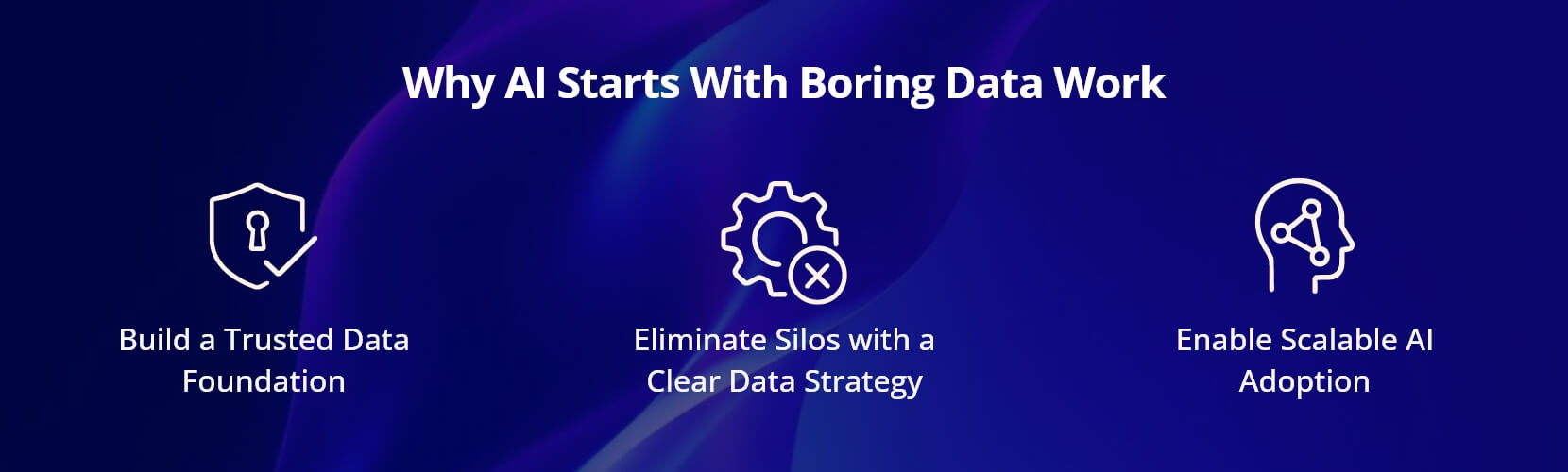
Why AI Starts With Boring Data Work
Most teams start AI initiatives by asking, “What use cases can we automate?” The better starting point is, “Can our data reliably support those use cases?” That’s the question your data strategy roadmap is supposed to answer.
AI models amplify whatever they sit on. Strong inputs mean consistent decisions and credible insights. Messy inputs mean inconsistent predictions, unexplained bias, and endless manual checks that cancel out the promised efficiency.
The Real Risks Of Skipping The Foundation
Without a clear enterprise data strategy, the same problems repeat across business units. Teams buy separate tools, define metrics differently, and create overlapping datasets no one fully trusts.
On paper it looks like progress. In practice, your analysts spend half their week reconciling numbers and your AI proofs of concept stall because no one can agree which data is authoritative.
Step 1: Tie Data To Business And AI Outcomes
You don’t start a data management strategy by cataloging every table; you start by deciding which business problems deserve better data first. This avoids spending two years “modernizing the stack” before anyone sees value.
Pick 3–5 outcomes that matter in the next 12–24 months. For example: reduce customer churn, shorten quote cycle time, or cut inventory write-offs. Then list the AI or advanced analytics use cases that support each outcome. An AI strategy and value identification exercise exists to make that shortlist defensible rather than aspirational.
Translate Outcomes Into Data Questions
For each outcome, ask simple questions: Which customer signals predict churn? Which fields drive pricing accuracy? Which stock movements cause write-offs? That list turns fuzzy ambition into concrete data needs your data strategy framework can work against.
Now you can prioritize by impact and feasibility, instead of trying to “fix all the data” at once. This is also where you align with finance, risk, and compliance so they know what’s changing and why.
Step 2: Design An Architecture That Can Grow With AI
Once you know the high-value use cases, you can sketch an architecture that supports them without locking yourself into a single vendor path. A practical data architecture strategy doesn’t start from tools; it starts from how data flows.
Think in layers: sources, ingestion, storage, transformation, serving, and governance. For each layer, decide what must be standardized enterprise-wide and where business units can choose their own patterns. The modern data architecture question and the platform question are separate, and taking them in that order avoids a lot of rework.
Set Guardrails, Not Concrete
The goal of an AI data strategy isn’t rigid control. It’s predictable behavior at the edges: how data is defined, how quality is measured, and how models access features.
Agree on shared concepts like customer, product, and risk, then allow local teams to extend them. That balance keeps AI experimentation fast while protecting the integrity of your core data foundation. A semantic layer is the usual mechanism for holding those shared definitions in one place.
Step 3: Modernize In Thin Slices, Not Big Bangs
A realistic data modernization strategy avoids multiyear replatforming before any value lands in the business. Instead, you modernize in thin slices: one outcome, one domain, one data product at a time.
Take a single use case, such as churn prediction for one region, and trace the end-to-end data path. That slice becomes your template for the next domain, which speeds up delivery and reduces surprises.
Prioritize Domains, Then Platforms
Too many programs start with a data transformation strategy focused on tools: warehouses, lakes, and pipelines. Flip that order. Prioritize domains like customer, pricing, or supply chain first, then select technology that serves their needs.
This shift keeps meetings grounded in concrete questions: which fields matter, how fresh the data must be, and who owns decisions when numbers don’t match across reports.
Step 4: Get Governance And Operating Model Out Of The Way
Governance often shows up in slide decks as a committee structure, then vanishes when real delivery begins. That’s how you end up with data that is technically compliant but practically unusable for AI.
A working enterprise-wide data operating model is simple: clear ownership, lightweight standards, and feedback loops between builders and business users. Everything else is detail. A data governance strategy that fits on a page beats one that fills a binder.
Make Ownership Non-Negotiable
Every important dataset and metric needs a named owner who understands the business meaning, not just the schema. This is where data strategy consulting partners can help by setting up roles, decision rights, and escalation paths that survive reorgs.
Owners don’t just approve access. They decide how definitions change, what quality thresholds apply, and when to deprecate old feeds so AI models don’t silently rely on stale fields. The mechanics of making that stick are covered in this data governance framework for AI.
Build AI-Ready Delivery Practices
To keep up with AI demand, your delivery model has to change. Central teams can set standards and platforms, but domain squads should own their data and models end to end as part of your enterprise data strategy vision.
Reusable patterns help here: shared feature stores, documented pipelines, and monitoring practices that every team adopts instead of reinventing from scratch. What “AI-ready” means concretely at the pipeline level is set out in AI-ready data pipelines.
Step 5: Turn The Roadmap Into A 12–18 Month Plan
“Roadmap” becomes real when it has dates, owners, and trade-offs. A practical data strategy roadmap fits on one page that executives can actually read and challenge.
Start by mapping quarters, not years. For each quarter, list 3–5 deliverables that move a specific outcome forward, such as a new churn model in production, a single product catalog, or consolidated customer IDs.
What A 12–18 Month Data Strategy Roadmap Looks Like
| Quarter | Focus | Representative deliverables | What proves it worked |
|---|---|---|---|
| Q1 | Outcomes and ownership | 3–5 business outcomes agreed; data questions written per outcome; named owners for core datasets and metrics | Finance, risk, and compliance can state what is changing and why |
| Q2 | First thin slice | One end-to-end data path for one use case in one domain; shared definitions for customer, product, or risk | One model or decision running on governed data, not an extract |
| Q3 | Shared capabilities | Identity resolution or common catalog landed before dependent use cases; reusable pipeline and monitoring patterns | The second domain reuses the first domain’s template |
| Q4 | Scale and adoption | Two to three further domains; self-service access for domain squads; deprecation of superseded feeds | Adoption metrics moving, not just delivery tickets closing |
| Q5–Q6 | Operating rhythm | Governance running as policy rather than committee; backlog triaged by owners; measured manual-effort reduction | New use cases start from existing assets by default |
The sequencing in Q3 is the part most roadmaps get wrong. Shared capabilities have to land before the use cases that depend on them, or every later initiative pays the integration cost again.
Sequence Work To Reduce Rework
A strong enterprise data strategy avoids redoing integration work every time a new initiative appears. That means sequencing projects so shared capabilities land early and expensive refactors later are less likely.
For example, invest in a common identity graph before scaling marketing AI use cases, so your models don’t quietly multiply “new” customers who are just duplicates in different systems. That identity problem is the core of master data management for enterprise AI.
Measure Real Adoption, Not Just Delivery
A roadmap that only tracks completed technical tasks will look green while the business still works in spreadsheets. Build adoption metrics into your data management strategy from the start.
Track how many users rely on the new datasets, how often AI outputs drive decisions, and how much manual work has disappeared. Those numbers keep everyone honest about progress, and they are the same ones that make an AI ROI case hold up in front of a CFO.
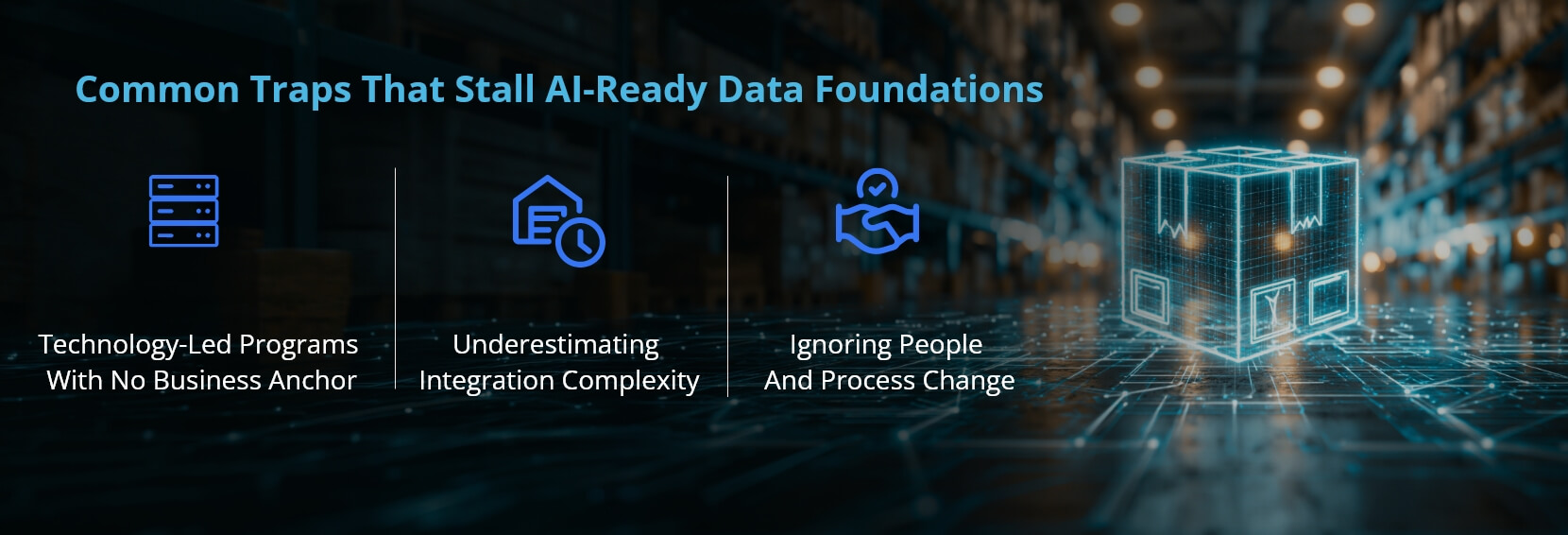
Common Traps That Stall AI-Ready Data Foundations
Even with a solid plan, certain patterns keep showing up across large organizations. Recognizing them early can save you a year of wheel-spinning.
One common trap is treating every data problem as unique. In reality, issues like missing identifiers, unclear ownership, and conflicting definitions tend to repeat across domains.
Technology-Led Programs With No Business Anchor
Many data transformation programs start strong but struggle to prove value. A data transformation strategy that reads like a tool rollout plan instead of a business plan is a warning sign.
If your success measures are mostly platform adoption statistics instead of business or AI outcomes, expect skeptical stakeholders and shrinking budgets when the next cost-cutting cycle arrives.
Underestimating Integration Complexity
Most large organizations underestimate the hidden dependencies in their data landscape. A sound data architecture strategy calls out these dependencies and plans for staged integration instead of promising an overnight consolidation.
Planning for messy reality — legacy systems, manual workarounds, local spreadsheets — keeps your AI ambitions grounded and your timelines honest.
Ignoring People And Process Change
Even the cleanest technical design fails if teams keep old habits. A thoughtful data consulting approach pairs architecture work with training, incentives, and new ways of working.
This might look like shifting report creation to domain teams, building self-service data access, or changing how performance reviews account for data quality responsibilities. A data fluency assessment is a practical way to find out where those habits actually sit before you plan around them.
Where Infocepts Fits
Infocepts sequences data strategy so shared capabilities land before the use cases that depend on them, and measures adoption alongside delivery.
- Rated #1 Data & Analytics provider on Gartner Peer Insights, three years running, with 97.2% client retention across 20+ years of delivery.
- Assessment-led entry points — a data strategy assessment and a data fluency assessment — so the roadmap starts from measured reality rather than a workshop opinion.
- Fractional advisory through Advisory Aircover for organizations that need senior data leadership without a permanent hire.
The Bottom Line
Building an AI-ready data foundation is less about a perfect architecture and more about a disciplined sequence of moves. A clear data strategy roadmap ties business outcomes to specific domains, modernizes in thin slices, and sets up ownership so data stays fit for AI over time.
If you align your roadmap to a handful of high-impact outcomes and measure adoption as carefully as delivery, your AI initiatives stop being experiments and start becoming part of how you run the business.
Frequently Asked Questions
Turn Your Data Strategy Slide Into A Plan
Assessment-led data and AI strategy that sequences shared capabilities before dependent use cases, modernizes in thin slices, and measures adoption alongside delivery.
Recent Blogs



Infocepts