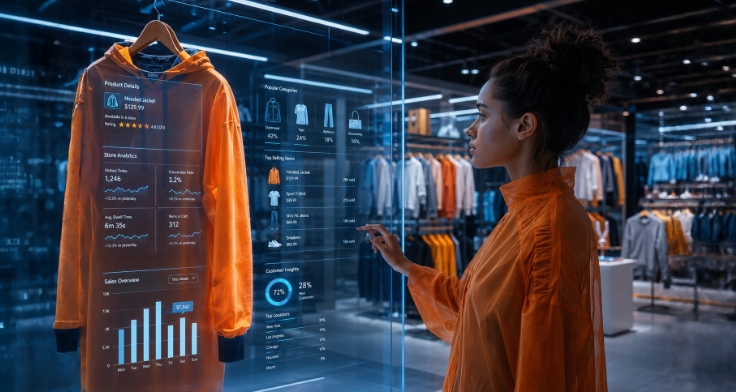
Your team has more reports than time, yet decisions about pricing, stock, and promos still lean on gut feel. Retail analytics promises answers, but turning data into better margins and fewer stockouts is where most retailers get stuck.
The gap isn’t data. It’s knowing what to track, how to connect the dots, and how to get those insights in front of merchants, planners, and marketers while they can still act on them. This guide breaks down how to use retail analytics to tune pricing, inventory, and promotions in a way that shows up in your P&L, not just in a dashboard.
Why Retail Analytics Matters To Merchants, Not Just Data Teams
Retail analytics is only useful if it helps a buyer decide what to stock, a planner decide where to ship it, or a marketer decide what to promote. If it doesn’t change a decision, it’s just decoration.
Most chains sit on years of transactions, loyalty data, web behavior, and store traffic, but it lives in silos. That’s why the same items are overstocked in one region and constantly sold out in another. Stitching these sources together into retail data analytics that speaks the language of margin, sell-through, and contribution is what actually changes outcomes.
Teams that use this well don’t wait for month‑end reports. They look at yesterday’s performance by store, by size, and by channel, then adjust transfers, purchase orders, or promo calendars accordingly.
Core Capabilities Of Modern Retail Data Solutions
Effective retail data solutions share a few common traits: they consolidate data from store systems, ecommerce, ERP, and marketing; they model it around products, customers, and locations; and they deliver insights in tools your teams already use.
That means near real‑time feeds from POS and online orders, clean product and location hierarchies, and business rules that flag exceptions instead of making people hunt for issues. If your team spends hours copying CSV files together, you don’t have an analytics problem, you have a plumbing problem.
From there, you can layer retail AI on top of that foundation so models can forecast demand, suggest prices, and predict promo lift with enough accuracy to change how you plan.
Pricing Analytics: From Blanket Markdowns To Surgical Moves
Most retailers discount broadly, then hope the volume makes up for the lost margin. Pricing analytics gives you a more precise playbook so you cut price where it actually changes behavior and keep it where customers will pay full fare.
Start by segmenting items based on elasticity. Some products barely move with a discount, while others spike with even a small price cut. Pull 12–18 months of price and unit data, and have your data team fit simple demand curves before you jump into more advanced retail AI solutions.
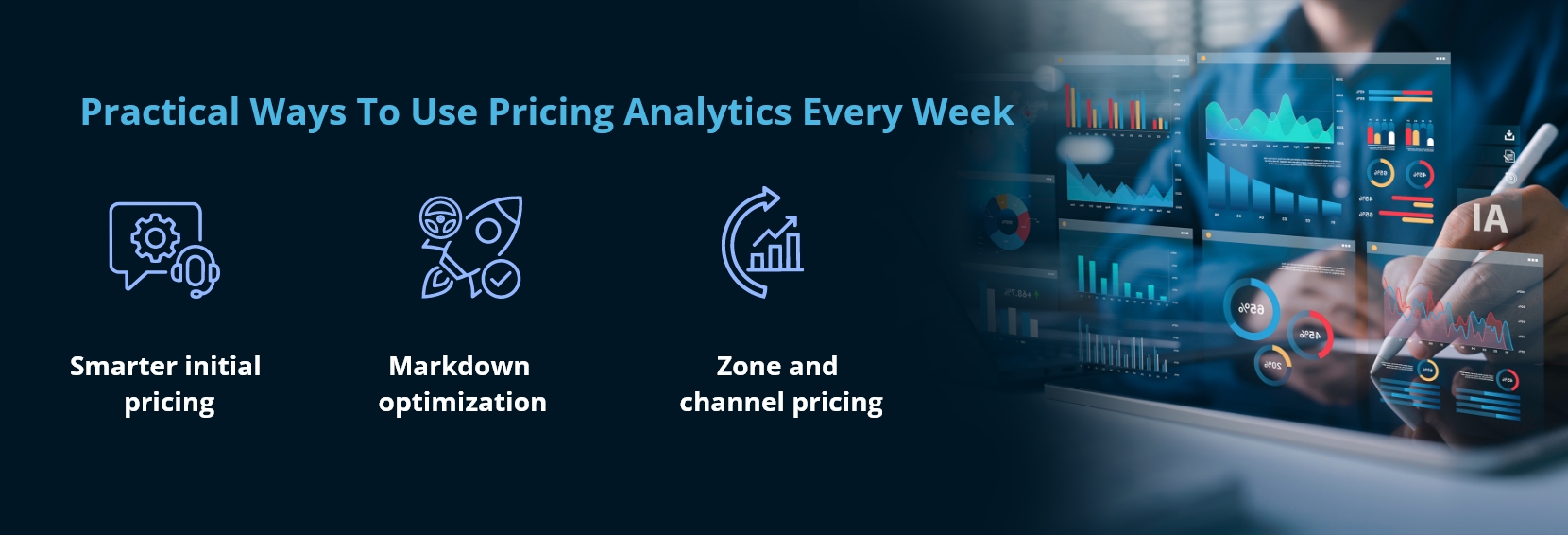
Practical Ways To Use Pricing Analytics Every Week
Once the foundation is in place, there are three pricing rhythms that usually deliver quick wins for retailers under 500 stores.
1. Smarter initial pricing: Use pricing analytics to compare your planned price to historical competitor data, your own promo history, and category role. Traffic drivers can carry lower margin, but your “gotta‑have” items often tolerate a higher starting price.
2. Markdown optimization: Replace end‑of‑season fire sales with progressive markdowns based on projected sell‑through. The goal is to start discounting 4–6 weeks earlier on problem SKUs, at lower depths, instead of waiting and taking a 60% hit all at once.
3. Zone and channel pricing: Use inventory analytics to tie price moves to local stock positions. If a style is overstocked in the Midwest but tight on the coasts, you don’t need a national discount. Take a deeper markdown where you’re heavy, and protect margin where you’re already selling through.
Inventory Analytics: Getting The Right Units In The Right Place
If you talk to store managers, their top complaints are late allocations, the wrong size curves, and slow replenishment on proven winners. Inventory analytics tackles these problems directly by combining sales, returns, and on‑hand data at SKU‑store level.
Instead of “weeks of supply” averaged across a region, you see which stores are chronically short on certain sizes, which DCs are sitting on dead stock, and where you’re wasting open‑to‑buy on items that won’t earn their space.
Using Retail Forecasting To Shape Your Buy And Replenishment
Good retail forecasting isn’t about getting a single perfect number. It’s about a realistic range that helps planners set buys, safety stock, and reorder points that balance risk and return.
A practical approach is to forecast at the product‑location cluster level, then apply store‑level factors based on historic demand patterns. From there, use inventory analytics to highlight where your forecast is consistently off so you can refine the models instead of treating them as infallible.
Retailers that make this shift often see 1–3 points of margin improvement in under a year, mostly from lower markdowns and fewer lost sales on core styles.
From Reports To Daily Inventory Decisions
Dashboards alone won’t fix stock issues. You need clear actions tied to what the metrics say. That usually means alerting planners when a high‑margin item is about to stock out in top stores, or when tail SKUs are clogging DC space.
Retail business intelligence that surfaces “do something now” events outperforms static reports every time. Examples include auto‑generated transfer suggestions, reorder proposals for bestsellers, and exception lists for stores with unusual shrink or return patterns.
Customer And Promotion Analytics That Actually Drive Growth
Promotions are often set on tradition and vendor pressure: same calendar, same discounts, same channels. Customer analytics lets you break that pattern by focusing your promotional budget where it changes customer behavior, not where it simply rewards shoppers who would have purchased anyway.
Start with a clear view of new versus returning customers, trip frequency, and basket size by campaign. Look at which segments respond to deep discounts versus targeted offers like early access, bundles, or exclusive colors.
Designing Smarter Promotions With Retail AI
Once you understand segment‑level behavior, you can use retail AI to simulate different promo structures before you commit. That might include testing alternate discounts on a sample of stores or online traffic, then rolling out the winner.
Retail AI solutions can also score customers on their likelihood to respond to a particular offer. Instead of blasting a 30% off coupon to an entire list, send a lower discount to deal‑sensitive buyers and a value‑focused message to customers who care more about newness or convenience.
Over time, this approach trims discount costs and makes your promotional calendar less dependent on blanket “friends and family” events that train customers to wait for sales.
Making Retail Analytics Stick In Your Organization
Tools don’t change outcomes by themselves. The real shift comes from getting merchants, planners, and marketers to trust and use the insights in their daily decisions.
That starts with shared definitions: margin, like‑for‑like, sell‑through, and on‑hand should mean the same thing in finance and on the merchandising floor. From there, your retail business intelligence environment should reflect those definitions so people don’t waste time arguing over whose numbers are “right.”
Practical Steps To Operationalize Analytics
There are a few moves that consistently help retailers turn analytics into habit instead of a side project.
- Embed key reports and alerts in tools teams already use, like planning systems and store apps.
- Run pilot tests with one category or region, then socialize real before‑and‑after results.
- Pair data scientists with merchants so models are grounded in category realities, not just math.
- Set clear ownership for retail data solutions, so quality and availability stay high.
This is where many analytics programs stall. Without clear roles and visible wins, dashboards become wallpaper instead of a decision engine.
Conclusion
Retail analytics isn’t about having more charts. It’s about using data to make better pricing calls, position inventory where it sells, and build promotions that grow profitable trips instead of margin‑draining spikes.
Done well, it creates a shared view of performance across stores, channels, and categories so teams argue less about the numbers and focus more on action. If you’re ready to move from static reports to decisions driven by clear, timely insight, partner with Infocepts to put retail analytics at the center of how your business runs.
Frequently Asked Questions
Retail analytics helps retailers use data from sales, inventory, customers, ecommerce, and marketing channels to make informed decisions. It improves pricing strategies, inventory management, customer engagement, and overall profitability.
Retail analytics identifies pricing opportunities, reduces unnecessary markdowns, improves inventory allocation, and helps retailers optimize promotions. These insights can increase sell-through rates while protecting margins.
Inventory analytics tracks stock levels, sales patterns, replenishment performance, and product movement across stores and channels. It helps retailers reduce stockouts, prevent overstocking, and improve inventory turnover.
Retail forecasting uses historical sales, seasonality, demand trends, and customer behavior to predict future demand. Better forecasts help retailers set accurate inventory levels, optimize purchasing decisions, and lower holding costs.
Retail AI analyzes customer behavior, price elasticity, sales trends, and promotion effectiveness to recommend optimal pricing strategies and personalized offers that drive revenue while protecting margins.
Retailers should monitor sell-through rate, inventory turnover, gross margin, stockout rate, markdown percentage, basket size, customer retention, and promotion performance to improve operational efficiency and profitability.
Infocepts helps retailers unify data, build scalable analytics platforms, develop AI-powered forecasting models, optimize pricing and inventory strategies, and deliver actionable insights that improve business performance.
Drive Margin Growth with Modern Retail Analytics
Empower merchants, planners, and marketers with real-time insights for smarter pricing, inventory optimization, and customer engagement.
Talk to Our Experts
Frequently Asked Questions
Drive Margin Growth with Modern Retail Analytics
Empower merchants, planners, and marketers with real-time insights for smarter pricing, inventory optimization, and customer engagement.

Author
The Infocepts Retail COE brings together data and analytics specialists focused on helping retail and CPG organizations turn complex data into smarter decisions. From demand forecasting and inventory optimization to customer analytics and omnichannel performance, the team works at the intersection of data engineering, AI, and retail strategy.
Read Full BioRecent Blogs


Infocepts