
Conversational BI breaks down when your metrics disagree. A common semantic model fixes that, and it’s far less technical than it sounds.
Picture a Monday leadership meeting. Your CFO asks Copilot for last quarter’s customer churn rate, and it comes back with 4.2 percent. Ten minutes later, the head of sales pulls up a dashboard that says 5.1. By Wednesday, someone on the product team has asked Genie the same question and gotten a third number.
Nobody in that room is talking about churn anymore. They’re talking about which number to believe.
If that scene feels familiar, you’re in good company. Most enterprises running conversational BI on top of older reporting estates have lived some version of it. And the instinct in the room is almost always the same: the AI must be wrong.
The Tools Are Mostly Doing Their Job
Most of us bought into conversational analytics for good reasons. After years of cloud migrations, dashboard builds, and self-service programs, the idea of typing a question in plain English and getting an answer felt like the finish line. No SQL, no ticket to the analytics team, no waiting until Thursday.
To be fair, Microsoft Copilot and Databricks Genie largely deliver on that promise. They understand the question, find relevant data, and return an answer quickly and confidently.
The confidence is where things get tricky. When three tools give three answers, each with equal certainty, it’s easy to conclude the technology is broken. In most cases, it isn’t. What you’re seeing is something your organization has quietly worked around for years, now showing up fast and in front of everyone.
Legacy BI Has Been Hiding The Problem
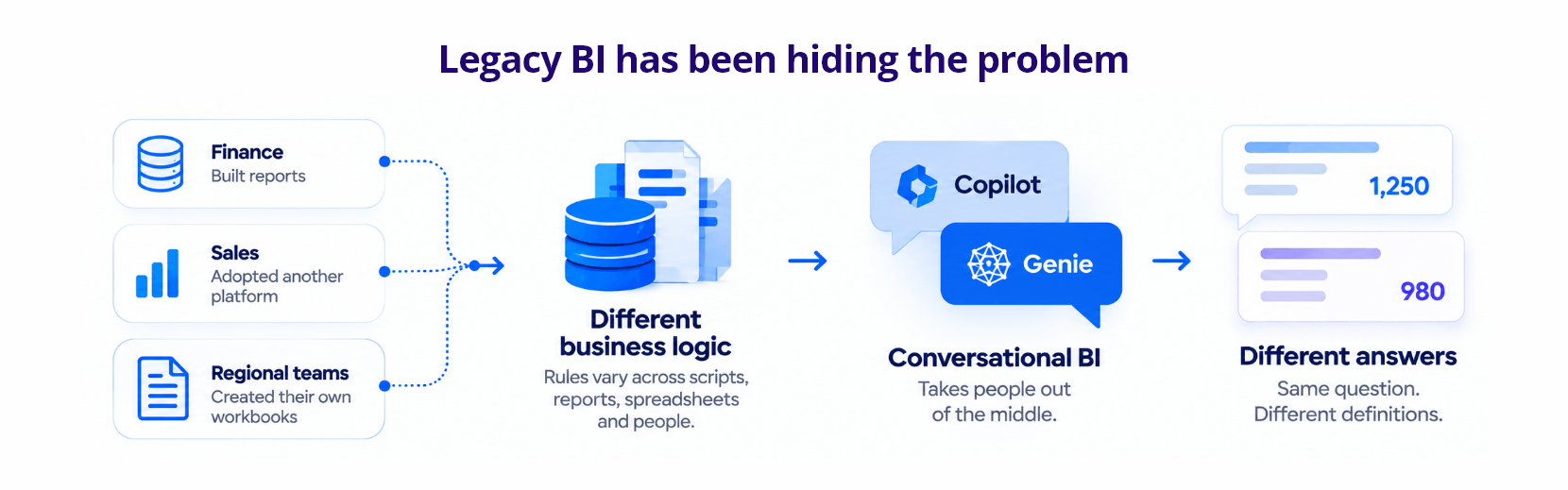
Think about how most BI estates actually grew. Finance built its reports in one tool fifteen years ago. Sales adopted another platform after a reorg. A regional team created its own workbooks because the central ones didn’t reflect local pricing. Every one of those decisions made sense at the time.
Along the way, business logic got baked into all of them. The rule for what counts as revenue might live in a database script, a report filter, a spreadsheet macro, and one senior analyst’s memory, each slightly different.
| Team | “Revenue” means | Where that logic tends to live |
|---|---|---|
| Finance | Recognized revenue | Database scripts, finance reporting tool |
| Sales | Bookings | CRM reports, report-level filters |
| Marketing | Influenced pipeline | Spreadsheet macros, campaign workbooks |
| Regional teams | Revenue at local pricing | Local workbooks, one senior analyst’s memory |
Every version is defensible, and none of them match. Duplicate, orphaned, and unused reports pile up the same way, and the accumulated cost is what we call BI debt.
People learned to live with it. Analysts knew which report to pull for which meeting. Quarterly reviews opened with ten minutes of “whose number is this?” The inconsistency stayed contained because people were standing in the middle, translating.
Conversational BI takes those people out of the middle. That’s the whole point of it. So when Copilot reads from one data model and Genie reads from another, and each was built on a different flavor of legacy logic, you get different answers. The AI isn’t guessing. It’s faithfully repeating whichever definition it was handed.
A Brilliant New Hire With Six Rulebooks
Here’s an analogy that tends to land with executive teams.
Imagine hiring the sharpest analyst you’ve ever met. On day one, you give them access to every report, database, and spreadsheet in the company. Then you ask a simple question: what’s our customer retention rate?
By lunch, they’ve found six different calculations, owned by four teams, living in three systems. They’re more than capable of running every one. What they can’t do is decide which one the business actually means. That’s a policy call, and it belongs to leadership.
Copilot and Genie sit in exactly the same seat. Large language models are remarkably good at understanding what you asked. They were never designed to settle internal disagreements about what a word means at your company.
Trust Matters More Than Model Choice
Plenty of boardroom AI conversations focus on the models themselves. Which assistant reasons better? Which platform is faster? Those are fair questions, but they aren’t what decides whether conversational BI succeeds inside a large enterprise.
Trust decides it.
The first time an executive catches two conflicting numbers, they start double-checking. By the third time, they’ve stopped using the tool. They email an analyst instead, or go back to the spreadsheet they know. Adoption stalls, and the productivity gains that justified the investment slowly fade. The technology didn’t fail. Confidence in the answers did.
That’s the part we’d ask every CIO and CDO to sit with for a minute. Trust isn’t something an AI model produces on its own. It comes from consistency, and consistency has to be built on purpose.
What A Common Semantic Model Actually Is
The phrase sounds more intimidating than it is. A common semantic model is a shared business dictionary that every tool agrees to use.
It’s one place where the company writes down, in plain business terms, what its most important numbers mean. What counts as revenue. How churn is calculated. Who qualifies as an active customer. Which date a sale gets counted on. Each definition has a clear owner, and each one is written once.
Every tool then reads from that same dictionary. Your dashboards, your finance reports, Copilot, Genie, and whatever AI agent you roll out next year all pull revenue from the same definition. Ask the question anywhere and you get the same answer, because there’s only one answer to give. Why this layer is what makes enterprise AI trustworthy is set out in why a semantic layer finally makes enterprise AI trustworthy.
It also helps to be clear about what it isn’t. It’s not another dashboard, and it’s not a full data warehouse rebuild. Nobody has to abandon the BI tools they already rely on. The semantic model sits between your data and the tools people use to ask questions, doing the translating that analysts used to do by hand.
There’s a quieter benefit, too. When a board member asks where a number came from, you can point to the definition, the owner, and the source, instead of reverse-engineering someone’s old report logic at 9 p.m. the night before. The same idea applied to one sector is worked through in how a semantic layer helps a retail analytics team trust their numbers.
Getting There Is Mostly A Business Conversation
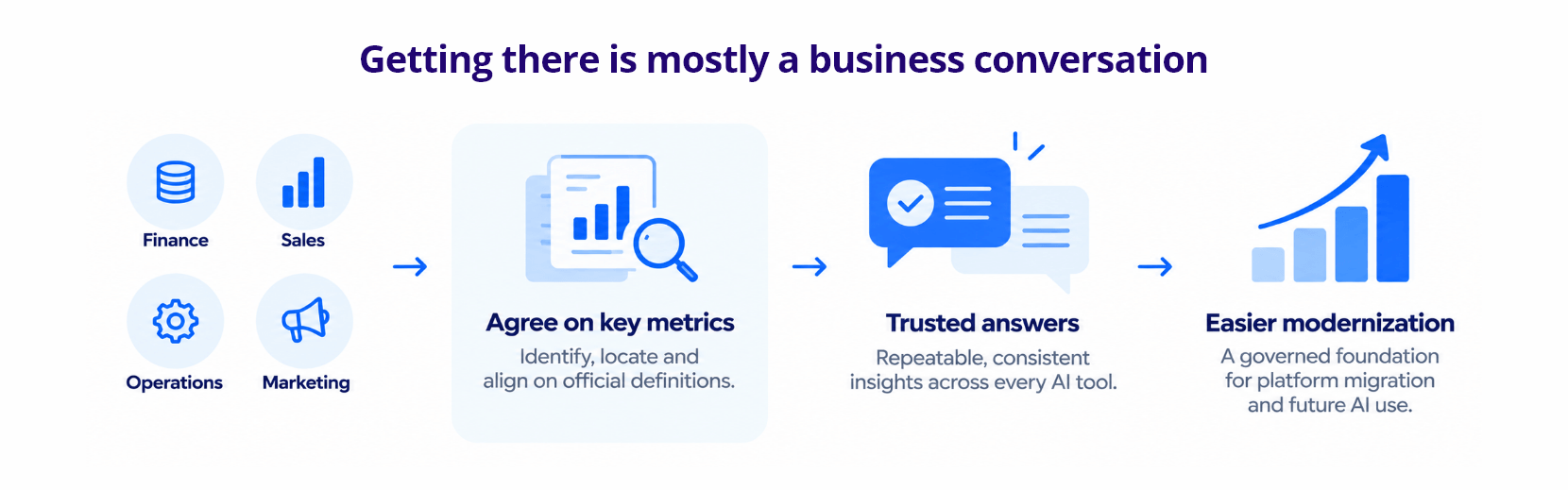
If you’re wondering where to start, the hardest part usually isn’t technical. It’s getting finance, sales, operations, and marketing to agree on the twenty or thirty metrics that actually run the business.
That work tends to begin with a handful of practical questions. Which metrics do our executives ask about most? Where do those metrics live today, and how many versions exist? Who has the authority to decide the official definition — the decision-rights question a data governance strategy exists to settle? And will every AI tool we deploy reference that decision, or keep its own private copy?
Organizations that work through those questions usually feel the shift quickly. Answers become repeatable. Leaders stop arguing about whose number is right and start discussing what to do about it. Use of conversational BI climbs, because people finally believe what it tells them.
For companies still running older BI platforms, there’s a bonus. Pulling years of buried logic out of individual reports and into one governed place makes every future modernization step easier, whether that’s a BI platform migration or the next wave of AI agents.
This Is Your AI Foundation
Nearly every CIO, CDO, and analytics leader we talk to feels pressure to move faster on AI. Boards want a plan. Business leaders want answers in seconds. That urgency is real, and it’s healthy.
But scaling conversational BI on top of conflicting definitions doesn’t speed anything up. It multiplies the confusion. Each new assistant and each new agent becomes one more way to get a different number. When the definitions are aligned, the same investment works in your favor, and every new tool adds clarity instead of noise.
That’s why the strongest AI programs don’t start with the model. They start with the foundation: agreed business meaning, applied consistently, and available to every tool that asks. Get that right, and Copilot, Genie, and whatever comes next can finally do the job you bought them for.
So the next time an AI assistant hands you a number that doesn’t match the dashboard, resist the urge to blame the model. Ask a better question instead. Do we, as a business, actually agree on what this metric means?
Where Infocepts Fits
Infocepts treats the semantic model as the first thing built, not the last thing bolted on — so every conversational tool reads from one governed set of definitions.
- Rated #1 Data & Analytics provider on Gartner Peer Insights, three years running, with 97.2% client retention across 20+ years of delivery.
- Power AI Migrate lands every BI migration on one governed semantic model, the foundation Copilot or Genie need to answer correctly. Its BI Estate Inventory Assessment catalogs your reports, models, and dependencies, showing where legacy BI logic is hiding.
- Named services for the layers underneath — conversational analytics and data governance strategy — so definitions have owners as well as a home.
The Bottom Line
Before you scale AI, build a foundation your business can believe in. If your leaders are getting different answers from dashboards, reports, Copilot, and Genie, it’s worth taking a hard look at what sits underneath them.
Frequently Asked Questions
Ready to Establish Your AI Foundation?
Every Power AI Migrate migration lands on one governed semantic model, the foundation Copilot or Genie need to answer correctly. Claim $25K in BI Migration Services, free: a BI estate assessment plus a pilot migration of your key reports, for organizations with 300+ reports.
Recent Blogs



Infocepts