
This document expands the listed technical, architecture, and strategy topics with specific reference to Databricks. It focuses on how Databricks Lakehouse, Mosaic AI, Agent Bricks, Unity Catalog, Unity AI Gateway, MLflow, Model Serving, Vector Search, MCP integrations, and Databricks Apps can be used to design, govern, secure, evaluate, and scale enterprise-grade AI and agentic systems.
Advanced Agentic Architectures with Databricks
Advanced agentic architecture is the shift from simple prompt-response applications to systems that can observe enterprise context, reason across tasks, call tools, retrieve knowledge, execute actions, and improve over time. In a Databricks context, the foundation for this architecture is the Data Intelligence Platform, where the lakehouse acts as the governed source of truth and Mosaic AI provides the model, retrieval, evaluation, deployment, and governance capabilities required for production-grade agents.
A Databricks-based agentic architecture typically begins with enterprise data stored in Delta Lake and governed by Unity Catalog. Structured data, documents, logs, policies, tickets, and operational records are prepared as AI-ready data assets. Mosaic AI Vector Search can then be used to create semantic indexes for retrieval-augmented generation, while Unity Catalog enforces the same access controls, lineage, and auditability across data, functions, models, and tools. This is important because an enterprise agent should not simply be intelligent; it must be trustworthy, permission-aware, and operationally controlled.
The key architectural pattern is a compound AI system: a combination of foundation models, retrieval pipelines, tool calls, orchestration logic, monitoring, and human feedback loops. Databricks supports this through Mosaic AI Agent Framework, Agent Bricks, MLflow tracing and evaluation, Model Serving endpoints, Databricks Workflows, and Databricks Apps. Instead of deploying an isolated chatbot, the enterprise can deploy an agent that understands business terminology, retrieves governed data, invokes approved functions, logs traces, and exposes a controlled endpoint for applications.
For senior architecture and strategy leaders, the significance is that Databricks enables agentic AI to be treated as a platform capability rather than a fragmented experiment. Agentic design decisions should include data domains, access boundaries, agent responsibilities, tool catalogs, model selection policies, evaluation gates, observability requirements, cost controls, and escalation paths. The role of the architecture team is to standardize these building blocks so every business unit can build agents without creating unmanaged risk or duplicate technology stacks.
Model Context Protocol (MCP) on Databricks
The Model Context Protocol, commonly referred to as MCP, provides a standardized way for AI agents to connect with tools, APIs, data systems, and external services. In enterprise architecture terms, MCP is important because it reduces one-off integrations between agents and business systems. Instead of every agent using a custom pattern for tools, MCP creates a more consistent interface for context and action.
Databricks supports MCP in the broader Mosaic AI and Agent Bricks ecosystem by allowing agents to interact with governed tools and services under Unity Catalog and Unity AI Gateway controls. This matters because tool access is often the highest-risk part of an agentic system. A language model that only answers questions has limited operational impact, but an agent that can query databases, trigger workflows, call APIs, or modify records must be constrained by least privilege, policy, audit logging, and human oversight where appropriate.
In a Databricks reference architecture, MCP servers can expose controlled capabilities such as querying governed data, invoking Unity Catalog functions, accessing external enterprise services, or coordinating with specialized subagents. Unity Catalog can govern these tools as securable assets, while Unity AI Gateway can add runtime controls such as service policies, routing, rate limits, and monitoring. This creates a practical model for agent extensibility: teams can add new tools without bypassing enterprise governance.
Multi-Agent Systems on Databricks
Multi-agent systems divide complex work across specialized agents instead of forcing one large agent to handle every task. On Databricks, a supervisor or orchestrator pattern can coordinate subagents such as a Genie agent for structured data analysis, a RAG agent for unstructured documents, a knowledge assistant for policies, a code-capable agent for controlled automation, or a custom agent deployed through Databricks Apps or Model Serving.
Databricks provides two major approaches for this pattern. The first is a managed supervisor-agent approach, where a supervisor coordinates agent endpoints, Genie agents, Unity Catalog functions, MCP servers, and custom tools. The second is a custom multi-agent orchestrator built with Databricks Apps, where the architecture team defines routing, delegation, fallback, and synthesis logic explicitly. The managed option is useful when teams want speed and standard governance; the custom option is useful when business processes require specialized routing or domain-specific orchestration.
For enterprise adoption, multi-agent architecture should be aligned with business domains. For example, a finance transformation agent may route questions to a revenue-data agent, a policy agent, a reconciliation agent, and an approvals agent. A talent development agent may route requests to learning content, employee policy, skills taxonomy, and reporting agents. Databricks makes this practical by combining governed data access, specialist agents, traceability, and endpoint-based deployment into one platform architecture.
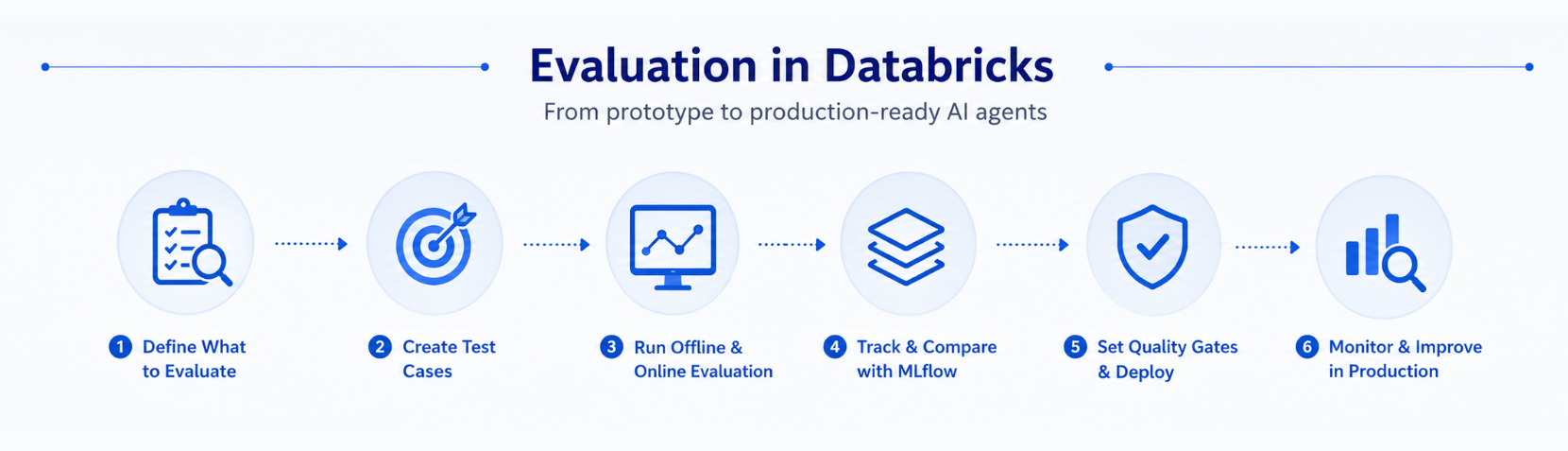
Evaluation Systems for Databricks AI Agents
Evaluation is the discipline that separates a promising AI prototype from a production-ready system. In Databricks, evaluation can be implemented through MLflow tracing, experiment tracking, automated evaluation datasets, human feedback, production monitoring, and quality gates before deployment. This is especially important for agents because correctness is not limited to the final answer. Teams must also evaluate retrieval quality, tool selection, reasoning path, latency, cost, safety, and whether the agent respected access-control boundaries.
A Databricks evaluation system should include offline and online evaluation loops. Offline evaluation uses curated test cases before release: representative prompts, expected answers, approved source citations, rejection cases, adversarial prompts, and tool-use scenarios. Online evaluation monitors production conversations and traces to detect degradation, hallucination risk, high-cost interactions, repeated fallback behavior, unsafe tool calls, and user dissatisfaction. MLflow provides a common mechanism for recording traces, comparing versions, and making improvement measurable.
Architecturally, evaluation should be embedded into the release lifecycle. Every agent should have a baseline evaluation set, a deployment threshold, a rollback process, and a post-production monitoring plan. For Databricks-based agents, this connects naturally with Model Serving endpoints, MLflow runs, evaluation datasets in Delta tables, and governance metadata in Unity Catalog. This turns agent quality from a subjective judgment into an operational metric.
AI Security with Databricks
AI security for agentic systems must address new risks that do not exist in traditional analytics. Agents can retrieve sensitive information, combine data into prompts, call tools, execute actions, store memory, and interact with other agents. Databricks addresses these concerns through a layered control model that includes Unity Catalog, Unity AI Gateway, service policies, model and tool permissions, audit logs, lineage, monitoring, and the Databricks AI Security Framework.
The security architecture should follow least privilege by default. Agents should run under controlled identities, only access approved tables and functions, and only call tools required for their task. Tool execution should be sandboxed where appropriate, risky actions should require approvals, and all interactions should be logged. For MCP-based integrations, security reviews should cover the server, exposed tools, authentication model, data sent to the model, rate limits, and whether tool responses may contain sensitive or regulated information.
Databricks also helps security teams shift from fragmented controls to platform-level policy. Unity Catalog governs data and AI assets; Unity AI Gateway can govern runtime model and agent interactions; MLflow traces can help investigate incidents; and Model Serving endpoints provide a managed deployment boundary. The enterprise security objective is not to stop AI adoption, but to make safe adoption repeatable.
TOGAF Concepts Applied to Databricks AI Architecture
TOGAF provides a disciplined way to design enterprise architecture through business, data, application, and technology layers. When applied to Databricks, TOGAF is useful for moving AI from isolated proof-of-concepts to an enterprise capability. The Architecture Development Method can be used to define the current state of data and AI maturity, identify target-state capabilities, design transition architectures, and build roadmaps for adoption.
In the business architecture layer, Databricks AI use cases should map to measurable outcomes such as faster audits, better service resolution, lower analytics cycle time, improved forecasting, or accelerated employee learning. In the data architecture layer, Delta Lake, Unity Catalog, data quality monitoring, lineage, metadata, and certified data products define the foundation. In the application layer, Mosaic AI agents, Databricks Apps, Genie, dashboards, workflows, and APIs deliver business-facing capabilities. In the technology layer, serverless compute, Model Serving, networking, identity, secrets, and observability define the operational footprint.
The TOGAF value in a Databricks program is governance of change. Architecture boards can establish reference patterns for agent development, AI-ready data products, model access, evaluation gates, security reviews, and reusable platform services. This avoids uncontrolled proliferation of tools while still enabling business experimentation.
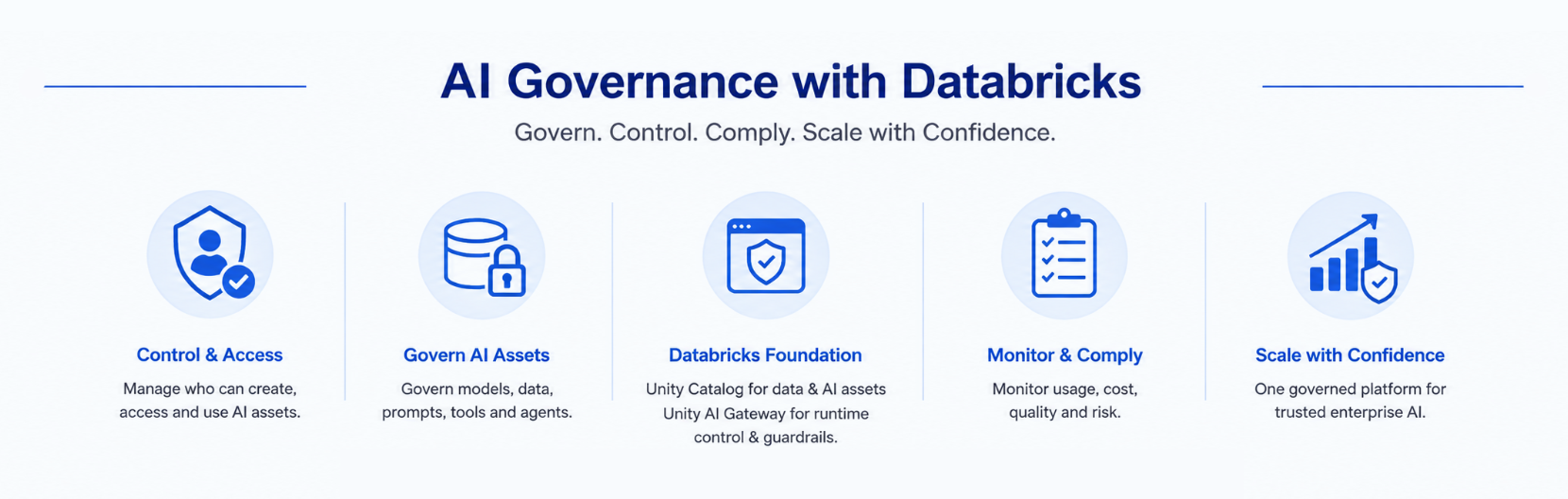
AI Governance with Databricks
AI governance defines how an organization controls AI assets, model usage, data access, risk, quality, compliance, ownership, and cost. Databricks provides a governance foundation through Unity Catalog for data and AI assets and Unity AI Gateway for runtime AI interactions. This is critical because modern AI systems involve more than models: they include prompts, embeddings, vector indexes, agents, MCP servers, tools, external providers, and user interactions.
A Databricks AI governance model should define who can create agents, which model providers are approved, what data can be used for retrieval, how sensitive data is classified, how prompts and outputs are monitored, how cost is attributed, and what controls apply to high-risk use cases. Unity Catalog supports access control, discovery, lineage, classification, auditing, and quality monitoring, while Unity AI Gateway can control runtime access, routing, guardrails, usage, and cost.
The strategic implication is that Databricks can become the system of record for governed enterprise AI. Rather than allowing each team to choose separate vector databases, model gateways, monitoring tools, and custom audit mechanisms, the enterprise can create a shared platform with reusable governance patterns. This improves compliance, simplifies audits, and accelerates delivery because teams build within known guardrails.
AI Operating Models for Databricks Adoption
An AI operating model defines how people, process, technology, and governance come together to deliver AI at scale. For Databricks, a practical operating model often combines a central platform team, federated business AI teams, data product owners, risk and security partners, and architecture governance. The central team owns platform patterns; business teams own use-case delivery; governance teams define policies; and architecture ensures reuse and alignment.
Key operating-model capabilities include AI-ready data product management, model and agent lifecycle management, prompt and evaluation management, access reviews, incident handling, cost allocation, and continuous improvement. Databricks supports these through Unity Catalog ownership and permissions, MLflow experiments and traces, Model Serving endpoints, Databricks Workflows, Unity AI Gateway policies, and shared workspace standards.
From a leadership perspective, the operating model should make AI development repeatable. A successful Databricks AI program should define intake criteria, risk tiering, data readiness checks, architecture review, evaluation thresholds, deployment approval, and production monitoring. This allows teams to innovate quickly while preserving accountability.
Enterprise Architecture on Databricks
Enterprise architecture on Databricks is about creating a unified platform for data, analytics, machine learning, and generative AI. The lakehouse pattern reduces duplication between data lakes and data warehouses, while Unity Catalog adds a governance layer across data and AI assets. Mosaic AI extends the architecture into model training, agent development, evaluation, deployment, and governance.
A target-state enterprise architecture should separate concerns clearly. The data foundation manages ingestion, quality, lineage, and domain data products. The AI foundation manages vector indexes, model endpoints, agent frameworks, evaluation assets, and tool catalogs. The governance foundation manages policies, access, auditing, and runtime controls. The application foundation exposes AI capabilities through apps, APIs, workflows, dashboards, and enterprise channels.
The main architectural advantage of Databricks is convergence. Instead of moving governed enterprise data into disconnected AI systems, AI capabilities can be built close to the data, under common governance and observability. This is especially valuable for regulated, data-rich, and process-intensive organizations.
Agent Platform Design on Databricks
An agent platform is the shared foundation that allows multiple teams to build, deploy, govern, and monitor agents consistently. On Databricks, this platform can be built using Mosaic AI, Agent Bricks, Unity Catalog, Unity AI Gateway, MLflow, Vector Search, Model Serving, Databricks Apps, and Databricks Workflows. The goal is to abstract common complexity while still giving teams flexibility to build domain-specific agents.
The platform should provide standardized templates for RAG agents, tool-using agents, multi-agent orchestration, MCP integration, evaluation, deployment, and monitoring. It should also define reusable policies for model access, sensitive data, approval workflows, and cost controls. Agent Bricks can help manage agent sprawl by providing a unified way to build, govern, and scale production AI agents, while Unity AI Gateway provides runtime governance for model and tool usage.
A strong agent platform also needs a product mindset. Platform teams should publish patterns, starter kits, guardrails, reusable connectors, evaluation suites, documentation, and support channels. Success should be measured by adoption, reuse, quality improvements, reduction in duplicate tooling, faster delivery time, and lower operational risk.
Executive Communication for Databricks AI Programs
Executive communication should translate technical architecture into business outcomes, strategy, risk, and investment decisions. When communicating Databricks AI initiatives to executives, the message should focus on how the platform accelerates value from enterprise data, reduces fragmentation, improves governance, enables trusted AI, and creates reusable capability across business units.
A useful executive narrative includes five elements: the business problem, the opportunity enabled by governed data and AI, the Databricks architecture pattern, the operating model required for scale, and the roadmap of measurable outcomes. For example, instead of saying “we are implementing vector search and model serving,” the message should say “we are creating a governed enterprise AI platform that allows employees to safely ask questions, automate work, and access trusted insights from approved data sources.”
Executives also need clarity on risk. Databricks helps address executive concerns by bringing data governance, AI governance, evaluation, model serving, and observability closer together. Communication should highlight that AI adoption is being managed through access controls, auditability, evaluation gates, cost monitoring, and phased delivery rather than uncontrolled experimentation.
AI Transformation Roadmaps with Databricks
An AI transformation roadmap should move the organization from experimentation to scaled adoption. With Databricks, the roadmap can be organized into phases: foundation, pilot, platformization, scale, and optimization. The foundation phase establishes Unity Catalog, data quality, certified data products, security patterns, and AI governance principles. The pilot phase selects high-value use cases such as enterprise knowledge search, customer support, forecasting assistance, compliance research, or learning recommendations.
The platformization phase standardizes reusable Databricks patterns such as RAG pipelines, Vector Search indexes, Model Serving endpoints, MLflow evaluation, Unity AI Gateway policies, tool catalogs, and Databricks Apps. The scale phase expands adoption across domains with federated delivery teams, clear operating-model responsibilities, executive sponsorship, and measurable business outcomes. The optimization phase improves quality, cost, performance, user experience, and governance based on production telemetry.
For a senior manager or architecture leader, the roadmap should balance ambition with control. Databricks enables rapid AI delivery, but successful transformation depends on data readiness, governance maturity, platform engineering, change management, and executive alignment. A practical roadmap should therefore combine technology milestones with adoption metrics, risk controls, capability building, and communications plans.
Frequently Asked Questions
Databricks Agentic AI Architecture is a framework for building AI systems that can reason, retrieve data, use tools, execute actions, and operate under enterprise governance. It combines Lakehouse architecture, Mosaic AI, Vector Search, and Unity Catalog to support secure and scalable AI agents.Agentic AI systems interact with enterprise data and operational processes. Governance ensures access control, lineage tracking, auditability, compliance, and risk management. Databricks provides governance through Unity Catalog, monitoring tools, and policy enforcement capabilities.Mosaic AI provides model management, vector search, retrieval pipelines, evaluation workflows, deployment capabilities, and observability. These components help organizations build, test, deploy, and optimize enterprise-grade AI agents.Model Context Protocol (MCP) standardizes connections between AI agents and enterprise tools, APIs, and systems. It reduces integration complexity and enables reusable, governed, and scalable architectures for AI applications.Unity Catalog provides centralized governance for data, functions, models, permissions, lineage, and audit trails. It allows enterprises to apply consistent controls across AI assets and business systems.Organizations scale agentic AI by standardizing architecture, enforcing governance policies, monitoring agent behavior, controlling model access, and implementing evaluation frameworks before production deployment.Databricks provides an integrated platform that combines data, AI, governance, monitoring, security, and deployment capabilities. This reduces architectural complexity and accelerates production-ready AI adoption.Build Enterprise-Ready Agentic AI on Databricks
Design, govern, and scale intelligent AI agents with Mosaic AI, Unity Catalog, Vector Search, and MCP integrations to accelerate business outcomes while maintaining security and compliance.
Talk to Our Experts
Frequently Asked Questions
Build Enterprise-Ready Agentic AI on Databricks
Design, govern, and scale intelligent AI agents with Mosaic AI, Unity Catalog, Vector Search, and MCP integrations to accelerate business outcomes while maintaining security and compliance.
The Infocepts Media & Entertainment COE helps streaming, publishing, and content businesses harness data to grow audiences and optimize revenue. The team specializes in content analytics, subscriber intelligence, ad tech data, and building the data foundations modern media companies need to compete.
Read Full BioRecent Blogs



Infocepts