
Your data modernization strategy isn’t really about technology. It’s about getting out from under a fragile legacy platform without breaking reporting, compliance, or the business processes stitched around it.
The hard part isn’t “moving to cloud.” It’s deciding what to retire, what to rebuild, and how to design a cloud-native target that supports today’s use cases without boxing you in for the next five years. That sequencing is the substance of data modernization services, and it is where programs are won or lost.
Why Legacy Platforms Hold Enterprises Back
Legacy data modernization efforts usually start after one too many outages, missed deadlines, or failed analytics projects. The symptoms are familiar: overnight loads running into the workday, siloed marts that don’t match, and teams relying on spreadsheets because they don’t trust the warehouse.
Most on-prem data warehouses were never designed for self-service analytics, machine learning, or real-time integration. They were built to support a handful of curated reports. Layering more marts and integration jobs on top doesn’t fix the problem. It just makes every change slower and riskier.
Defining A Practical Data Modernization Strategy
A good data modernization strategy starts with business outcomes, not a vendor RFP. You’re designing an operating model for data, not just picking a new cloud data platform.
Start by mapping 8–12 priority use cases that truly matter: regulatory reporting, executive dashboards, pricing analytics, customer churn, or supply chain visibility. Tie each use case to clear metrics like reduced cycle time, fewer manual reconciliations, or faster access to trusted data.
From Vision To Executable Roadmap
Once you know which use cases drive value, you can shape a roadmap that aligns technology changes with business milestones. This is where many enterprise data modernization efforts fall apart because they jump straight from “vision slide” to “multi-year, big-bang program.”
Break your roadmap into 3–6 month releases that each deliver something concrete: a new subject area in the warehouse, a modernized pipeline, or a decommissioned legacy feed. Treat it like product delivery rather than a back-office IT project.
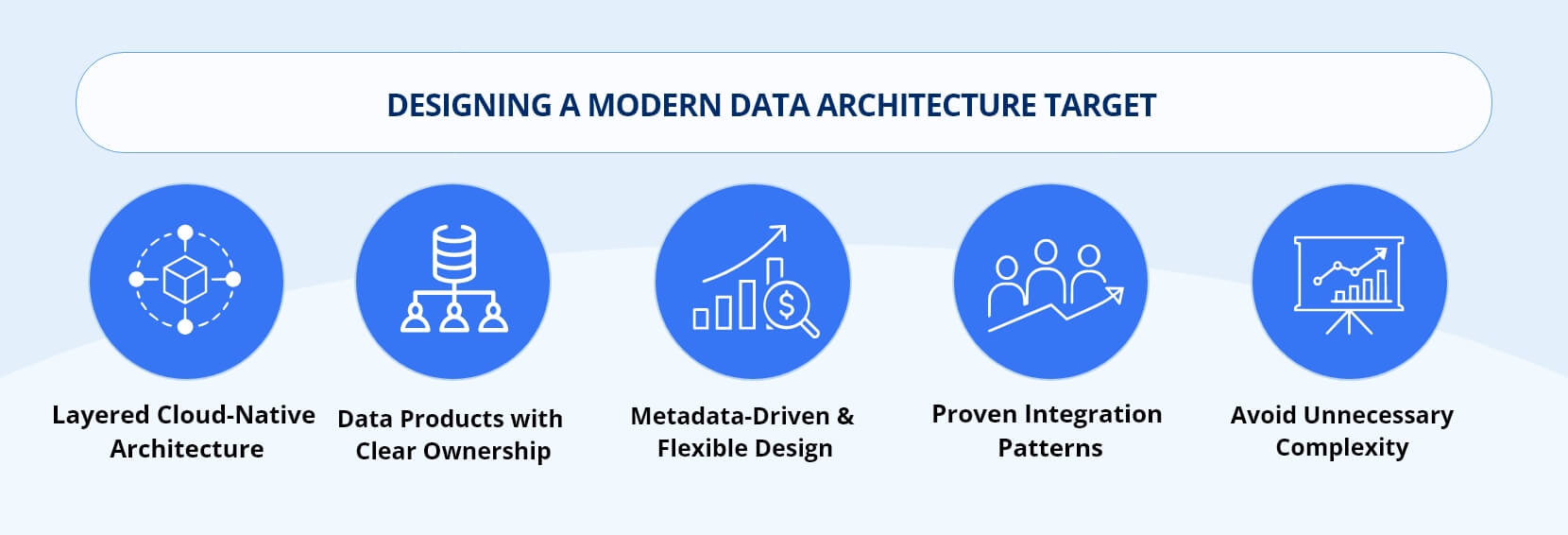
Designing A Modern Data Architecture Target
Before any migration script is written, you need a clear picture of your modern data architecture. Think in layers: ingestion, storage, processing, semantic, and consumption. This makes it easier to reason about trade-offs and assign ownership.
Most enterprises blend a cloud data lake with a warehouse or lakehouse to serve different workloads. Raw landing zones capture source changes cheaply, curated zones standardize business meaning, and presentation zones support BI and operational analytics. Which of those patterns should carry which workload is its own decision — data lakehouse choices works through the trade-offs.
Key Principles For Cloud-Native Design
Cloud data modernization succeeds when you design for change rather than for a perfect snapshot of today’s requirements. That means favoring metadata-driven pipelines, schema evolution strategies, and clear boundaries between raw and curated layers.
Think “data products” instead of giant, monolithic models. A customer subject area, for example, should have its own owners, quality checks, SLAs, and documentation so consumers know when and how to use it.
Architectural Patterns That Actually Work
Patterns like domain-oriented data marts, event-driven ingestion, and CDC-based replication are common building blocks of modern data architecture. They’re not silver bullets, but they reduce batch windows, give fresher data, and make impact analysis easier.
The traps to avoid: pushing every workload into streaming just because you can, overusing microservices for simple ETL, and building a separate tech stack for every business unit.
Planning Legacy Data Modernization Without Breakage
Legacy data modernization is less about code translation and more about dependency management. Your biggest risk is not the warehouse itself; it’s the hundreds of reports, extracts, and integrations hanging off it.
Start with an inventory of reports, jobs, and downstream systems tied to each legacy subject area. Most organizations discover that 20–30% of what’s running is unused or duplicated, which is the fastest way to reduce scope and cost.
Deciding What To Rehost, Refactor, Or Retire
Every data platform modernization program has three types of workloads: things you can rehost with minimal changes, things that need refactoring to fit the new architecture, and things you should simply retire.
A simple scoring model helps: rate each workload on business value, technical debt, and complexity. High-value, low-complexity items go into early waves. Low-value, high-complexity items are retirement candidates unless they’re mandatory for compliance.
Rehost, Refactor, Or Retire: A Scoring Guide
| Disposition | Business value | Complexity | Wave | What you actually do |
|---|---|---|---|---|
| Rehost | Moderate to high | Low | Early | Lift with minimal change; prove the migration path on something that matters but won’t fight you |
| Refactor | High | Moderate to high | Middle | Rebuild to fit the target architecture; budget for undocumented transformation rules |
| Retire | Low | Any | Immediately | Decommission — unless a compliance obligation forces you to keep it |
| Defer | Low to moderate | High | Last, or never | Leave in place and revisit; these are the items that quietly consume a whole wave |
The inventory is what makes this table usable rather than theoretical. Since 20–30% of what’s running is typically unused or duplicated, the retire column is usually the largest one — and cutting it is the cheapest scope reduction available to the programme.
Executing Cloud Data Modernization And Migration
Migration isn’t a single event; it’s a controlled sequence of moves aligned to your roadmap. Treat data migration services as part of a broader change program rather than as a one-time technical exercise.
The pattern that works best is “strangle the legacy.” Build new pipelines and models in the cloud, redirect specific reports and consumers once validated, then progressively cut off their legacy equivalents until you can fully shut down a component. Platform-specific versions of that pattern are set out in the Snowflake migration playbook and the Databricks migration guide.
Building Trust Through Testing And Parallel Runs
No amount of architecture diagrams will matter if business users don’t trust the numbers. That’s why cloud data platform projects live or die on testing discipline and communication.
For each migrated domain, run the new and old platforms in parallel for at least one full reporting cycle. Reconcile key measures, log discrepancies, and sit with subject matter experts to agree on the “source of truth” before you cut over. The same reconciliation discipline is what makes a cloud data migration land without a credibility problem.
Managing Data Transformation At Scale
As you move pipelines, you’ll face a long backlog of rules that were never documented. Treat data transformation as a modeling and business engagement problem, not just a technical rewrite.
Use profiling to discover real data patterns, not just what’s in the spec. Document rules once in a semantic model or business glossary so that transformations, metrics, and reports all reference the same definitions. A data catalog is what keeps that documentation discoverable once the programme ends.
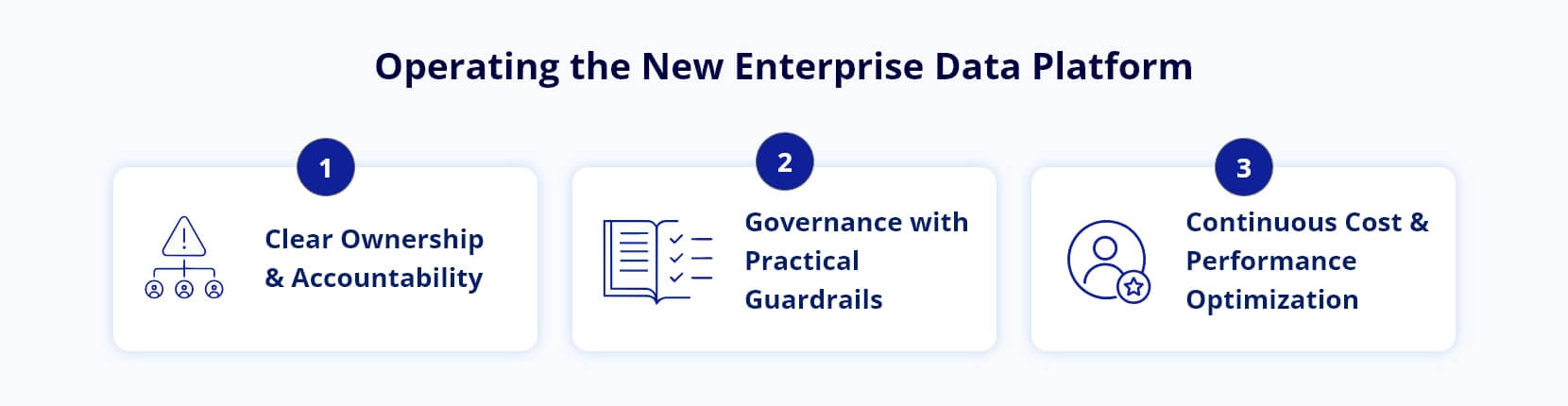
Operating The New Enterprise Data Platform
Enterprise data modernization is only successful when the new platform runs reliably and can evolve without constant firefighting. Too many teams declare victory at cutover and then struggle with cost spikes and support tickets.
Define clear ownership across engineering, platform ops, and analytics. Who approves new datasets, who manages performance, and who communicates incidents to business stakeholders? Write it down before the first major outage.
Governance And Guardrails Without Killing Agility
Heavy, committee-based governance models from the on-prem age don’t work for self-service cloud data modernization. But the answer isn’t chaos.
Start with a small set of non-negotiable guardrails: identity and access standards, tagging for cost and data classification, mandatory lineage tracking for regulated data, and a simple intake process for new data products. Building those as policy rather than committee is the subject of this data governance framework.
Cost, Performance, And Continuous Improvement
Cloud platforms make it easy to overprovision compute and storage. Data migration services should include cost guardrails such as auto-suspend for warehouses, lifecycle policies for cold data, and clear expectations for who can spin up new environments.
Set up monthly operational reviews where product owners, engineers, and finance look at usage, incidents, and backlog. That keeps optimization iterative instead of waiting for a crisis to trigger a redesign — the operating rhythm described in cloud FinOps tactics to cut data platform spend.
Where Infocepts Fits
Infocepts runs modernization as staged waves tied to business outcomes, with legacy retired progressively rather than in a single cutover event.
- Rated #1 Data & Analytics provider on Gartner Peer Insights, three years running, with 97.2% client retention across 20+ years of delivery.
- Named services for each stage above — modern data architecture consulting, cloud migration, and data migration.
- Migration accelerators through the FLASH platform, so conversion work starts from tooling rather than from a blank sheet.
The Bottom Line
Replacing a legacy warehouse with a cloud-native stack isn’t a one-off IT project; it’s a staged change in how your organization collects, manages, and uses data, guided by a clear data modernization strategy. The companies that succeed keep the roadmap tied to business outcomes and retire legacy in waves, not all at once.
If your team is feeling the weight of aging platforms and unfinished migrations, this is the moment to reset your plan, pick a focused first wave, and move with intent — before the next renewal locks you in for another cycle.
Frequently Asked Questions
Retire Legacy Without Breaking The Business
Staged data modernization tied to business outcomes - scored workload dispositions, parallel-run validation, and progressive legacy shutdown instead of a single risky cutover.
Recent Blogs



Infocepts