Searches for “Snowflake vs Databricks” usually start the same way: leadership wants an enterprise AI strategy, your teams are stuck in half a dozen tools, and someone has asked for a recommendation on which core data platform to back for the next five years.
The trouble is, all three major contenders now claim they can do everything: data warehouse, data lake, lakehouse, streaming, and AI data platform in one. On slides, they look similar. In reality, Snowflake, Databricks, and Microsoft Fabric make different trade-offs that matter a lot once you start building production workloads.
What Problem Are You Actually Trying To Solve?
Before you compare Snowflake vs Databricks on features, get very clear on the job this platform needs to do for your business. Most enterprises aren’t choosing a tool; they’re choosing a long-term architectural center of gravity.
For some organizations, the immediate pressure is analytics modernization and getting out of legacy appliances into a scalable cloud data warehouse. For others, the real bottleneck is machine learning experimentation and governance across a messy, growing data lakehouse. Your answer shapes which trade-offs are smart and which will haunt you in 18 months.
Four Questions To Align Stakeholders
Teams often jump straight to feature checklists and miss the discussions that prevent regret later. Bring business, data, and IT leaders into the same room and force specific answers to a handful of questions.
First, is the primary driver AI use cases, standard BI and reporting, or a mix, and in what ratio? Second, are you optimizing for time-to-value in a single cloud, or do you expect multi-cloud bargaining power and portability to matter? Third, who will actually build on this platform: data engineers, SQL-savvy analysts, software developers, or a mix that includes citizen developers?
How Snowflake, Databricks, And Fabric Position Themselves
All three position as an enterprise data platform, but they start from different DNA. Snowflake comes from the cloud data warehouse world, Databricks from Apache Spark and big data, and Fabric from the Microsoft analytics stack anchored around Power BI.
Each vendor has since expanded into what they call a data lakehouse or lake-centric platform, adding features for streaming, data science, and AI workloads. On paper, that narrows the gap. In practice, their strengths still trace back to their origins, and that shapes how teams experience them daily.
Snowflake vs Databricks vs Fabric At A Glance
| Snowflake | Databricks | Microsoft Fabric | |
|---|---|---|---|
| Origin | Cloud data warehouse | Apache Spark and big data | Microsoft analytics stack, anchored on Power BI |
| Strongest when | Governed SQL analytics at high concurrency; escaping fragile ETL into an aging warehouse | Complex ETL, streaming, and large-scale ML training in one estate | The organization already lives in Microsoft 365, Entra ID, and Power BI |
| Team it suits | Strong SQL talent; gentle learning curve | Python, Scala, and engineering depth | BI and analytics teams overwhelmed by separate Azure services |
| Governance approach | Long-standing fine-grained access control on structured data | Unity Catalog, moving fast | Microsoft Purview and Microsoft 365 security models |
| AI and ML tooling | Native ML plus external integrations, closing the gap | Deeply integrated ML tooling — feature stores, experiment tracking, deployment | Aligned around Azure ML and Copilot experiences |
| Cloud posture | Cloud-neutral; mature cross-cloud and data sharing | Multi-cloud, engineering-led | Opinionated around OneLake and the Microsoft ecosystem |
| Friction shows up in | Highly customized ML pipelines and non-SQL workloads | Dependence on engineering maturity and platform governance | Multi-cloud plans or keeping options open beyond Microsoft |
Read down the “friction” row rather than the “strongest when” row. Every one of these platforms demos well; the question that decides an 18-month outcome is which of those three frictions your organization is least able to absorb.
Snowflake In A Nutshell
Snowflake shines when you need governed SQL analytics, clear separation of storage and compute, and predictable performance for hundreds or thousands of concurrent BI users. If your current pain is fragile ETL into an aging warehouse and you want a cleaner cloud data warehouse with minimal ops overhead, Snowflake is often the most straightforward move — the sequencing for which is set out in the Snowflake migration playbook.
Its marketplace, data sharing, and cross-cloud story are mature, and for many enterprises with strong SQL talent, the learning curve is gentle. Where teams hit friction is highly customized machine learning pipelines or non-SQL workloads that stretch what Snowflake was built for.
Databricks In A Nutshell
Databricks is strongest as a lakehouse platform with deep roots in data engineering and machine learning. If your frustration is scattered data lakes, duplicated pipelines, and research-grade ML models that never quite reach production, Databricks gives you one environment where engineers and data scientists can actually collaborate on the same data and code.
Its strengths show up when you have complex ETL, streaming, and large-scale ML training in the same estate. The trade-off: success tends to depend more on engineering maturity and solid platform governance than with a more opinionated warehouse-first environment. The Databricks migration guide covers what that maturity has to look like in practice.
Microsoft Fabric In A Nutshell
Microsoft Fabric takes the Power BI and Azure analytics ecosystem and pulls it into a unified Software as a Service experience. If your world is already deeply invested in Microsoft 365, Azure AD, and Power BI, Fabric can feel like a natural extension that reduces the sprawl of separate services.
Fabric is opinionated around OneLake as the shared storage layer and strongly tied to the rest of the Microsoft stack. That can be a strength if you want integrated security and simplified licensing, but it can be a constraint if you expect to mix multiple clouds or keep options open beyond the Microsoft ecosystem.
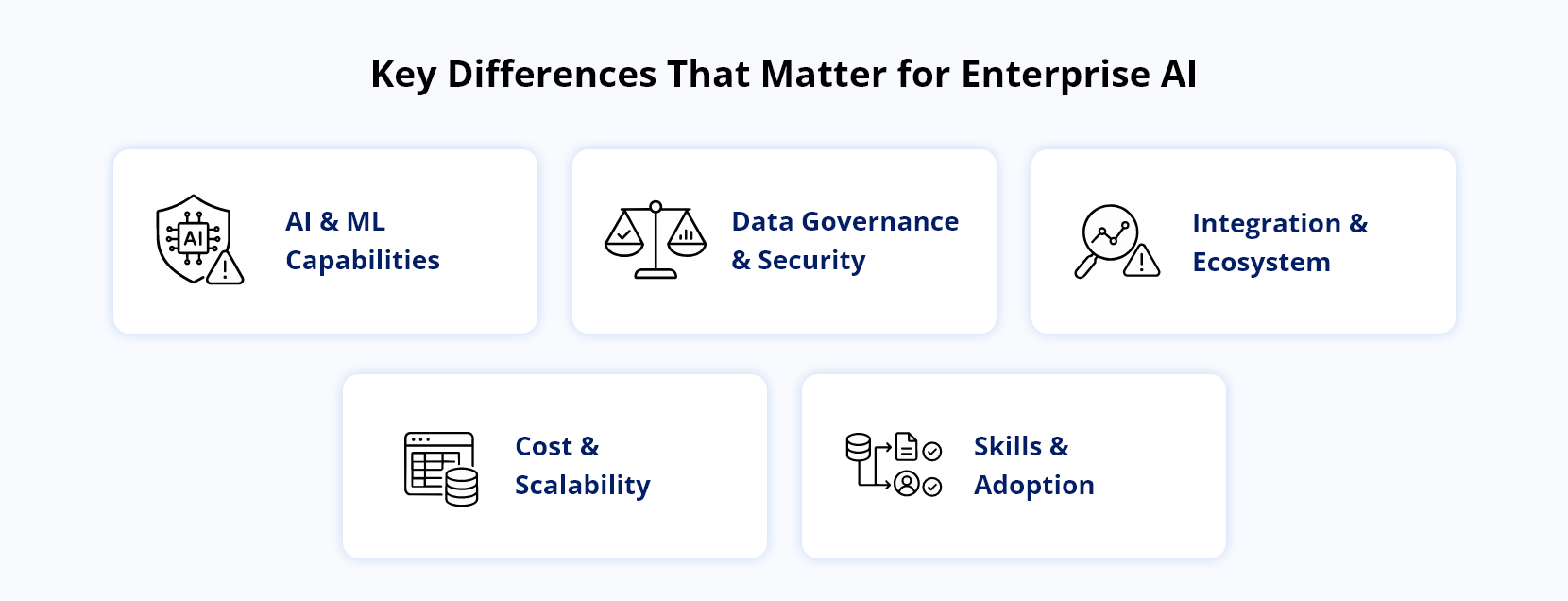
Key Differences That Matter For Enterprise AI
For AI programs, the headline features rarely tell the full story. Daily developer experience, data governance depth, and cost behavior under real workloads usually determine whether a platform accelerates your strategy or becomes another expensive experiment.
Think about how each platform handles experimentation, productionization, and monitoring across models and data assets. A platform that makes it easy to build proofs of concept but hard to operationalize will quietly slow down every AI project you attempt — the gap examined in AI-ready data pipelines.
Data, AI, And Governance Trade-Offs
From an AI data platform perspective, pay attention to how each environment supports feature stores, experiment tracking, and model deployment. Databricks tends to lead on deeply integrated ML tooling, Snowflake is closing the gap with native ML and external integrations, and Fabric is aligning its AI story around Azure ML and Copilot experiences.
On governance, Snowflake has historically had the clearest story for fine-grained access control on structured data, while Databricks has been moving fast with Unity Catalog. Fabric leans on Microsoft Purview and Microsoft 365 security models, which can be a real advantage if your security team is already standardized there. Whichever you pick, the policy layer still has to be designed — see this data governance framework for AI.
Integration, Ecosystem, And Skills
Integrations are not just about connectors; they are about how naturally the platform fits your existing stack. For some enterprises, the pull of a lakehouse platform that brings together engineering, analytics, and AI in one environment is strong because it cuts down cross-tool friction. Which storage pattern that implies is worked through in data lakehouse choices.
Skills matter just as much. If your teams are mostly BI developers and SQL analysts, the learning curve for heavy Spark development might slow you down. On the other hand, if you already have a strong base of Python, Scala, and engineering talent, a warehouse-only environment can feel limiting quickly.
How Microsoft Fabric Compares To Snowflake And Databricks
The right way to think about Microsoft Fabric vs Snowflake is not “which is better,” but “which aligns with the way your organization wants to work.” Fabric is deeply integrated into Microsoft 365, Teams, and Power BI, while Snowflake is more cloud-neutral and tends to sit at the center of a modern data stack assembled from best-of-breed tools.
Fabric’s tight integration can reduce time spent on identity, basic governance, and report distribution for organizations that already live in the Microsoft ecosystem. In Snowflake-centered setups, you’ll likely rely more on external tools for cataloging, transformation, and orchestration.
Microsoft Fabric Versus Databricks On AI Workloads
When you look at Microsoft Fabric vs Databricks for AI and machine learning, the trade-off centers on how much control you want over underlying components. Databricks is closer to a unified workbench for data engineers and data scientists who expect control over Spark, clusters, and code.
Fabric abstracts more of that away in a Software as a Service wrapper that aims to simplify adoption for BI and analytics teams. That can be a relief for organizations overwhelmed by the number of Azure services, but it may feel less flexible for teams that already have strong engineering practices and want low-level tuning options.
A Practical Framework To Choose Your Platform
Abstract debates about Databricks vs Snowflake or Fabric usually generate more heat than light. A practical way to move forward is to break the decision into a small number of concrete dimensions and score each option based on how your organization actually works.
Start with business alignment, then move to technical fit, operating model, and cost behavior under load. That sequence prevents you from picking a platform that looks perfect in a lab but fails once actual business users and budget constraints show up.
Decision Dimensions To Score
First, business alignment: does the platform directly support your top 5 data and AI initiatives for the next three years? Second, data architecture fit: do its strengths align with your preferred data lakehouse, warehouse, or hybrid design, and does it integrate cleanly with your primary cloud? Framing that target is what modern data architecture consulting is for.
Third, team model: does the platform map well to how your teams are staffed today and how you expect that to change? Finally, economics: model at least two realistic workload scenarios and look at long-term operating cost, not just storage and compute list prices — the discipline described in cloud FinOps tactics to cut data platform spend.
When A Hybrid Approach Makes Sense
In larger enterprises, the answer is sometimes “both” or even “all three,” but that only works with discipline. A hybrid strategy might use Databricks for heavy data engineering and advanced ML while Snowflake anchors governed reporting for finance and operations.
In that kind of setup, clarity about system of record, data contracts, and where transformations live becomes more important than which vendor you choose. Without that clarity, a modern data stack quickly turns into the same sprawl you were trying to clean up.
Where Infocepts Fits
Infocepts holds delivery partnerships with all three vendors, which is what makes a platform evaluation an architecture exercise rather than a sales conversation.
- Rated #1 Data & Analytics provider on Gartner Peer Insights, three years running, with 97.2% client retention across 20+ years of delivery.
- Named practices for each contender — Snowflake, Databricks (Silver Partner, 300+ certified professionals), and Microsoft Azure — so the recommendation is not constrained by a single alliance.
- Migration tooling either way through FLASH Databricks Migrate and the Enterprise Snowflake Usage Monitor for the cost-behavior question above.
The Bottom Line
Choosing among Snowflake, Databricks, and Microsoft Fabric is less about picking a winner in a “Snowflake vs Databricks” contest and more about backing the platform that fits your people, cloud strategy, and AI roadmap. The right choice should make your next 10 data and AI projects easier, not just the proof of concept you are running this quarter.
If you are about to make this decision, treat it as an architecture choice, not a tool purchase, and invest the time to get it right.
Frequently Asked Questions
Make It An Architecture Decision, Not A Tool Purchase
Vendor-neutral platform evaluation backed by delivery practices across Snowflake, Databricks, and Microsoft Azure - scored dimensions, modelled workloads, and pilots that surface real trade-offs.
Recent Blogs



Infocepts